


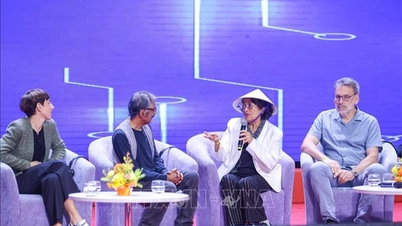
In his opening speech, Mr. Nguyen Xuan Thuy, Deputy Director of the Department of Vocational Education and Continuing Education , Ministry of Education and Training, emphasized: “Eliminating illiteracy is the foundation of improving people's knowledge, and is the first condition for each citizen to access development opportunities in the digital age”. In fact, although the literacy rate of the 15-35 age group has reached 99.39% and the 15-60 age group has reached 99.10%, illiteracy and re-illiteracy still occur in many ethnic minority communities where socio-economic conditions are still difficult.
At the workshop, delegates heard real stories from teachers who directly taught literacy, such as Ms. Phu Minh Diep (Lao Cai), Ms. Bui Thi Hong Lam ( Lam Dong ), Ms. Lieu Thi Phuong (Lang Son)... Evening classes in remote villages, where adults aged 40-60 hold a pen for the first time, have brought about clear changes: being able to read signs, sign their names, do paperwork, and confidently integrate.

In particular, many students shared their journey of overcoming their inferiority complex to learn to read and write, including Ms. Ro Si Gia, Mr. Mach Ta Res, a Cham person in An Giang, or Ms. Lo Thi Nhot, the head of the Women's Association, who was a former literacy student in Son La.
A highlight of the workshop was the participation of social forces in eliminating illiteracy, especially border guards - those who both protect the border and teach literacy to people in remote areas.
Major Lo Van Thoai (Nam Lanh Border Guard Station, Son La) said that many classes are opened right in the border guard station, combining literacy with legal propaganda, preventing child marriage, human trafficking and instructing production techniques. " To get people to come to class, sometimes we have to help them finish harvesting rice before starting the class," he shared.
In addition to the border guards, the role of village elders, hamlet chiefs, and religious dignitaries is also emphasized. In An Giang, many literacy classes in the Cham community operate effectively when the Chief Priest and Chief Monk participate in the mobilization. In Nghe An, at the Ky Son Economic-Defense Zone, the village elder also mobilized 5 sisters and 5 husbands to go to school together.

The “community alliance” model was agreed by delegates as the “golden key” to maintaining attendance and limiting re-illiteracy - a problem that is a big challenge in many localities.
Besides the success, the workshop also pointed out some difficulties: population movement, difficult economic conditions, unstable classrooms, lack of teaching materials suitable for ethnic languages, and part-time teachers.
Faced with these challenges, delegates proposed many systematic solutions: Strengthening training for literacy teachers, compiling bilingual digital learning materials, applying technology to manage data on illiterate and re-illiterate people; and at the same time linking literacy with vocational training and livelihood development to increase people's motivation to learn.

The models, stories and experiences shared in the program not only recognize the efforts of forces on the education front but also open up new directions for lifelong learning to become a reality. Delegates believe that this spirit will continue to spread, helping to narrow the gap, improve people's knowledge and ensure that no one is left behind on the journey to access knowledge.
Source: https://nhandan.vn/ton-vinh-dien-hinh-tien-tien-trong-cong-tac-xoa-mu-chu-cho-dong-bao-dan-toc-thieu-so-post928412.html


![[Photo] 60th Anniversary of the Founding of the Vietnam Association of Photographic Artists](/_next/image?url=https%3A%2F%2Fvphoto.vietnam.vn%2Fthumb%2F1200x675%2Fvietnam%2Fresource%2FIMAGE%2F2025%2F12%2F05%2F1764935864512_a1-bnd-0841-9740-jpg.webp&w=3840&q=75)


![[Photo] National Assembly Chairman Tran Thanh Man attends the VinFuture 2025 Award Ceremony](/_next/image?url=https%3A%2F%2Fvphoto.vietnam.vn%2Fthumb%2F1200x675%2Fvietnam%2Fresource%2FIMAGE%2F2025%2F12%2F05%2F1764951162416_2628509768338816493-6995-jpg.webp&w=3840&q=75)















































































Comment (0)