

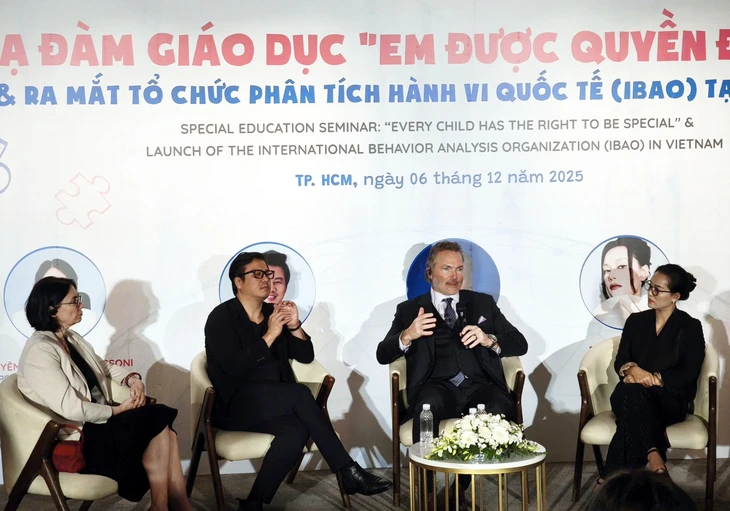
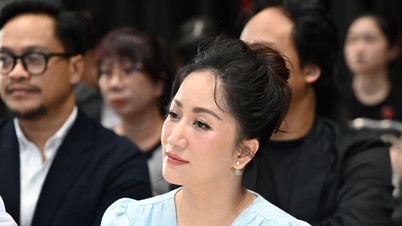
Experts shared at the seminar, bringing new perspectives to parents on the autism spectrum - Photo: TRONG NHAN
Autistic children develop very diversely.
Expert Simona Bossoni, Professional Director of the International Center for Diagnosis and Early Intervention of Autism Spectrum Disorders (VCIA), emphasized the core difference of autistic children in the way they communicate, receive and convey information.
According to her, signs can be detected from around 2 years old, but more obvious manifestations often appear when children enter a nursery environment that requires many social communication situations.
She emphasized that the key issue is to change thinking because autism is not a disease, it is a form of development that is different from the majority.
If in the past experts viewed autism as a problem that needed to be fixed or treated, today with more research and understanding, the scientific community sees it as a developmental diversity.
Because of the wide spectrum, children may experience different levels and forms of expression such as delayed speech, limited eye contact, difficulty in social interaction or expressing emotions.
"Understanding this difference, parents and teachers can find more appropriate ways to interact to help children develop their abilities," she said.
Adults expecting children to make eye contact and be confident in front of a crowd or use the right voice and volume… will not make sense to children on this spectrum.
“We need to adjust our expectations and accept these traits as a natural part of how children experience the world . We can learn to understand and adapt,” she advises.
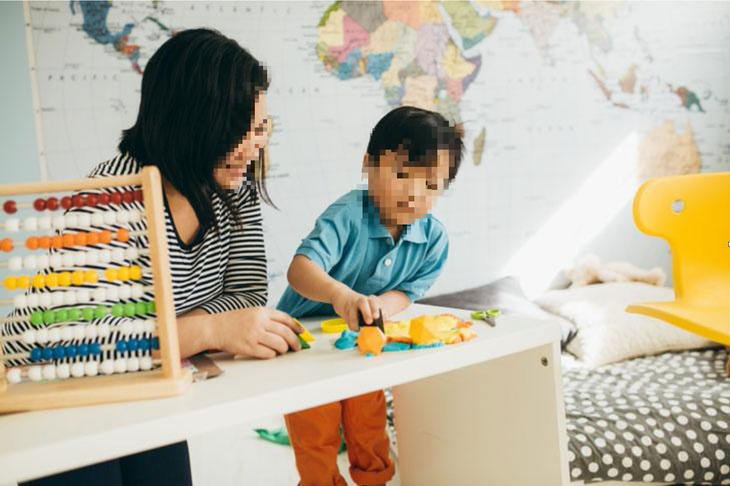
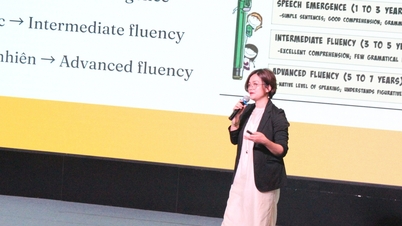
Children on the autism spectrum need early intervention - Photo: HUYNH MAI
Don't think "wait until you grow up and see"
Meanwhile, Mr. Michael Mueller - founder of the International Behavior Analysis Organization (IBAO) - said that research on the behavior of people on the autism spectrum has been conducted since the 1960s.
These studies show that children on the spectrum possess a very distinctive set of behaviors, different from typically developing children, and many may use different forms of communication.
Therefore, the task of both experts and parents is to accompany and expand communication skills instead of just relying on spoken language.
One of the most common misconceptions among parents is the thought that "it will be normal when the child is older".
And many families miss out on the 0-3 age period, which is considered the "golden time" for behavioral intervention.
For example, many children can develop normal language with early intervention.
Otherwise, the child's communication process will turn to other directions such as non-verbal communication, and late intervention will be difficult to achieve optimal results.
There are many different intervention models available, from medical to behavioral, but this diversity sometimes confuses parents, said Mr. Mueller.
"Some are suitable, some are not, but if you delay intervention because of hesitation, the child may lose the opportunity for development time," he warned, adding that the child should be evaluated as soon as possible if unusual signs are noticed.
Parents who compare less will be healthier.
Educator Thanh Bui believes that many famous people such as Einstein, Mozart, Jefferson, Elon Musk... were once considered to be on the autism spectrum and clearly they were not "sick".
He emphasized that parents' fear of being judged is a big barrier. The more afraid parents are, the more disadvantaged their children and their families are because "there is nothing more harmful than comparison."
According to him, comparing your child with yourself in the past or with your friends or neighbors' children only creates unnecessary pressure. Instead, you should look at your child in his or her own development process because each young person "comes into the world with a different journey and destiny."
Source: https://tuoitre.vn/tu-ky-khong-phai-benh-chi-la-dang-phat-trien-khac-voi-so-dong-20251206160623631.htm
![[Photo] 60th Anniversary of the Founding of the Vietnam Association of Photographic Artists](/_next/image?url=https%3A%2F%2Fvphoto.vietnam.vn%2Fthumb%2F1200x675%2Fvietnam%2Fresource%2FIMAGE%2F2025%2F12%2F05%2F1764935864512_a1-bnd-0841-9740-jpg.webp&w=3840&q=75)



![[Photo] National Assembly Chairman Tran Thanh Man attends the VinFuture 2025 Award Ceremony](/_next/image?url=https%3A%2F%2Fvphoto.vietnam.vn%2Fthumb%2F1200x675%2Fvietnam%2Fresource%2FIMAGE%2F2025%2F12%2F05%2F1764951162416_2628509768338816493-6995-jpg.webp&w=3840&q=75)















































![[Photo series] Appearance of Ring Road 3 - Ho Chi Minh City before technical opening day](https://vphoto.vietnam.vn/thumb/402x226/vietnam/resource/IMAGE/2025/12/06/1765025589840_anh_6_20251206163529_20251206170332.jpeg)




















Comment (0)