

THE FIRST TIME SET CLEAR STANDARDS FOR ELECTRONIC TEXTBOOKS
The leader of the General Education Department (Ministry of Education and Training) shared that the issuance of the draft circular is based on the 2019 Education Law which stipulates: "Textbooks are presented in the form of printed books, Braille books, and e-books". Moreover, the compilation of e-textbooks contributes to creating a rich source of digital learning materials associated with the specific conditions of Vietnam and in line with advanced educational trends in the world, ensuring the best interests of learners, while ensuring the goal of promoting national digital transformation and developing digital citizens.
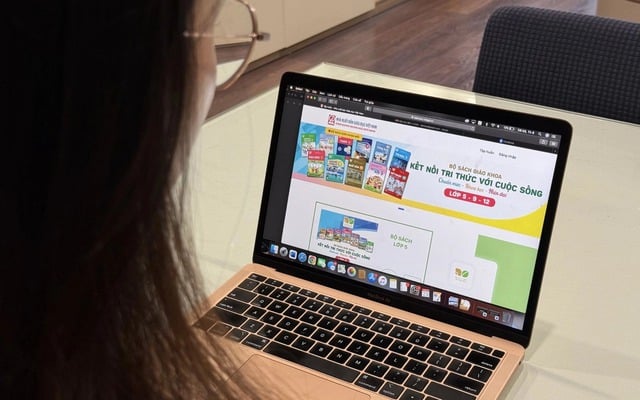
The Ministry of Education and Training has just announced a draft circular regulating electronic textbooks.
PHOTO: TUE NGUYEN
Regarding the standards for electronic textbooks, the representative of the Ministry of Education and Training emphasized: "The prerequisite for electronic textbooks is to fully meet the current standards of textbooks. The content of electronic textbooks is guaranteed to be consistent with the content of printed textbooks. The digital format of electronic textbooks complies with current technical standards and regulations, supports multiple platforms (computers, phones, e-readers); fully meets current regulations on copyright, intellectual property rights, security standards, and deposit standards".
The interface of electronic textbooks must be optimally displayed on different devices; suitable for the health and vision of students at all levels in terms of fonts, font sizes, colors, visual effects, and sounds; flexible integration and update features, capable of linking with learning management systems according to popular standards, artificial intelligence, virtual reality technology, etc. At the same time, electronic textbooks must be able to be used online or downloaded when there is no stable internet connection, ensuring that users can always use them.
Also according to the draft of the Ministry of Education and Training, organizations, agencies, and publishers that fully meet the conditions for electronic publications or other organizations and agencies that have publishing links with publishers that meet the conditions for electronic publications are assigned by the Minister of Education and Training to convert textbooks from printed to electronic textbooks according to the provisions of law. Electronic textbooks converted from printed copies must fully meet the prescribed criteria.
Notably, the adaptation unit coordinates with general education institutions to organize technical experiments and evaluate user experience on representative groups of students and teachers. The minimum number of experimental periods is equal to 10% of the total number of periods prescribed in the general education program of each subject and educational activity.
The conversion unit organizes the editing, proofreading, and completion of the electronic textbook template and requests the appraisal unit to conduct appraisal of the electronic textbook template.
The draft circular stipulates that electronic textbooks are edited and updated when printed textbooks are edited and updated. In cases where it is necessary to organize experimental editing and updating of electronic textbooks, the Minister of Education and Training will decide.

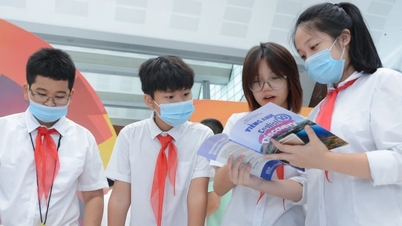
The use of electronic textbooks in class has long been applied by many teachers in their lectures to help make lessons more lively and rich.
Illustration: Nhat Thinh
ESSENTIAL NEEDS
Dr. Ton Quang Cuong, Head of the Faculty of Educational Technology, University of Education ( Hanoi National University), stated his opinion: Electronic textbooks will create a boost with the ability to integrate into a platform, smart system. Moreover, the personalization as well as self-orientation and self-adjustment of learners are increasingly evident. When there is a resonance between education and the application of modern technology, electronic textbooks will also change the entire approach to thinking about textbooks of everyone. It is the foundation for excitement and confidence to be able to create new generation textbooks.
Dr. Pham Quang Hung, Director of the Department of Science, Technology and Information (Ministry of Education and Training), said that with the techniques and technology used in electronic textbooks, especially with the application of artificial intelligence (AI), it not only helps improve the capacity and quality of learners but also helps teachers conveniently monitor the learning process of learners to make appropriate adjustments.
According to Mr. Hung, the Ministry of Education and Training will soon issue an AI application strategy, which includes content related to building a database so that students can access data accurately and completely. Therefore, accessing official textbook sources to apply to electronic textbooks is very appropriate and this will be the first step in the digital transformation of education.
National Assembly delegate Trinh Thi Tu Anh (Lam Dong) also proposed researching a set of electronic textbooks and supporting disadvantaged students to borrow reading devices, when commenting on the draft resolution on specific policies for education development. According to Ms. Tu Anh, the form of electronic textbooks helps save printing costs, allows books to be reused for many years and is suitable for the digital transformation process in education.
Delegate Duong Minh Anh (Hanoi), who is also the Principal of Hanoi College of Arts, also said that issuing new paper textbooks every year can easily lead to waste because many sets of books are left behind after each school year, while the model of lending books from school libraries and developing electronic textbooks is a more economical and sustainable solution. According to Ms. Anh, although the initial cost of investing in digital infrastructure is large, in the long run it will significantly reduce learning costs for parents. In addition, electronic textbooks are easy to update new content, can integrate multimedia forms such as videos, images, interactive exercises, thus creating a sense of attraction, excitement, keeping learners focused longer during class time, students can access easily, anytime, anywhere as long as there is internet, instead of having to carry heavy school bags to school like today...
Many opinions also say that when applying electronic textbooks into teaching, it requires teachers to regularly update and improve their professional qualifications, skills and ability to apply information technology in teaching, and innovate teaching methods.
It is noted that the use of electronic textbooks in class has long been applied by many teachers in their lectures to help make lessons more lively and rich.
Besides, using electronic textbooks, updating books and changing content, for example, changing the curriculum content of many subjects after implementing the 2-level local government model and recent province mergers... will be done faster and more effectively than with paper books.
Some problems when using electronic textbooks
The principal of a high school in Hanoi also agrees with the above benefits of electronic textbooks, but believes that it will not be easy to apply them uniformly even in a large city like Hanoi when it comes to solutions for devices to use electronic textbooks. Therefore, the issue of replacing paper textbooks should not be raised when the accompanying conditions are not met. On the contrary, according to this principal, schools in Hanoi do not allow students to use personal electronic devices during class. If electronic textbooks are used, the issue of using those textbooks on which devices to control students from using them for other purposes (such as playing games, accessing social networks, etc.) during class also raises many issues of management and supervision.
There are also opinions that electronic textbooks help save money, which is not convincing. Electronic textbooks will cost money to invest in equipment (millions of dong), electricity to charge, equipment to degrade and break; not to mention the impact on students' eyes when used continuously...
According to records, although there are no mandatory regulations, current textbook publishers have fully updated textbooks on the electronic textbook system of the publisher with the desire to bring favorable conditions for teaching and learning. For example, the electronic textbooks of the Vietnam Education Publishing House are fully updated and completely free on the website taphuan.nxbgd.vn. The leader of this publishing house said: "This platform is directly managed by the publishing house, the content is updated accurately according to the published paper textbooks".
Source: https://thanhnien.vn/sach-giao-khoa-dien-tu-co-loi-ich-nhung-can-lo-trinh-phu-hop-185251203230233174.htm
![[Photo] Cat Ba - Green island paradise](/_next/image?url=https%3A%2F%2Fvphoto.vietnam.vn%2Fthumb%2F1200x675%2Fvietnam%2Fresource%2FIMAGE%2F2025%2F12%2F04%2F1764821844074_ndo_br_1-dcbthienduongxanh638-jpg.webp&w=3840&q=75)
































![[VIMC 40 days of lightning speed] Da Nang Port: Unity - Lightning speed - Breakthrough to the finish line](https://vphoto.vietnam.vn/thumb/402x226/vietnam/resource/IMAGE/2025/12/04/1764833540882_cdn_4-12-25.jpeg)































Comment (0)