

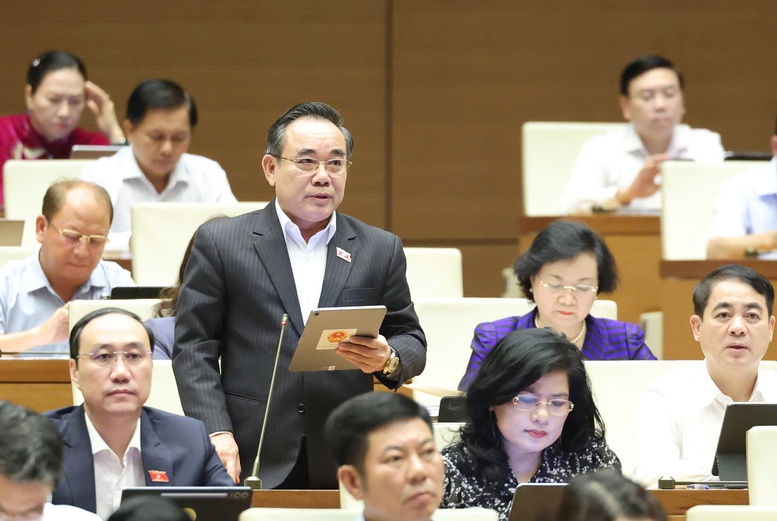
Representative Le Huu Tri (National Assembly Delegation of Khanh Hoa province) discusses in the assembly hall - Photo: VGP/Nhat Bac
During the plenary session, delegate Le Huu Tri (from the National Assembly delegation of Khanh Hoa province) emphasized that the draft Resolution of the National Assembly on the medium-term public investment plan for the period 2026-2030 clearly defines the key objective as improving the efficiency of public investment, promoting its leading and spreading role, and attracting maximum non-state resources; contributing to promoting rapid and sustainable growth, completing the strategic infrastructure system, ensuring social security and national defense and security.
Delegates argued that capital allocation must comply with the Constitution, laws on public investment and the state budget, be consistent with the ability to balance resources, and ensure public debt safety; at the same time, the management and use of capital should be based on socio-economic efficiency, feasibility, and lessons learned from previous periods.
To achieve the set goals, delegates proposed continuing to review and resolutely eliminate projects that are not truly necessary or do not meet the necessary conditions, focusing resources on key projects; fundamentally reforming public investment management, eliminating the "request-and-grant" mechanism; prioritizing quality over quantity of projects, emphasizing the responsibility of those who decide on investment policies; and not approving inefficient projects.
Delegates also emphasized the challenges in reducing the ICOR coefficient to 4.5-4.8, requiring the rectification of scattered investments, slow progress, limited quality of consulting and surveying, and low disbursement rates.
At the same time, it is necessary to strengthen the "early and remote" monitoring mechanism and strictly handle violations in the survey, design, cost estimation, and bidding stages; thereby contributing to preventing and combating corruption and waste, and overcoming legal loopholes.
Expressing her agreement with the results of public investment in the 2021-2025 period and the plan for the 2026-2030 period, delegate Doan Thi Le An (National Assembly delegation of Cao Bang province) assessed that, in the context of many difficulties and challenges, the Government has managed decisively, considering public investment as an important driving force for growth and achieving many positive results.
The structure of budget expenditure for development investment has shifted in a positive direction, with resources being allocated more effectively, gradually overcoming the situation of scattered and wasteful spending; at the same time, enhancing the autonomy and responsibility of all levels and sectors; the allocation of capital basically adheres to the Party's guidelines and the National Assembly's resolutions.
However, delegates also noted that these results still fall short of expectations. "The situation of slow and uneven disbursement among ministries, sectors, and localities still persists; some areas have funds but cannot spend them, reflecting systemic bottlenecks ranging from institutional issues to implementation capacity," delegate Doan Thi Le An stated.
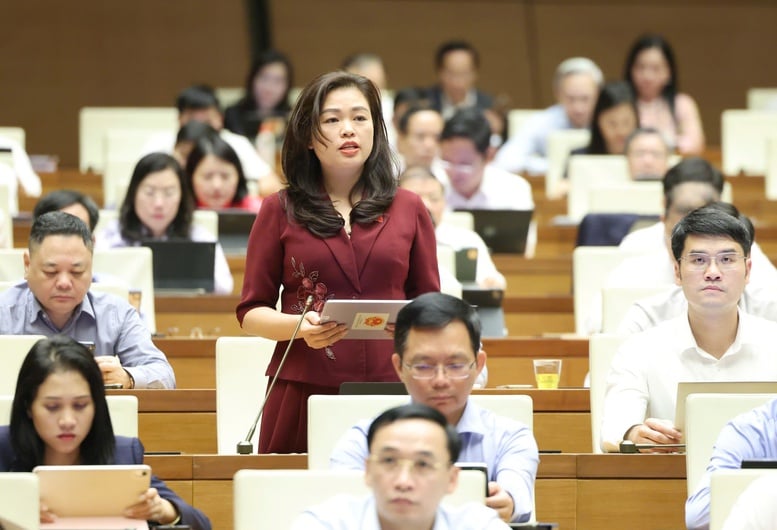
Delegate Doan Thi Le An (Cao Bang Provincial National Assembly Delegation) discusses in the assembly hall - Photo: VGP/Nhat Bac
Therefore, delegates recommended that the Government continue to improve institutions, simplify procedures, and enhance the quality of investment preparation; while also addressing the fear of making mistakes and creating conditions for officials to dare to think, dare to act, and dare to take responsibility for the common good.
Emphasizing the issue of ODA projects, especially in key infrastructure sectors, National Assembly delegate Nguyen Truc Son (Vinh Long province) stated that the demand for foreign loans is expected to increase 7-9 times during the 2026-2030 period. According to the delegate, this is a necessary requirement given the country's need for additional resources to promote socio-economic development.
However, delegates suggested that the Government and ministries continue to review and further harmonize investment procedures between domestic and donor sides, avoiding situations where a single project has two different investment processes and two different disbursement procedures, causing delays in implementation.
The delegates cited the fact that in the previous period, the disbursement rate of ODA funds only reached about 52.7%, arguing that this figure needs to be improved soon. Therefore, it is necessary to accelerate the simplification of procedures, shorten processes, and increase consistency in order to improve the efficiency of using these funds…
Clarifying solutions to improve the efficiency of public investment.
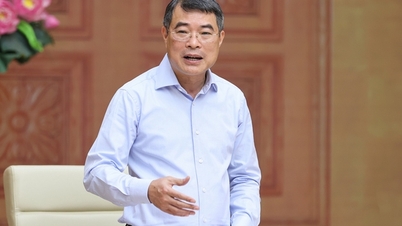
Following the discussions among National Assembly delegates, Minister of Finance Ngo Van Tuan focused on explaining key issues of concern, ranging from improving revenue policies and restructuring budget expenditures to enhancing the efficiency of public investment.
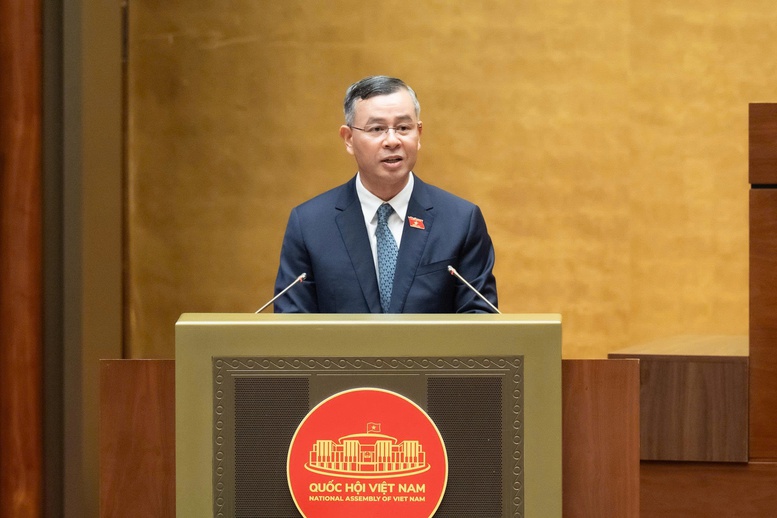
Minister of Finance Ngo Van Tuan gives explanations in the Assembly Hall.
Clarifying some specific issues of concern to the delegates, Minister of Finance Ngo Van Tuan stated that, regarding revenue policy, the need for investment and development in the coming period is very large, therefore the principle of "revenue must be used to fund expenditures" must be implemented. Revenue policy must be reviewed regularly to ensure that revenue is collected correctly, sufficiently, promptly, and comprehensively.
More importantly, this policy must serve as a support system for economic development, especially for small and medium-sized enterprises, while encouraging domestic businesses to participate deeply in global value chains and the value chains of FDI enterprises in order to improve productivity and the quality of growth.
"To achieve this goal, the tax collection policy needs to ensure the following criteria: simplicity, ease of understanding, ease of implementation, openness, and transparency. We need to optimize the process so that the costs for the tax collection apparatus as well as the compliance costs for taxpayers are kept to a minimum. In particular, the tax collection policy must be flexibly adjusted to respond to changing circumstances," Minister of Finance Ngo Van Tuan emphasized.
Regarding budget expenditures, in response to concerns expressed by many delegates about the efficiency of resource utilization, Minister of Finance Ngo Van Tuan clarified that, for recurrent expenditures, the plan aims to reduce the proportion to approximately 60% of total expenditures. This is a significant effort by relevant agencies to ensure the operation of the apparatus, prioritizing national defense and security, social welfare, education, healthcare, and especially innovation in the coming period.
To further increase savings, in addition to cutting recurrent expenditures by 10% in the 2026 budget, Prime Minister Le Minh Hung has directed a further review to cut an additional 5%, focusing resources on development investment.
Responding to delegates' concerns about the effectiveness of investment spending, Minister of Finance Ngo Van Tuan stated that the Prime Minister will direct a national conference to comprehensively review the process and procedures for disbursing public investment funds. In accordance with Resolution No. 18 of the Central Committee, the relevant agencies will finalize the consolidation of the Public Investment Law into the Budget Law, and simultaneously review the Construction Law and technical standards and norms to minimize preparation time. The goal is to select the right projects with a ripple effect, ensuring implementation in the shortest possible time, bringing them into operation, and creating new production capacity for development.
In addition, the Government will review the Bidding Law to thoroughly address obstacles related to land clearance, construction material prices, payment and settlement procedures, warranty and maintenance, etc.
Dieu Anh
Source: https://baochinhphu.vn/can-xoa-co-che-xin-cho-nang-hieu-qua-dau-tu-cong-102260421183919704.htm
![[Image] Close-up view of the interchange connecting the two expressways and Long Thanh Airport.](https://vphoto.vietnam.vn/thumb/1200x675/vietnam/resource/IMAGE/2026/05/25/1779703378210_ndo_br_z7863716673926-224453a31600126cce10622af6290afd-4549-jpg.webp)
![[Image] Hanoi's urban life under the challenge of a "scorching hot" environment](https://vphoto.vietnam.vn/thumb/1200x675/vietnam/resource/IMAGE/2026/05/25/1779706979265_nang-nong-t5-2026-minh-duy-7-4636-jpg.webp)




























































































Comment (0)