

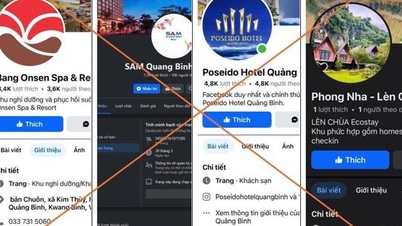
Fake Fanpages of tourist areas, resorts, and hotels.
On June 1st, Ms. NTTN, phone number 0909334xxx, residing in Ho Chi Minh City, became a victim of a scam, losing 1.3 million VND in deposit money for her family's summer vacation. "I contacted the Terracotta Phan Thiet resort's fanpage and received advice and guidance. After confirming the booking for June 6-7, the consultant sent a booking confirmation slip and provided a QR code and bank account information for the deposit transfer. Believing it was the resort's official fanpage, I transferred 1.3 million VND. After transferring the money, the scammer sent another link requesting 'Confirm payment.' I clicked on it and followed the instructions, but noticed something unusual. However, when I tried to contact them again, I received no support and realized I had been scammed."

Tourists should carefully check the transparency of the fan page before contacting them to book a room to avoid being scammed.
PHOTO: KHANG KA
According to Thanh Nien newspaper's investigation, there are currently many fake fan pages impersonating famous tourist areas, resorts, and hotels to scam customers out of their deposits. These fan pages are created using stolen images and video clips, making them look authentic. Therefore, it's necessary to carefully check the information in the transparency section to verify whether the fan page is genuine or fake. For example, in the scam case mentioned above, the fan page was created in 2021 with the initial name "Ong Cuc," and later changed to "Terracotta Resort Mui Ne Phan Thiet" in March 2025. Facebook's transparency information shows that the page administrator is not in Vietnam but is from Cambodia, India, or the Philippines.
Recommendation:
People who need to book rooms should contact the hotel/resort's official website; or book through reputable platforms such as Booking, Agoda, Traveloka, etc.

✅ Check the "Page Transparency" section on Facebook: page creation date, name change history, and the country managing the page.
✅ Do not click on links requesting "payment confirmation," "transaction verification," or "receive refund" after you have transferred the money.
✅ If you suspect you've been scammed: Stop all transactions, contact your bank immediately to report it, save messages and transfer receipts, and report it to the police.
Impersonating government agencies helps recover money from scams.
Recently, numerous fake Facebook fan pages impersonating government agencies such as "Vietnam Ministry of Finance," "Cyber Security Department," "Ministry of Public Security," and " Government Office " have appeared on social media, aiming to scam people who have previously lost money online. These scammers brazenly use national emblems, symbols of the Ministry of Public Security and the Ministry of Finance, and images of conferences and activities of government agencies. Exploiting the victims' desire to recover their money, these fan pages post content such as: "100% money recovered," "assistance in recovering money from investment platforms," "recovery of illegal transactions," "online application acceptance 24/7," etc.

People need to be wary of scams involving fake official fanpages impersonating government agencies.
PHOTO: KHANG KA
Notably, the fake "Ministry of Finance" fanpage is currently running extensive advertising campaigns and shows clear signs of impersonation and fraud. This fanpage claims to be a government agency but advertises content such as "100% capital recovery," "collection of illegal transactions," etc. These advertisements aim to attract people who have lost money in investment apps, cryptocurrencies, online tasks, online dating, etc., and request private contact for detailed discussions. In reality, the police, the Ministry of Finance, the Cyber Security Department, etc., do not charge fees through Facebook for "recovering fraudulent money." Therefore, people should not transfer money to any individual or organization claiming to be able to recover their stolen funds; and should not provide their ID card, bank account information, or OTP codes to strangers.

According to cybersecurity experts, after victims contact them via messaging, scammers collect personal information, request bank statements, ask for ID cards, account details, etc. They often demand "document verification fees," "account freezing fees," "refund taxes," "lawyer fees," or "disbursement fees." Finally, after receiving the money, they cut off contact or continue to demand more if the scam hasn't been detected.
Source: https://thanhnien.vn/canh-bao-nhung-chieu-lua-dao-dang-dien-ra-185260604141234639.htm





















































![[Video] Sunset at Lap An Lagoon – Where the sun sets over the fishing nets](https://vphoto.vietnam.vn/thumb/1200x675/vietnam/resource/IMAGE/2026/05/31/1780192137701_beach-landscape-sea-water-nature-grass-745871-pxhere-com.jpeg)


































Comment (0)