


Add an authentication layer when changing devices.
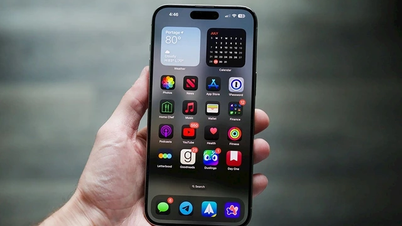
According to Circular No. 08 of the Ministry of Science and Technology on guiding the verification of information for terrestrial mobile subscribers, starting from June 15th, telecommunications businesses will implement an additional verification process for cases where the system detects that the subscriber has changed their terminal equipment compared to the information previously registered.
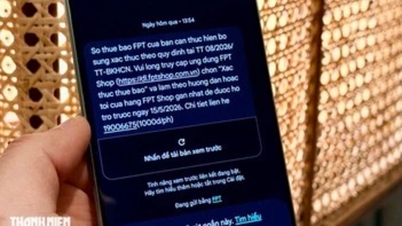
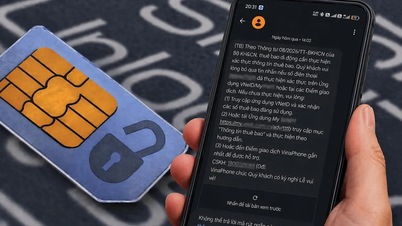
Specifically, within a maximum of 2 hours of detecting the change, the network operator must conduct a review, temporarily suspend the subscriber's outgoing services such as calling or texting, and send a notification requesting the subscriber to perform facial biometric authentication.
Users can perform authentication through electronic authentication services or by directly verifying their identity at the telecommunications company's transaction point. For electronic authentication, facial data must be verified and confirmed to match national databases such as the national population database, the national identity card database, the national immigration database, or data stored in the identity card.
In the case of direct verification, the telecommunications company will take a photograph of the subscriber's face and compare it with biometric data legally stored in the subscriber information management system. The telecommunications company is responsible for the accuracy and consistency of the verification data.
The circular also stipulates technical requirements for facial recognition systems. The technology used must meet the international FIDO standard, with a false rejection rate of less than 5% and a false acceptance rate not exceeding 0.01%. At the same time, the system must be able to detect forms of impersonation such as using photographs, videos , or 3D masks to bypass the authentication process.
In addition, telecommunications companies must store information proving the authentication process, including the time of execution for each subscriber, to facilitate inspection and monitoring when necessary.
According to regulations, if a user fails to complete the verification process within 30 days of changing devices, the telecommunications company may take further action such as blocking the subscription or terminating the service contract.
However, this regulation does not apply to all subscribers. Those who have used their phone number to register for a level 2 VNeID account or have registered their subscriber information using a chip-embedded citizen identity card in accordance with regulations will not have to re-verify their face when changing devices.
Filling the loophole in fraud
According to the regulatory agency, requiring biometric authentication when changing terminal devices is one of the technical solutions aimed at enhancing the reliability of subscriber information and overcoming limitations in mobile SIM management in the past.
In reality, despite numerous subscriber information standardization campaigns, the problem of SIM cards not registered in the owner's name, or SIM cards registered and then transferred to others for use, still persists. This is considered one of the reasons that facilitates the dissemination of spam calls, spam messages, and online fraud.
Previously, identity verification typically only occurred at the time of subscriber registration. After the procedure was completed, the SIM card could be transferred to another person for use, making it difficult for regulatory authorities and telecommunications companies to detect without additional verification mechanisms during use.
The new regulations are expected to bridge this gap, as changing devices becomes a point where user identity verification is required. Accordingly, the current subscriber must prove a match between their actual face and previously verified data.
In addition to limiting the buying and selling of SIM cards after verification, the new mechanism is also considered to enhance user protection in cases where the SIM card is lost or falls into the wrong hands. Even if a fraudster obtains the physical SIM card or holds some of the subscriber's personal information, continuing to use it on another device will face an additional obstacle from the biometric verification step.
While the actual effectiveness of the new regulations on the telecommunications sector will require more time to assess, linking subscriber management with biometric authentication is seen as a further step in building a safer digital environment and enhancing the ability to prevent the misuse of mobile SIM cards for illegal activities.
Source: https://daidoanket.vn/doi-dien-thoai-nguoi-dung-phai-xac-thuc-khuon-mat.html

![[Photo] General Secretary and President To Lam presides over a meeting with the Central Organizing Committee.](https://vphoto.vietnam.vn/thumb/1200x675/vietnam/resource/IMAGE/2026/06/03/1780482764658_a1-bnd-4741-3342-jpg.webp)

![[Photo] First session of the 14th Congress of the Vietnam Trade Union](https://vphoto.vietnam.vn/thumb/1200x675/vietnam/resource/IMAGE/2026/06/03/1780465947883_ndo_br_img-3852-jpg.webp)

![[Photo] Secretary of the National Assembly Party Committee, Chairman of the National Assembly presides over the meeting of the Standing Committee and Executive Committee of the National Assembly Party Committee.](https://vphoto.vietnam.vn/thumb/1200x675/vietnam/resource/IMAGE/2026/06/03/1780480353201_ndo_br_bnd-2585-jpg.webp)



















































![[Video] Sunset at Lap An Lagoon – Where the sun sets over the fishing nets](https://vphoto.vietnam.vn/thumb/1200x675/vietnam/resource/IMAGE/2026/05/31/1780192137701_beach-landscape-sea-water-nature-grass-745871-pxhere-com.jpeg)




































Comment (0)