

The registered area exceeded the target.
According to Deputy Director of the Department of Crop Production and Plant Protection Nguyen Thi Thu Huong: In the first year of implementation, all 12 provinces in the Mekong Delta region registered to participate in the Project, with a total area of up to 1,015,000 hectares, exceeding the set target. Provinces such as Kien Giang , Dong Thap, and An Giang are leading in terms of participation scale.
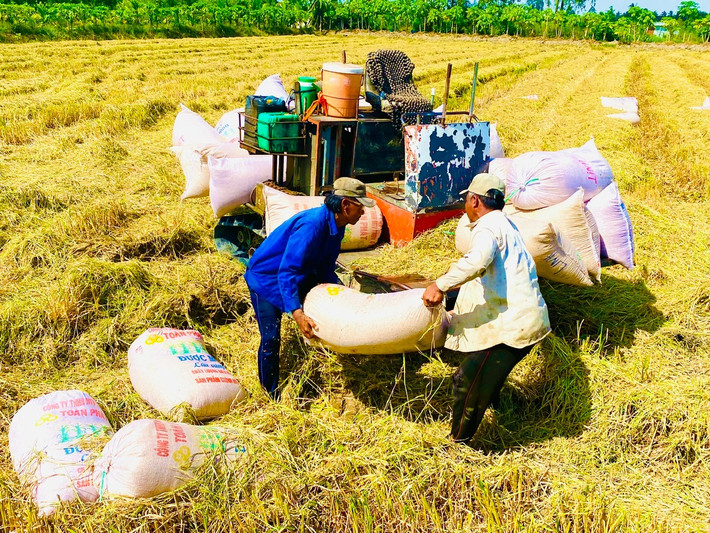
High-quality rice is purchased by businesses at prices 200-300 VND/kg higher than the market price. Photo: CTV
Advanced farming models have yielded significant results. Specifically, seven pilot models at the central level and hundreds of models at the provincial level have been implemented, demonstrating many outstanding benefits: production costs decreased by 8.2 - 24.2%, pesticide use decreased by 1 - 4 times, fertilizer savings of 30 - 70 kg/ha, irrigation water reduction of 30 - 40% while increasing productivity by 2.4 - 7%; greenhouse gas emissions decreased by an average of 2 - 12 tons CO₂/ha, and profits increased by 4 - 7.6 million VND/ha. Notably, all rice products are purchased by businesses at prices 200 - 300 VND/kg higher than the market price, creating a clear incentive for farmers.
Sharing the initial success of the project, Vice Chairman of the Soc Trang Provincial People's Committee Vuong Quoc Nam said: In 2025, the province will select one qualified cooperative to participate in a pilot production project on an area of 50 hectares, using the ST25 rice variety. The results show an increase in profit of about 25%, and a reduction in CO2 emissions of 4 tons/ha/season. The province plans to continue selecting 8 more pilot models with an additional 350 hectares in 2025.
Moreover, since the project's implementation, the production chain has expanded significantly. 620 cooperatives have been identified to participate in the initial phase, and nearly 200 businesses, 40% of which have a linked scale of 200 hectares or more, have collaborated with cooperatives to build a sustainable rice value chain, contributing to improved production capacity and stable consumption. Training has been intensified, with many cooperative officials receiving more systematic training, and hundreds of farmers receiving training on innovation, mechanization, and the circular economy of rice straw. Notably, 20 digital transformation training courses have been organized, supporting cooperatives in using accounting and traceability software.
Opportunities to attract new investment resources.
Besides the achievements, Deputy Director of the Department of Crop Production and Plant Protection Nguyen Thi Thu Huong also stated that there are still initial difficulties and uncertainties in implementing the project. Minister of Agriculture and Environment Do Duc Duy also acknowledged that some localities and units are still confused about the project's content. In particular, in 2025, when the organizational structure is restructured, many localities are hesitant in organizing implementation, especially regarding project approval and the issuance of support policies for farmers participating in the project.
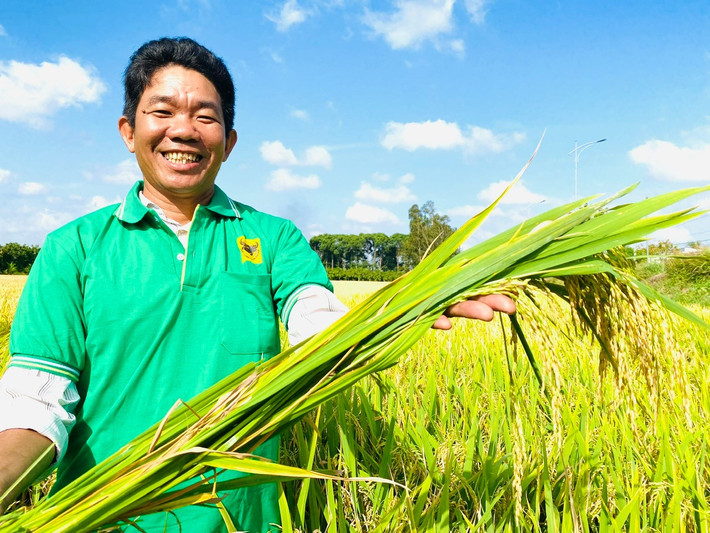
People in the Mekong Delta provinces are eager to participate in the project.
Notably, irrigation infrastructure, especially on-farm irrigation, still does not meet the requirements for rational and efficient irrigation; production linkages have been initially formed but remain weak; people participating in the project are not proactive and still have a mentality of waiting for support; investment capital for the project, especially projects financed by loans from the World Bank (WB) and the Transition Carbon Finance Fund (TCAF), is slow to be mobilized and has not completed the required procedures. In many places, there is more focus on generating carbon credits than on improving infrastructure and sustainable farming techniques, which risks affecting long-term effectiveness.
Furthermore, the linkage rate between farmers, cooperatives, and businesses is only below 30%, which is not strong enough to ensure stable output. Many businesses are still waiting for policy changes and lack proactive participation. Most activities depend on local budgets. Loan procedures from the World Bank and TCAF are slow, disrupting implementation progress. Some important regulations related to the carbon market, preferential credit, and technical support are still under development, causing difficulties for localities in implementing them comprehensively.
Affirming that low-emission and sustainable production is an inevitable trend, the Ministry of Agriculture and Environment stated that it is continuing to expand the area of high-quality, low-emission rice cultivation to 312,743 hectares in 2025. To achieve the target by 2030, the Ministry requested localities to urgently complete the registered area, prioritizing the application of emission-reducing farming practices such as alternating wet and dry irrigation (AWD), rational fertilization, circular straw management, and the simultaneous implementation of models at the grassroots level to create a solid foundation for the 2026-2030 period.
What many farmers, scientists, and businesspeople desire is that, alongside upgrading infrastructure and logistics serving production, investing in irrigation systems, storage facilities, drying stations, and logistics centers, the measurement, reporting, and verification (MRV) system for emissions should be perfected and effectively implemented. This is a key tool for accurately monitoring the effectiveness of emission reduction; it also provides the legal basis for Vietnam to participate in the international carbon credit market, opening up opportunities to attract new investment resources.
Source: https://daibieunhandan.vn/canh-cua-moi-cua-tang-truong-xanh-post410065.html
![[Photo] Closing Ceremony of the 15th Conference of the Central Committee of the 13th Party Congress](/_next/image?url=https%3A%2F%2Fvphoto.vietnam.vn%2Fthumb%2F1200x675%2Fvietnam%2Fresource%2FIMAGE%2F2025%2F12%2F23%2F1766462841764_a1-bnd-3731-1647-jpg.webp&w=3840&q=75)

































































Comment (0)