


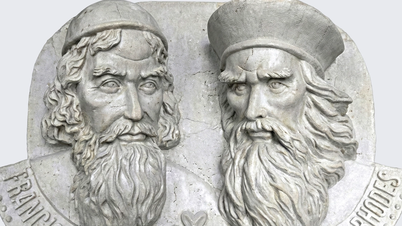
Father Alexandre de Rhodes was one of the first to mention the New Year's pole (cây nêu) in the Vietnamese traditional New Year celebration in the first half of the 17th century, in his work *Histoire du royalaume de Tunquin* (History of the Kingdom of Tonkin), printed in Lyon (France) in 1651.
In this work, he wrote about the Vietnamese Tet customs as follows: "At the end of the year, they have the custom of erecting a long pole near the door of their house, extending beyond the roof, with a basket or bag with many holes and filled with gold and silver paper money hanging at the top."
The short passage by Alexandre de Rhodes depicts a simple image of a New Year's pole in the past, and also clearly shows that the custom of using paper money made of gold and silver existed before the 17th century. The missionary further explains that this special type of paper money was sent to deceased parents to spend or to pay off debts in the afterlife.
In the first half of the 19th century, in his work Gia Dinh Thanh Thong Chi, Minister Trinh Hoai Duc provided a more detailed description of the New Year's pole.
According to him, on the last day of the lunar year, people erect a bamboo pole in front of their houses, tying a bamboo basket to the top containing betel nuts, lime, and gold and silver paper hanging from the side of the basket. The purpose of erecting the pole is to ward off evil spirits and welcome the new year. After the first few days of the year, on the seventh day of the first lunar month, along with the opening of the seals at the government offices, people also perform the ceremony of taking down the pole.
The Đại Nam thực lục (Chronicles of Đại Nam) records a story from the time of Emperor Minh Mạng: In 1835, the Emperor asked his courtiers, "From which classic text does the ritual of erecting the New Year's pole originate?" Cabinet Minister Hà Quyền replied, "The ancients also used the New Year's pole as a theme for their poems."
"I only heard that it originated from Buddhist scriptures, but I don't know the exact meaning," the king said. "The ancients established this ceremony because they believed it symbolized the new year. Therefore, the ceremony was born from meaning."
During the reign of Emperor Tự Đức, in 1876, the emperor "established the regulations for erecting and taking down the New Year's pole. The previous regulations stipulated that the pole would be erected on the 30th day of the Lunar New Year and taken down on the 7th day of the first lunar month of the following year, with the Imperial Observatory choosing an auspicious time. Later, it was stipulated that the hour of the Dragon (Thìn) would be the fixed time."
By the beginning of the 20th century, an article by a French author named A. Raquez published in the 1904 issue of Revue Indochinoise (Indochina Magazine) provided readers with a relatively complete understanding of the New Year's pole.

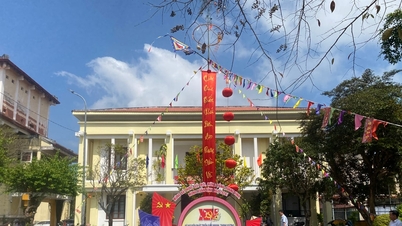
The ceremonial pole is erected right in front of the Đoan Môn gate at the Thăng Long Imperial Citadel - Photo: T. ĐIỂU
According to A. Raquez, on the 30th day of the Lunar New Year, Vietnamese people plant a tall bamboo tree in front of their houses, stripped of its branches, leaving only a small clump of bamboo leaves at the top. This clump of leaves often flutters in the winter wind.
The main purpose of the New Year's pole is to ward off evil spirits and prevent their harmful actions. The cluster of leaves at the top of the pole is a crucial part, as its combination with the east wind helps people predict good and bad fortune, luck and misfortune, that will occur in the new year.
According to local beliefs, when the leaves at the top of the ceremonial pole flutter in the winter wind, the following year's harvest will be relatively good; if they lean sharply towards the northwest, the harvest will be bountiful.
Conversely, if the wind blows the cluster of bamboo leaves on the New Year's pole towards the South, the new year will be marked by a complete drought; if it blows towards the Southwest, a partial drought will occur. When the cluster of leaves leans completely towards the West, the prediction is even more ominous: war; if it leans towards the East, it signifies favorable weather; and if it leans towards the Southeast, an epidemic will break out.
Thus, according to what A. Raquez discovered, the New Year's pole in the past was a tool for predicting the situation of the new year in many aspects of life. Furthermore, it was also a means of warding off evil spirits and foretelling bad luck and misfortune in the new year.
To do this, people hang various things on the New Year's pole: a basket of rice, paper gold and silver ingots, betel nuts and lime as offerings to the gods; clumps of pandan leaves, and branches of cactus with many thorns to prevent the intrusion of evil spirits.
In many homes, the owners also hang a rectangular bamboo mesh screen with four horizontal and five vertical bars. A. Raquez was told by Nordemann, the headmaster of Hue National High School, that the four horizontal bamboo bars symbolize the four cardinal directions (East, West, South, and North), while the five vertical bamboo bars represent the five fundamental elements of heaven and earth: Metal, Wood, Water, Fire, and Earth!
According to folk beliefs, the New Year's pole is maintained in front of each house for 7 days, a period during which the deities guarding the land ascend to heaven to convey their wishes to the Buddhas. It is also believed that evil spirits take advantage of this time to cause trouble for mortals, and the firecrackers are said to frighten them away.
Source: https://tuoitre.vn/cau-chuyen-cay-neu-202602041359565.htm
![[Image] Shipbuilders exposed to steel and record-breaking heat.](https://vphoto.vietnam.vn/thumb/1200x675/vietnam/resource/IMAGE/2026/06/04/1780545781745_ndo_br_img-5402-4683-jpg.webp)












































![[Video] Sunset at Lap An Lagoon – Where the sun sets over the fishing nets](https://vphoto.vietnam.vn/thumb/1200x675/vietnam/resource/IMAGE/2026/05/31/1780192137701_beach-landscape-sea-water-nature-grass-745871-pxhere-com.jpeg)


































Comment (0)