

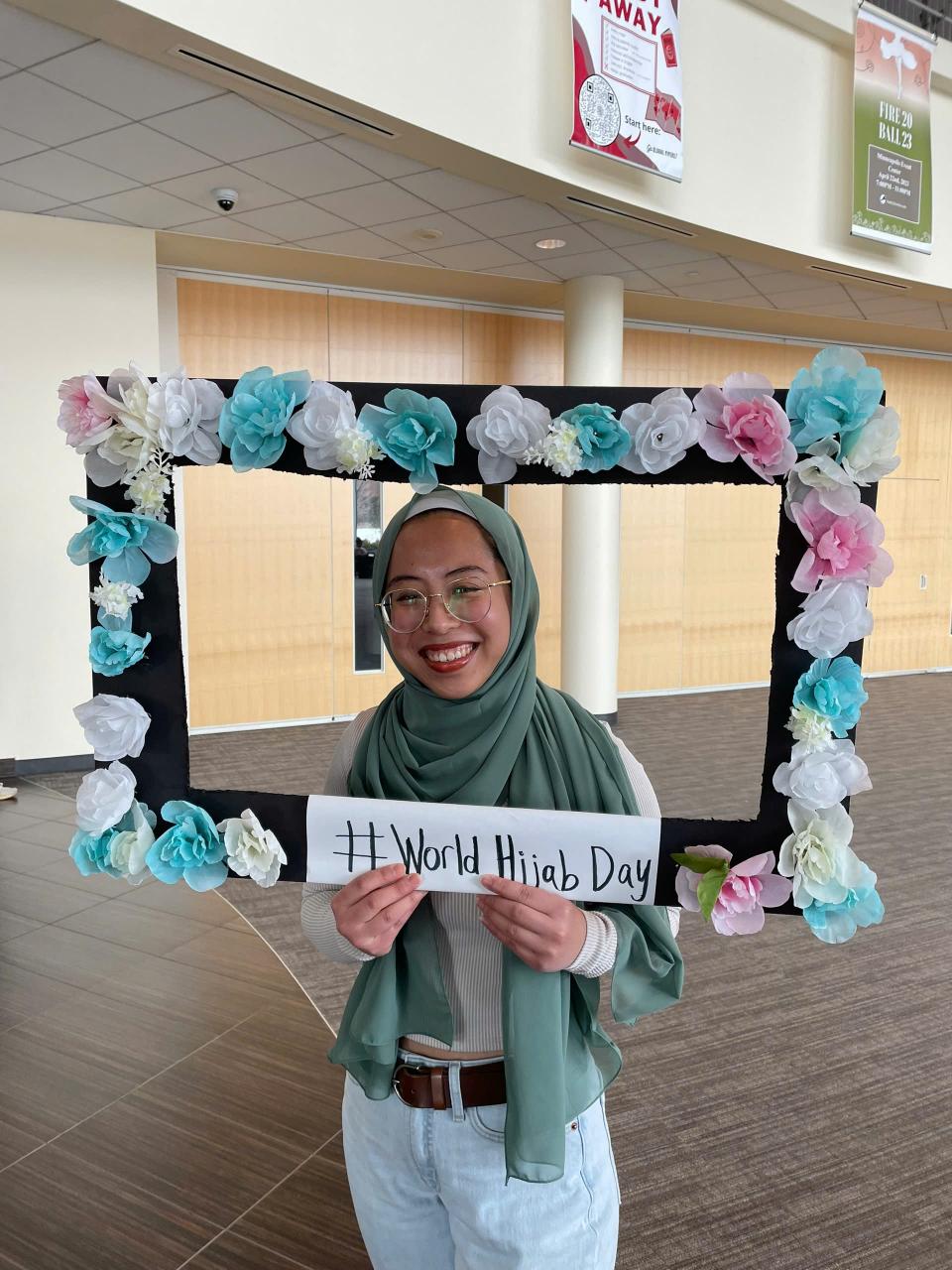
During my time abroad, my Muslim teachers and friends taught me about this religion. My teachers taught both Sunni and Shia Islam, but I had more exposure to Sunni Islam. This was because that was the environment in which many of my friends were born and raised, or converted and learned.
Learning to understand a religion
My friends adhere to the basic principles of Islam. They pray five times a day, fast from sunrise to sunset during Ramadan—the ninth month of the Islamic calendar.
A pilgrimage to Mecca in Saudi Arabia is a must, if possible, for Muslims. And above all, my friend always tries to create a small Muslim community on campus so that Muslim students can come together to socialize, learn, and even eat iftar – the post-sunset meal during Ramadan.
Furthermore, they follow Islamic rituals for weddings, funerals, and other important life events. I had the opportunity to attend a nikah – a traditional Islamic wedding ceremony – at the home of a Somali friend.
During my time in university, I learned how to fast during Ramadan. I also participated in Friday prayers with the Muslim student community. And best of all, my friends gave me a hijab and taught me to recite the Quran and pray with them.
Studying Islam to understand a religion, studying Islam to look at world history and the realities of life—that's what I feel. I understand that Islam has many good things, much more than what people might think about Islam and extremist Islam.
I am grateful to my friends and teachers for introducing me to an ancient religion and culture that spans the globe, and for allowing me to believe in Allah - the One and Only God in Arabic.
Cham Bani people
Because of my exposure to Islam, when I visited the Cham Museum ( Da Nang City) and learned about the Cham Bani people, I was surprised by how the Cham Bani worshipped and followed Islam.
The Cham Bani are an indigenous branch of Islam, a blend of Islam and Cham folk beliefs. The Cham Bani emerged from a flexible adoption of Islam, where they do not fully adhere to the regulations of orthodox Islam but only practice some basic rituals.
The Cham Bani people exhibit a distinct blend of Islam and indigenous cultural elements. These include Hinduism – the dominant religion of the Champa kingdom – and Buddhism. They do not pray daily, but rather focus their prayers on major festivals.
The Ramadan month for the Cham Bani people is also different, as they only observe fasting for a certain number of days instead of the entire month like Sunni Muslims. One of the prominent cultural characteristics of the Cham Bani is ancestor worship – a custom not common in orthodox Islam.
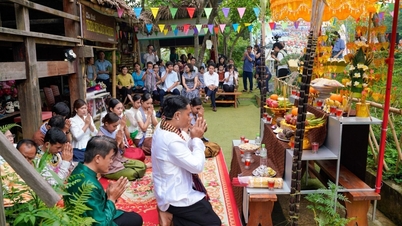
The Cham Bani people maintain rituals of ancestor worship and veneration, incorporating Islamic elements into their ceremonies. This demonstrates a fusion of Islam and folk beliefs, creating a unique identity for the Cham Bani.
During my time abroad, I learned that in Islam, Allah is the one and only supreme being, and Muslims worship no one but Allah. The phrase describing this faith is Tawhid (توحيد) – the oneness of Allah, the belief in absolute monotheism. Allah is unique and has no counterpart.
Ancestor worship is no exception, as their ancestors received life from Allah, making it a taboo in Islam. However, this is completely the opposite for the Cham Bani people.
Peace comes from combining faith.
The Cham Bani people worship Allah, venerate their ancestors, and recite the Quran, but they do not fast for the entire month of Ranuwan, even though Ranuwan coincides with the Muslim Ramadan, and they still use the Islamic calendar.
This raised questions about religious pluralism in me. In the 21st century, religious pluralism is not a new issue. But finding a dividing line between a monotheistic religion—Islam—and a polytheistic religion—Hinduism, ancestor worship, and Buddhism—to establish a single altar and uphold the faith together—is probably unique to the Cham Bani people.
What is most remarkable is that the religious pluralism of the Cham Bani people is the peaceful combination of beliefs from both monotheistic and polytheistic branches of religion.
We are no strangers to religious conflicts within the same nation or country in many different nations. In India, Muslims and Hindus are sworn enemies. The overlapping history and invasions, as well as the issue of assimilation, when discussing religion, are burning topics in this country of over a billion people.
In Vietnam, the Cham people, whether Cham Muslims or Cham Bani, live peacefully and respect one another. Even though the Cham Bani faith has never been a source of conflict or war, Allah or their ancestors remain places where the Cham Bani express their reverence and solemnity in their spiritual and religious lives.
The question of religious pluralism among the Cham Bani leads me to a larger question: does Allah accept them as true Muslims?
I don't know for sure, but I do know that the Cham Bani people have shown a student like me, who is learning about religion, that monotheistic and polytheistic religions can absolutely combine and enrich human beliefs. They show that why should we divide and draw boundaries when we can accept and combine differences?
Source: https://baoquangnam.vn/cau-hoi-cho-thanh-allah-3143675.html


![[Photo] General Secretary and President To Lam meets with National Assembly delegates from ethnic minorities.](https://vphoto.vietnam.vn/thumb/1200x675/vietnam/resource/IMAGE/2026/04/20/1776696701056_a1-bnd-8331-3342-jpg.webp)


![[Image] National Assembly discusses the implementation of the socio-economic development plan.](https://vphoto.vietnam.vn/thumb/1200x675/vietnam/resource/IMAGE/2026/04/20/1776696707422_ndo_br_img-20260420-185419-jpg.webp)






















































































Comment (0)