

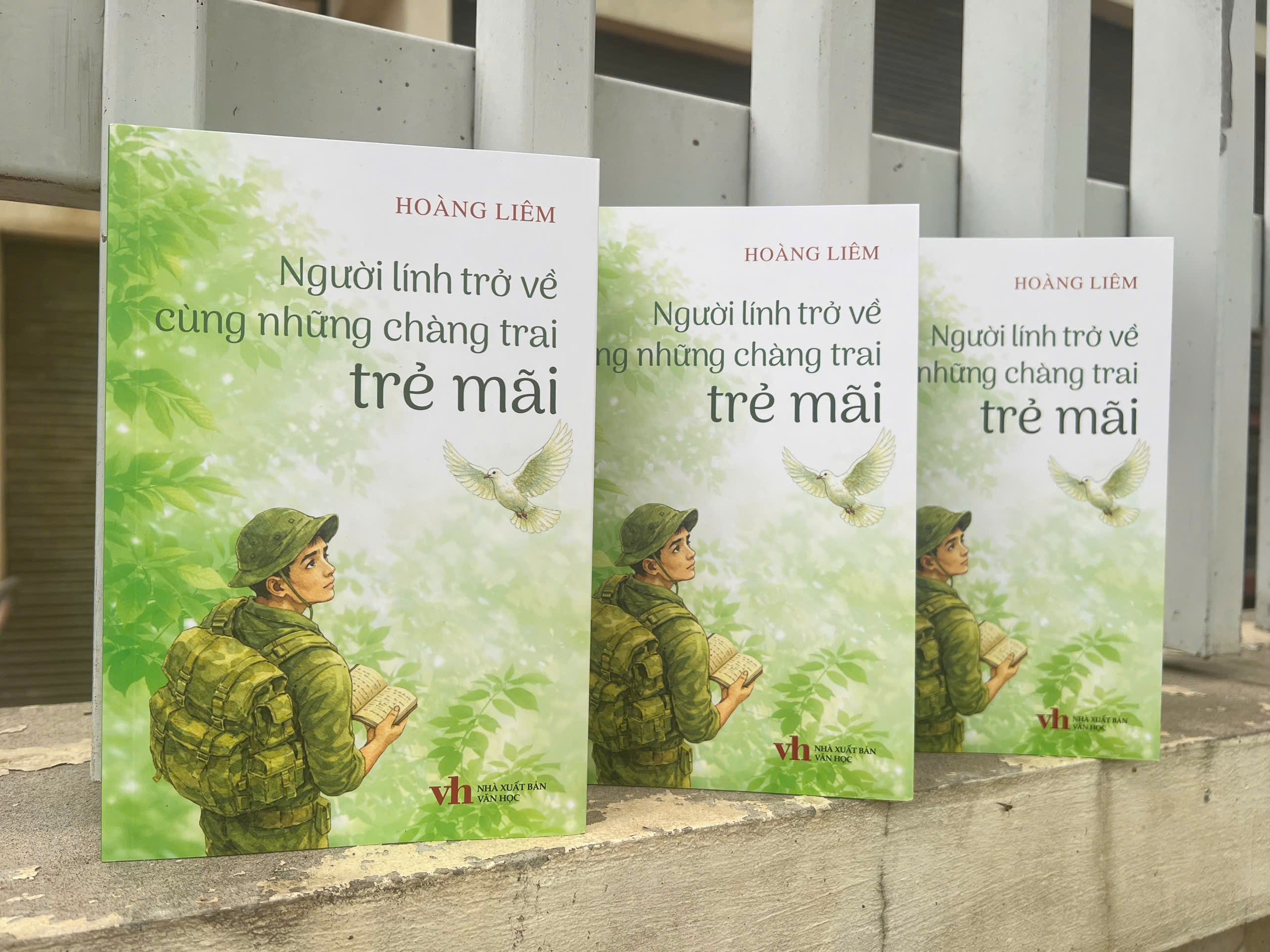
 |
The book is like a memoir of very real lives, told through the eyes of their close comrades. There is no distance between the narrator and the reader, because every detail is so relatable that one can clearly visualize the portrait of each person depicted.
To me, they were ordinary yet extraordinary people. They went to the battlefield not for lofty ideals, but for one simple reason: the word "homeland." And so, their unfulfilled dreams, their unspoken feelings… forever remain on the battlefield.
Like martyr Bui Khac Tuong - despite having three martyrs in his family and carrying a love he never dared to confess, he silently set off because "the order was to go." Or martyr Nguyen Sy Thieng - who carried his wife and a child less than a year old with him, yet still suppressed everything to enter the battlefield and fell "just before dawn" on the day of victory. And also teacher Nguyen Huu Huan - a respected teacher who sacrificed himself at a very young age, leaving behind not only the classroom but also memories in the hearts of generations of students.
Every time I stop at the end of a story, my eyes well up a little. Perhaps it's because I too went through carefree student years, where the biggest choices were just studying or the future – not the boundary between life and death like those young men did back then. And perhaps, now that I'm a mother, I can't help but feel a pang of sadness when I read about family, about those left behind. There's the image of a mother bidding farewell to her son going to war, "her figure seemingly growing longer, her strength seemingly increasing to hold the entire train back to a stop." There's the image of martyr Khai appearing in the memory of Trai's mother, quietly preparing every household item before his departure. And there's the image of the mother of martyr Thang, tearfully packing a little soil from the place where he died to bring back to her hometown.
What's remarkable is that the war in the book isn't just depicted through fierce battles, but also in the quiet moments that follow. The pain isn't limited to those who fell, but lingers for a long time in the survivors. Yet, the book doesn't become overly sentimental. Amidst the losses are vivid memories, joyful stories of young men during their arduous marches.
Through this experience, I also gained a deeper understanding of what camaraderie truly means – a feeling encapsulated in simple yet profound things: standing by each other through life and death, and when one falls, the other "takes care of their parents in their place." And even after so many years, they persevere in their journey to find their fallen comrades, ensuring that their names are never forgotten.
What makes this book even more relatable to readers today is its storytelling style. The writing is simple and unadorned, more like a personal confession than a work of literature. Sometimes, just a few lines of poetry are enough to encapsulate the emotions.
"I remember the times, carrying sacks of rice until my back ached / Khai carried some for me too because he felt sorry for me being so thin and weak / I remember the day when Kong Pong Cham was starving / Phan picked out the last peanut for me."
[...]Khanh Thuy! Where is that unfinished poem? I've been searching everywhere but can't find it...
[...]Hey, Black Thang! Why keep doing reconnaissance all the time? The country has been at peace for over thirty years now!
Over a hundred pages long, the stories have come to a halt, but the emotions remain.
After reading it, I don't think I can fully understand everything they went through. But I know that there are memories that need to be preserved so that those of us who come after us won't forget.
And what ultimately remains is perhaps a sense of gratitude – for those who “didn’t return from the war,” for those who went through the war, and for those who recounted their memories.
Source: https://znews.vn/cham-vao-ky-uc-cua-nhung-chang-trai-tre-mai-post1642065.html




































































Comment (0)