

(NLĐO) - The truth about Chicxulub - the "killer" asteroid that once wiped out the dinosaurs - has just been discovered.
Chicxulub is the name of a giant asteroid that crashed into Earth 66 million years ago, causing a devastating chain of events that wiped out dinosaurs on the continents, as well as pterosaurs in the sky and ichthyosaurs and merfolk in the seas.
We know about Chicxulub through a massive impact crater perched precariously on the Yucatán Peninsula in Mexico, spanning a vast area of the surrounding sea.
Chicxulub itself remains shrouded in mystery, as it was shattered in the collision.
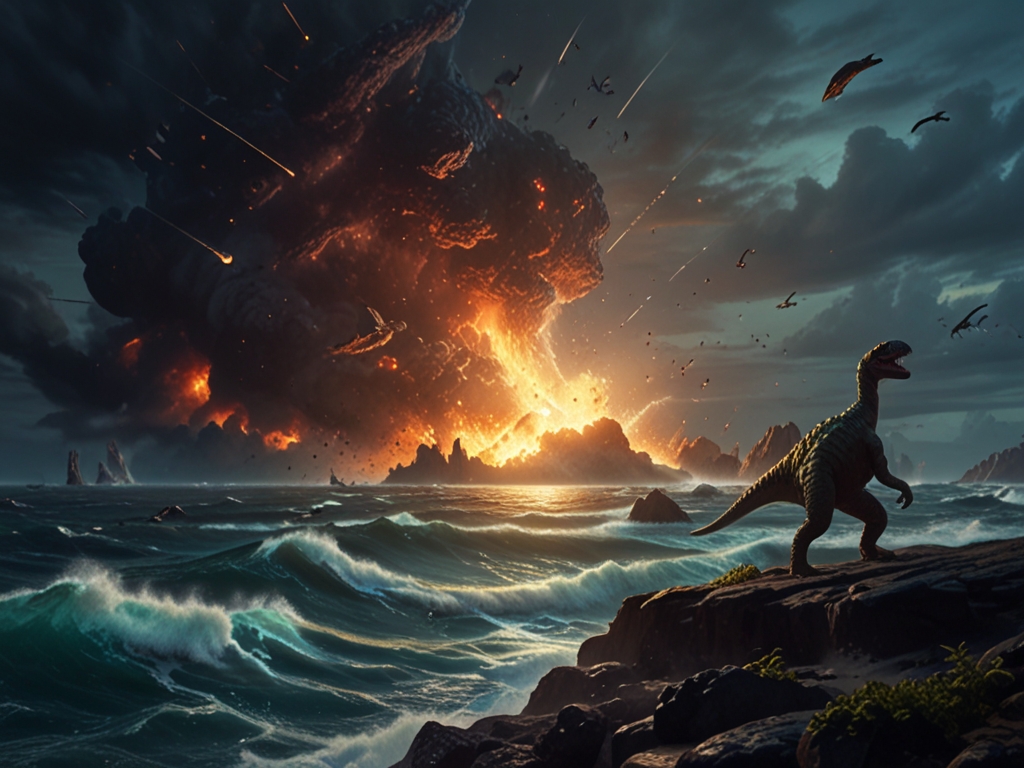
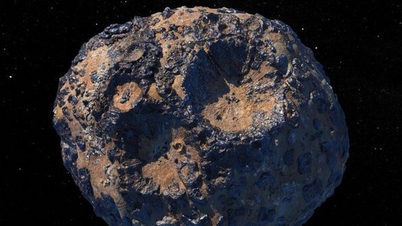
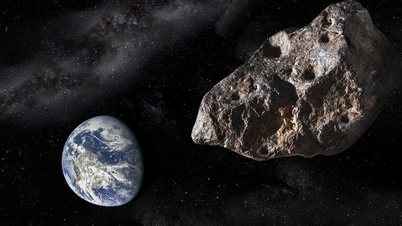
The asteroid that killed the dinosaurs was a rare "invader," originating from the giant gas planets it inhabits - AI illustration: Anh Thu
Now, a new study led by geochemist Mario Fischer-Gödde from the University of Cologne (Germany) has unveiled the mystery of this "killer."
The paper published in the scientific journal Science asserts that Chicxulub followed an extremely circuitous route before "invading" Earth.
Scientists' research focuses on a mineral called ruthenium. Several isotopes of this mineral can be found in the sedimentary boundary layers of the Cretaceous and later Paleolithic periods.
The boundary between these two eras is precisely 66 million years ago, right after the collision occurred.
According to Science Alert, ruthenium from five different locations was brought to the laboratory for isotopic analysis: one in Spain, one in Italy, and three from the Stevns Chalk Cliffs in Denmark.
The authors also analyzed ruthenium from five other impacts over the past 541 million years, as well as globular layers (small meteorite fragments that fall off when rocks melt under the heat of the atmosphere) dating back 3.5-3.2 billion years.
The results showed that the ruthenium isotope ratios from the sediment containing the remnants of the Chicxulub asteroid best matched a rare type of asteroid called a carbonaceous chondrite.
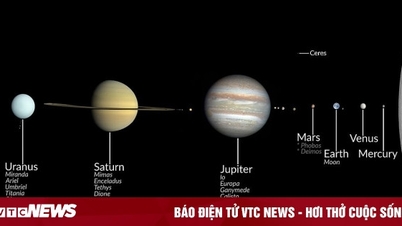
These asteroids are not located in the region around Earth, but rather in the "outer solar system," that is, the region beyond Jupiter's orbit, home to giant, cold gas planets.
These findings ultimately revealed the identity of the space rock that caused the catastrophe.
In the Solar System, the region of space where small rocky planets like Mercury, Venus, Earth, and Mars reside is relatively peaceful due to the presence of their "guardian" planet, Jupiter.
This giant planet, possessing a powerful magnetic field, acts as a barrier to prevent asteroids in the outer regions of the solar system from "invading" the peaceful inner regions.
However, some "invaders" occasionally manage to slip through, albeit in fragmented pieces.
With an estimated diameter of around 10 km, the giant Chicxulub is still just a fragment of a much larger mother body.
Nevertheless, this "invader" was still capable of causing devastating effects equivalent to a million atomic bombs, triggering megatsunami waves, causing massive volcanic eruptions, and resulting in sudden climate change...
Source: https://nld.com.vn/chan-tuong-ke-xam-lang-tu-the-gioi-hanh-tinh-khong-lo-196240817073424172.htm

![[Photo] Prime Minister Pham Minh Chinh presides over a meeting on private sector economic development.](/_next/image?url=https%3A%2F%2Fvphoto.vietnam.vn%2Fthumb%2F1200x675%2Fvietnam%2Fresource%2FIMAGE%2F2025%2F12%2F20%2F1766237501876_thiet-ke-chua-co-ten-40-png.webp&w=3840&q=75)
























































































Comment (0)