

 |
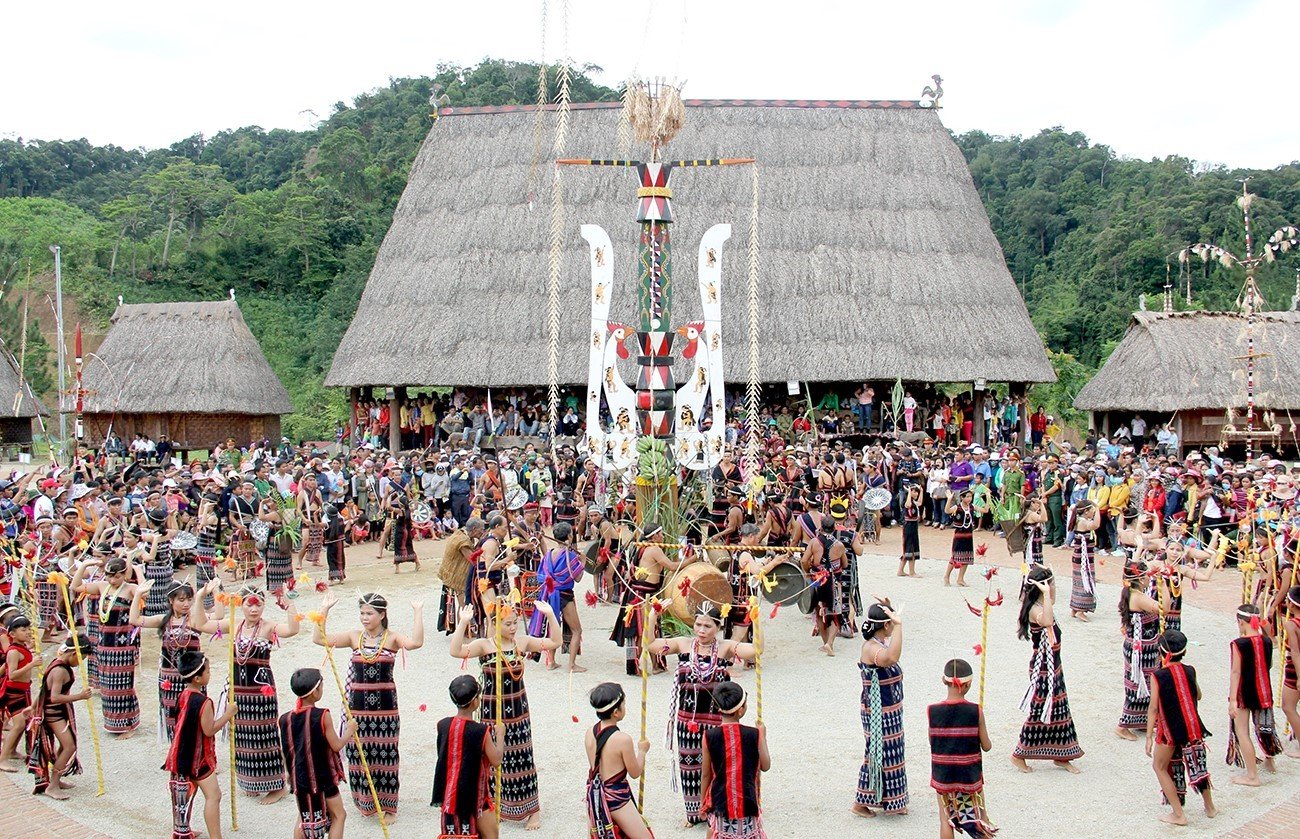
| Vibrant colors of brocade fabrics adorn the Co Tu people's New Year's pole erection festival. Photo: Pơloong Plênh |
The traditional indigo color and the creative way of producing brocade products and patterns in each region have their own unique characteristics. I still vividly remember the indigo colors in various shades and types that the Co Tu people in the mountainous districts of Tay Giang, Dong Giang, and Nam Giang diligently wove, displayed, and decorated on ancestral altars and in the sacred spaces of the village's communal house during festivals or the traditional New Year.
On the altars in every Katu home, there are always traditional woven fabrics and jewelry used as decorations, each with its own unique characteristics. These include woven fabrics, belts, loincloths, and even jewelry such as colorful bead necklaces, agate beads, and silver bracelets (pa-nang), creating a solemn altar space that reflects the respect, reverence, and spirit of the people, who always look back to their roots.
Village festivals or Tet (Lunar New Year) are occasions for family members to gather and reunite under the warm roof of their stilt houses, surrounded by glowing hearths, in the cool, transitional weather of the mountainous region. I had the opportunity to browse the personal Facebook pages of young people, and I was surprised to see many young Co Tu people choosing to sew and wear traditional clothing such as shirts and loincloths made from forest bark and brocade woven and sewn by their own skillful hands. This shows the positive effect of spreading love for traditional culture. From cherishing the indigo color of brocade to many young people independently learning about the traditional dances, music , and cuisine of their ethnic group during festivals.
I suddenly remembered my mother's words. At the loom in our stilt house, she was meticulously weaving beads while showing her children and grandchildren how to create patterns, how to weave, and the meaning of each pattern on traditional clothing. She said: “Our ethnic clothing is like our skin, our flesh, our liver, our intestines… it expresses the unwavering loyalty and devotion of women through the creation of brocade products, from growing cotton, spinning yarn, creating colors, selecting seeds to form shapes with many humanistic meanings such as the land, water, forests, birds, animals, the Gươl roof, tân-tung, da-dắ, weaving, brocade… these patterns express love for the mountains, forests, rivers, remembering our roots, showing community cohesion. Brocade also speaks of the authority, the good qualities of people, the resilience, the diligence, and the meticulousness of its creator.”
During my trip up the mountain to the border villages, I was fortunate to hear outstanding Co Tu artisans talk about their traditional Co Tu costumes. Outstanding artisan Co Lau Bhlao from Tr'hy commune, Tay Giang district, said: “In the past, the people in the mountainous areas faced countless difficulties, relying mainly on the forest for everything from food, water, medicine, to clothing. At that time, there was no fabric; the highlanders mainly used tree bark to make their clothes. Later, they discovered plants with cotton and seeds, learned how to weave them into fibers, and created natural colors to create the traditional costumes that reflect the Co Tu identity we see today.”
Distinguished artisan Bhơriu Pố from Lăng commune, Tây Giang district, shared at the Cơ Tu cultural festival held in the district for international guests: "Clothing and jewelry not only reflect the simple act of dressing and beauty, but more importantly, they represent the soul and beautiful identity, vividly, humanely, and objectively reflected through the subtlety in each line of the brocade woven by the skillful hands of Cơ Tu women in particular, and Vietnamese women in general."
When the indigo hues connect generations of mountain people, the elderly and the young, amidst the vibrant blue sky and dazzling colors of village festivals, gently evoking the heavens with dances that invite all directions, it is a joyful sign, a living environment where beautiful traditional cultural values are "continued and passed on," giving young people the opportunity to learn about and cherish their beautiful identity, contributing to spreading the beauty of brocade in particular, and cultural values in general.
Today, the emergence of young artisan weavers in the traditional brocade weaving and sewing industry has led to the creation of many innovative clothing and jewelry products from traditional brocade fabrics, using agate and beads such as ao dai (traditional Vietnamese dress), vests, men's suits, and women's bracelets. Young Arat Mai (from Nam Giang district), proudly wearing the traditional indigo brocade of the Co Tu people, said that patriotism means cherishing the beautiful traditional cultural values of one's own ethnic group, from clothing, dances, and folk songs that express love for nature, the country, and its people, living in unity and loving peace , and vowing to work together to build a prosperous and sustainable nation.
The vibrant traditional indigo color shines brightly in village festivals and on the Facebook pages of young people, a positive sign that cultural values are being given wings to reach the world , contributing to the preservation, promotion, and development of beautiful traditional cultural values. It acts as an invisible thread connecting communities, linking young people from mountainous regions, especially those studying, working, and living in large cities, to further cherish traditional culture, becoming ambassadors to spread cultural identity in general, and traditional costumes, jewelry, and dances to reach even greater heights.
KA LANG
Source: https://baodanang.vn/channel/5414/202504/chap-canh-sac-cham-bay-xa-4003193/


![OCOP during Tet season: [Article 4] Elevating local products](/_next/image?url=https%3A%2F%2Fvphoto.vietnam.vn%2Fthumb%2F402x226%2Fvietnam%2Fresource%2FIMAGE%2F2026%2F01%2F29%2F1769652810578_2935-z6982071462129_649e82db06fb2f2ea701388b1f5f5b0b-173322_176-185229-202804_457.jpeg&w=3840&q=75)


![OCOP during Tet season: [Part 3] Ultra-thin rice paper takes off.](/_next/image?url=https%3A%2F%2Fvphoto.vietnam.vn%2Fthumb%2F402x226%2Fvietnam%2Fresource%2FIMAGE%2F2026%2F01%2F28%2F1769562783429_004-194121_651-081010.jpeg&w=3840&q=75)

![OCOP during Tet season: [Part 2] Hoa Thanh incense village glows red.](/_next/image?url=https%3A%2F%2Fvphoto.vietnam.vn%2Fthumb%2F402x226%2Fvietnam%2Fresource%2FIMAGE%2F2026%2F01%2F27%2F1769480573807_505139049_683408031333867_2820052735775418136_n-180643_808-092229.jpeg&w=3840&q=75)



Comment (0)