

Tired of waiting for students.
In recent years, enrollment in vocational training programs has consistently faced difficulties. Despite government regulations waiving or reducing tuition fees by 70-100% for many vocational training programs, annual enrollment remains slow.

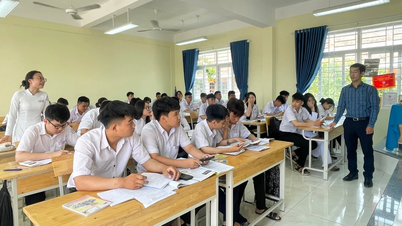
Despite tuition fee waivers, many vocational training programs are still facing difficulties in student recruitment.
PHOTO: NTCC
At Khoi Viet Vocational College (Ho Chi Minh City), Mr. Tran Thanh Duc, the school's principal, said that in recent years, the school's enrollment has faced many difficulties. Short-term training programs (3 months) such as beauty care and traditional medicine still have relatively good enrollment, but enrollment for long-term courses is very challenging. "Recruitment from high school graduates has to wait until university and college admissions are completed; and enrollment for junior high school graduates has to wait until they enroll in public high schools," Mr. Duc added.
The situation at Saigontourist Tourism and Hotel Vocational School (Ho Chi Minh City) is not much different. In 2025, the school's enrollment target was 1,000, but so far it has only reached 50-60%. "This year, the number of 9th-grade students is low, and high school graduates are still applying to universities and colleges, so the school is still in the waiting period," said Ms. Vo Thi My Van, the school's principal.
According to Ms. Van, job opportunities for graduates in the tourism , restaurant, and hotel sectors are vast. However, the number of students remains very low, failing to meet recruitment needs. Regarding the reasons why students are selective about vocational training, Ms. Van shared: "Partly because many colleges and universities are now offering tourism programs, coupled with the family's desire for their children to attend university, as vocational training requires additional time for further education if they wish to pursue higher education."
Viet Giao Vocational College (Ho Chi Minh City) continues to maintain its enrollment target of 500 students. However, according to Ms. Tran Phuong, the school's principal, this year there is a lack of qualified junior high school graduates, and so far the school has only recruited just over 120 students. "It's not just Viet Giao Vocational College; many vocational education institutions that used to enroll 800-900 students annually are now only around 200," Ms. Phuong added.
According to Master Tran Phuong, there are many reasons why student recruitment at vocational schools is becoming increasingly difficult. Since the Covid-19 pandemic, the economy has been struggling; educational policies have undergone many changes; students have more educational options; university entrance requirements are no longer as strict; and colleges are also recruiting students who have graduated from junior high school, thus vocational schools are losing a source of applicants.
EFFORTS TO INCREASE COMPETITIVENESS
Amidst challenging circumstances, many vocational schools are not simply waiting for students but are proactively innovating to increase their competitiveness.
Over the past period, Saigontourist College of Tourism and Hotel Management has collaborated with many joint venture hotels and service groups to provide customized training and guarantee employment for students. According to Ms. Van, instead of general teaching, the school focuses on training for specific job positions. Students studying reception skills specialize in welcoming guests and making reservations; those studying culinary arts learn to prepare over 120 European, Asian, and Vietnamese dishes…
Similarly, Viet Giao Vocational College has been closely collaborating with businesses, providing customized training to ensure that graduates can start working immediately without further training. Regarding the curriculum, the college continuously updates it to meet international standards and anticipate the trends of integration into the ASEAN Economic Community, enabling graduates to freely move between job markets within the region.
In addition to recruiting students for short-term training courses, Khoi Viet Vocational School has expanded its cooperation with continuing education centers in the Mekong Delta to reach students who graduate from junior high school earlier.

Vocational schools have faced many difficulties in student recruitment in recent years.
PHOTO: My Quyen
SYSTEM RESTRUCTURING
Despite proactive reforms, many vocational schools are still struggling to improve their enrollment figures.
According to an analysis by Dr. Hoang Ngoc Vinh, former Director of the Department of Professional Education (Ministry of Education and Training), the causes stem from both the learners themselves and the management and organization of training. In the current context, learners have more choices, with the priority order usually being universities, then colleges, and only then vocational schools, putting schools at a disadvantage right from the start. Many schools have not yet updated their programs to reflect technological trends, the labor market, and new skill needs; the training content is still heavily theoretical, lacks appeal, and is not linked to specific career experiences, reducing the motivation to enroll. Not to mention that quite a few private vocational schools rent off-campus facilities for teaching.
Furthermore, the vocational training system currently has many models such as 9+1, 9+2, 9+3, and 12+2. This diversity lacks a unified direction, leading to confusion regarding study time, learning outcomes, difficulties in international integration, and the standardization of labor skills. With the 12+2 system (graduating from high school to continue vocational training for two years), the study duration is equivalent to a college-level program in many countries, blurring the lines between the two levels of education and making it difficult to classify skill levels. Notably, colleges are also allowed to recruit students who have graduated from junior high school, eliminating a traditional recruitment source that traditionally belonged to vocational training.
In some major localities like Ho Chi Minh City, colleges and vocational schools still offer overlapping training programs, leading to a dispersion of resources, a lack of practical training opportunities in businesses or hospitals, reduced training effectiveness, and difficulty in creating a unique brand for each institution. Even with curriculum and training method reforms, if the school's organizational and management model remains unchanged, without adjusting towards flexibility, collaboration, and resource optimization, then the "bottlenecks" to development will persist.

The demand for personnel in the tourism, restaurant, and hotel industries is very high, but there are few students pursuing these degrees.
Photo: Yen Thi
To overcome difficulties and enhance the competitiveness of vocational secondary education, Dr. Hoang Ngoc Vinh suggests reforming "vocational high schools." With a 12+2 system, students should pursue higher education at the college level, similar to most countries worldwide, shortening the learning path and increasing the value of their diplomas. Vocational secondary schools that do not yet meet the requirements for upgrading to college level should focus on training according to the vocational high school model – integrating core high school cultural knowledge with vocational skills. The diplomas (qualifications) should have equal legal value in terms of opportunities for further education, employment, and career development, thus making the schools more attractive and serving the goal of career guidance after lower secondary education.
"At the local level, public vocational schools should be merged into colleges to provide college-level or vocational high school training. This merger would not only address the shortage of student enrollment, but more importantly, ensure rationality in training stratification, optimize investment efficiency, and facilitate articulation," Dr. Vinh proposed.
Forming a "college alliance" model
According to Dr. Hoang Ngoc Vinh, in Ho Chi Minh City alone, it is possible to form a "college alliance" to create synergy, avoiding duplication of training programs while leveraging the strengths of each school, increasing autonomy, attracting investment, and expanding cooperation with businesses.
According to Dr. Vinh, Ho Chi Minh City could consider the Institute of Technical Education (ITE) model, which is suitable for streamlining the administrative apparatus and decentralizing management. In reality, the Department of Education and Training will face significant challenges and will not be able to manage effectively if it maintains the current model of managing vocational education institutions in a fragmented and less autonomous manner, while having to meet the diverse and stringent quality demands of the market.
"Regardless of the approach, the quality of training must remain the decisive factor. When the content, methods, and learning experiences are engaging and closely linked to career opportunities, students will proactively choose it, rather than being persuaded by low tuition fees or short-term support policies," Dr. Vinh affirmed.
According to this expert, the vocational high school model that most countries are operating has proven effective in training middle-level workforce during the period of industrialization and modernization, with South Korea being a prime example.
Source: https://thanhnien.vn/chat-vat-tuyen-sinh-trung-cap-185250810214412837.htm
![[Photo] Delegation attending the 14th Congress of the Vietnam Trade Union visits the Mausoleum of President Ho Chi Minh.](https://vphoto.vietnam.vn/thumb/1200x675/vietnam/resource/IMAGE/2026/06/03/1780451842301_ndo_br_img-3824-jpg.webp)











![Transforming from Resolution 57: [Part 2] Businesses Lead the Way](https://vphoto.vietnam.vn/thumb/402x226/vietnam/resource/IMAGE/2026/06/02/1780399668663_5332-dsc09931-2-235637_295-235639.jpeg)
















































































Comment (0)