

Operating a generator unit when the reservoir water level drops below the dead water level puts both staff and management at the Thac Ba Hydropower Plant under constant stress, fearing accidents might occur.
At midnight on June 9th, the alarm clock rang, and Mr. Phung Dinh Hai, head of the hydraulic engineering team at Thac Ba Hydropower Plant (Yen Binh district, Yen Bai province), jumped out of bed. Wearing his power company uniform, he grabbed his specialized measuring device and rode his motorbike to the dam to measure the water level. This is a task he performs three times a day since the water level dropped below the location of the automatic measuring device.
Throughout the more than one kilometer walk from his house to the dam, Mr. Hai kept asking himself: Is there a lot of water today? Is the reservoir's water level high enough to resume power generation? Upon reaching the power plant, he walked quickly to the dam, lowered the water level gauge to the surface, shone his flashlight on the display, and shook his head as the water level remained almost unchanged compared to eight hours earlier.
"In over 10 years working here, I've never seen the water level in Thac Ba hydroelectric reservoir drop so low and take so long to rise again," Mr. Hai said while taking notes to report to the duty officer's office.
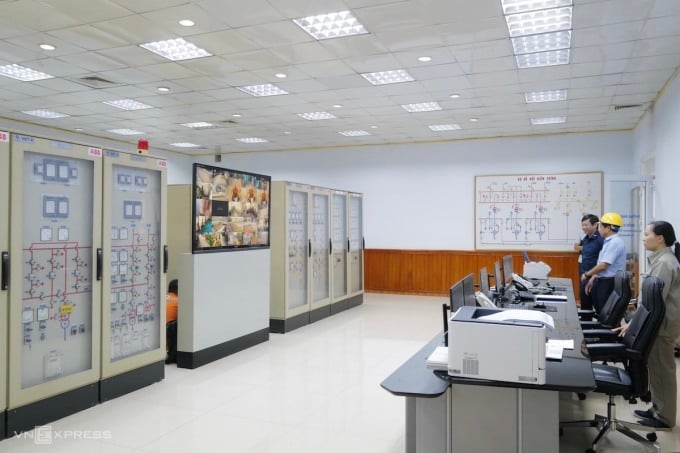
Thac Ba Hydropower Plant Control Room. Photo: Ngoc Thanh
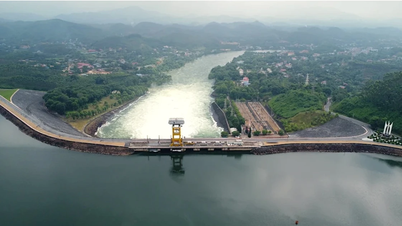
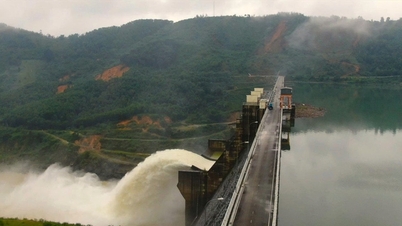
On June 1st, the water level in the reservoir dropped to 45.57 meters, below the dead water level (the minimum water level for operating the turbines is 46 meters). The distance from the water surface to the normal water level was nearly 13 meters. For the first time in 52 years of operation, the 120 MW Thac Ba hydropower plant had to shut down two turbines. The remaining turbine, which is in the best condition, ran at a reduced capacity, creating just enough flow downstream to ensure water quality.
Right below the dam is the control room with five staff members on duty. Constantly glued to the display screen showing the parameters, Mr. Nguyen Manh Cuong, Deputy General Director of Thac Ba Hydropower Joint Stock Company, worriedly stated that operating the turbines in their current state could lead to malfunctions at any time. Each indicator exceeding the limit requires immediate response measures.
Leaving the control room, Mr. Cuong went down to the turbine observation room. The closer he got, the louder the noise became. Listening carefully to the vibrations, with years of experience, he could assess the level of impact and issue a shutdown order when necessary. In 2016, when the water level was low, the blades of all three turbines cracked, and repairs were time-consuming and costly.
With two generating units shut down, the duty crew still has to check daily to ensure the machinery is ready to resume operation when the water returns. Normally, in June each year, Thac Ba hydropower plant produces about 20 million kWh, but in the first 10 days of June this year, it only produced 2 million kWh. If the water does not return to the reservoir, the plant's production plan cannot be completed.
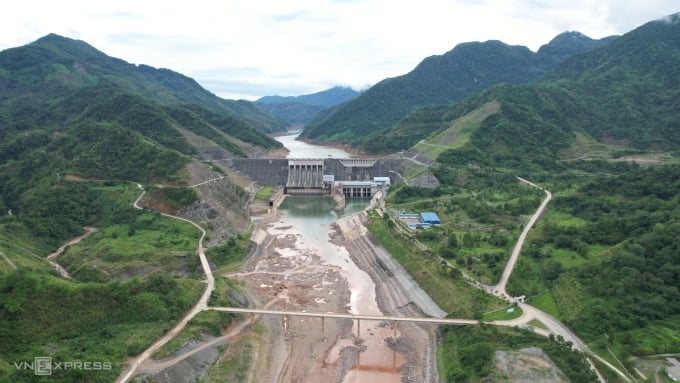
The Lai Chau hydropower plant ceased operations on June 9th. Photo: Ngoc Thanh
The situation at the Lai Chau hydropower plant, with a capacity of 1,200 MW, is even more serious. Since June 2nd, the reservoir has fallen below the dead water level, forcing the shutdown of six turbines. The Lai Chau hydropower plant is located upstream of the Da River, with two other cascade hydropower plants downstream: Son La (2,400 MW) and Hoa Binh (1,920 MW). The inability of river water to flow downstream has forced the Son La hydropower plant to cease operations. The Hoa Binh hydropower plant will only be able to operate for about another week.
Mr. Luu Khanh Toan, Deputy Director of Son La Hydropower (in charge of Lai Chau Hydropower), said that both Lai Chau and Son La reservoirs have fallen below the dead water level for the first time. Before ceasing operations, the turbines were only operating at 50-60% capacity.
Located more than 500 km from Thac Ba, Lai Chau, the Ban Ve hydropower plant, with a capacity of 320 MW – the largest among Nghe An 's 40 hydropower plants – is also experiencing water shortages. On June 7th, the water level at Ban Ve was 157 m, 20 m lower than the same period last year and only 2 m above the dead water level. The current water inflow into the reservoir is only one-third of what it was at this time last year.
Mr. Ta Huu Hung, Director of Ban Ve Hydropower Company, said that a few years ago, the water level in the reservoir approached the dead water level of 155 meters. However, that situation occurred at the end of July when the rainy season began, and heavy rains subsequently replenished the reservoir. Now, at the beginning of June, the water level has dropped to 157 meters, which is the first time this has happened. In the next few days, if there is no heavy rain, the reservoir will return to the dead water level.
"Everyone involved in hydropower projects hopes for ample water to ensure electricity supply and irrigation for downstream areas. In the near future, if the reservoir reaches its dead water level, there's a risk of insufficient electricity supply to the grid and water shortages for downstream areas. With the summer-autumn planting season just beginning, a lack of irrigation water will negatively impact the crop and reduce yields. We are very worried," Mr. Hung said.
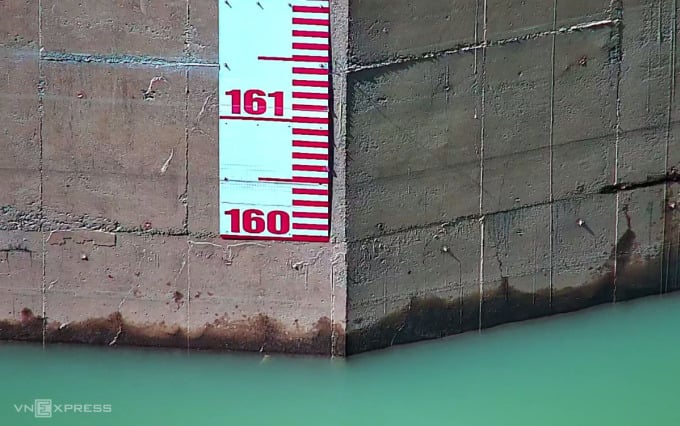
Water level at Ban Ve hydroelectric plant on June 7th. Photo: Duc Hung
Located upstream of the Thu Bon River in Bac Tra My district, Quang Nam province, the Song Tranh 2 hydropower plant, with a capacity of 190 MW, has not yet reached a state of complete depletion. However, due to prolonged heatwaves, the water level in the reservoir has dropped to only 260 million cubic meters, equivalent to 49% of its designed capacity.
As the largest hydroelectric reservoir in Quang Nam province, Song Tranh 2 releases approximately 70-80 m3/s of water downstream daily, three times higher than the inflow into the reservoir. "Even without rain, and with low inflow, the company still maintains water regulation downstream to prioritize drought relief," explained Mr. Tran Nam Trung, Director of Song Tranh Hydroelectric Company.
Forecasts indicate that from June to August, Song Tranh 2 reservoir will face difficulties in supplying water for domestic use and agricultural production in the downstream area, and there is a risk that it will not be able to accumulate enough water to reach its normal level by the end of this year to serve the dry season of 2024.
"The company is coordinating with Quang Nam province to optimize water resource management, working with the National Power System Dispatch Center to operate the generating units during peak hours to meet the increased load demand, contributing to ensuring national energy security," Mr. Trung added.
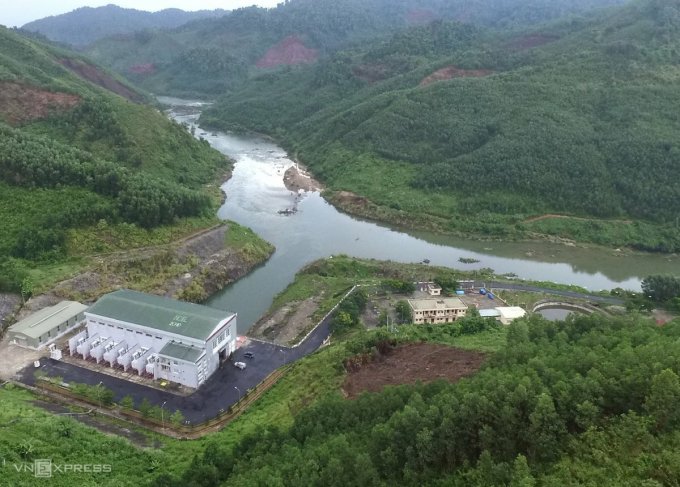
Song Tranh 2 hydroelectric plant in early June. Photo: Dac Thanh
According to the Department of Industrial Safety and Environmental Engineering (Ministry of Industry and Trade), nine hydropower reservoirs have fallen below their dead water levels. The generating units at 11 power plants, including Son La, Lai Chau, Huoi Quang, Thac Ba, Tuyen Quang, Ban Ve, Hua Na, Trung Son, Tri An, Dai Ninh, and Pleikrong, have had to cease operation. The water inflow into the reservoirs is primarily for regulation, ensuring minimum flow. Therefore, the North is currently facing a shortage of approximately 5,000 MW, forcing rolling and unannounced power cuts from the end of May until now.
Meanwhile, according to the National Center for Meteorological and Hydrological Forecasting, the North will experience heavy rain for the next few days, but water levels in rivers and hydroelectric reservoirs will remain lower than the multi-year average. Looking further ahead, for the next two months, due to the influence of El Nino, hot weather will continue for more days than the multi-year average in the North and Central regions. Rainfall in the North is expected to be deficient by 5-20%.
Reporters
Source link




![[Photo] General Secretary and President To Lam presides over a meeting on assessing national development resources.](https://vphoto.vietnam.vn/thumb/1200x675/vietnam/resource/IMAGE/2026/05/20/1779253785852_a1-bnd-2943-8519-jpg.webp)
![[Photo] National Assembly Chairman Tran Thanh Man working with the Standing Committee of the Economic and Financial Committee](https://vphoto.vietnam.vn/thumb/1200x675/vietnam/resource/IMAGE/2026/05/20/1779249584387_ndo_br_1-jpg.webp)






























































































Comment (0)