

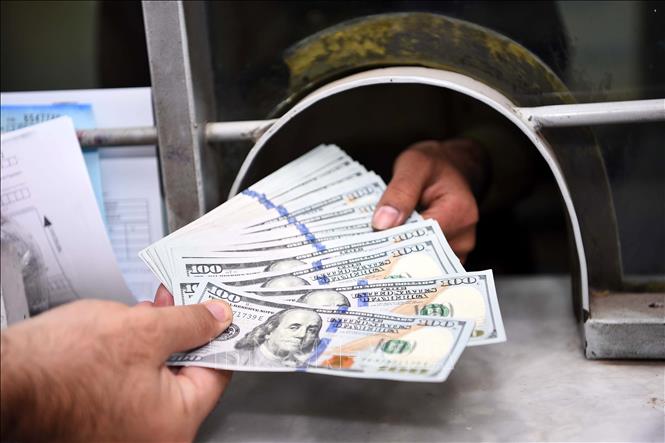
Specifically, the US dollar index remained virtually unchanged at 98.852 during the morning session on April 30, after rising 0.3% in the previous session, hovering near its highest level since April 13.
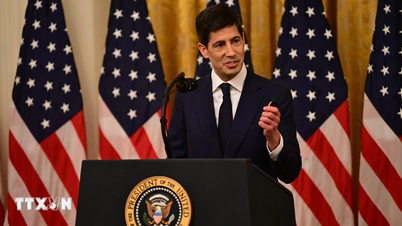
Federal Reserve Chairman Jerome Powell concluded the final policy meeting of his eight-year term with a decision to keep interest rates unchanged, amid concerns about rising inflation. The decision was passed by an 8-4 vote, the largest split since 1992, with three officials opposing it and arguing that the Fed should not continue signaling a tendency toward easing policy.
The shift to a hawkish stance has driven US bond yields sharply higher. The yield on 2-year Treasury bonds – which typically reflects interest rate expectations – rose to 3.928%, while the yield on 10-year bonds reached 4.421%, both the highest levels since March 27.
Traders have now completely ruled out the possibility of the Fed cutting interest rates this year. The market is even betting on a 55% chance that the Fed will raise interest rates in April 2027, a sharp increase from the approximately 20% predicted before the latest policy decision.
Rodrigo Catril, a currency strategist at National Australia Bank, noted that the shift in tone and internal disagreements within the Fed are noteworthy. He noted that some policymakers are beginning to worry about the inflationary impact of the Iran conflict on the economy , which directly affects the dovish stance the Fed technically maintains. He also pointed out that rising oil prices are adding to market anxiety, thereby supporting the US dollar through risk aversion and higher US bond yields.
The euro stood at $1.1689/euro, while the British pound traded at $1.34877/pound, both rising by around 0.1% in Asian trading on the morning of April 30.
The Bank of England and the European Central Bank are expected to hold policy meetings today, with market expectations leaning toward the possibility that both banks may soon have to raise interest rates.
Meanwhile, diplomatic efforts to resolve the conflict between the US and Iran remain stalled, keeping markets tense. US President Donald Trump is discussing with oil companies how to mitigate the impact if the US blockades Iranian ports for months.
The Australian dollar (AUD) traded at 0.71285 USD/USD, while the New Zealand dollar (NZD) was at 0.58394 USD, both up around 0.2%.
Notably, in this session, the Japanese yen fell 0.1% to 160.16 yen/USD, approaching levels that previously triggered government intervention, despite the Bank of Japan (BoJ) signaling after its policy meeting on April 28 that it may raise interest rates in the coming months. The yen has lost more than 2% of its value since the Middle East conflict erupted on February 28. Investors are also holding their largest short positions in the yen in nearly two years, expecting that neither interest rate hikes nor the risk of intervention are likely to help the currency recover.
Analysts at IG believe that, although the exchange rate is approaching a level where intervention is possible, the Japanese Ministry of Finance will be cautious, avoiding premature action given the country's vulnerability due to its heavy reliance on energy imports, as well as the ongoing stalemate in the Middle East.
Source: https://baotintuc.vn/thi-truong-tien-te/chi-so-dong-usd-neo-o-muc-cao-nhat-hai-tuan-20260430110709859.htm

![[Image] Close-up view of the interchange connecting the two expressways and Long Thanh Airport.](https://vphoto.vietnam.vn/thumb/1200x675/vietnam/resource/IMAGE/2026/05/25/1779703378210_ndo_br_z7863716673926-224453a31600126cce10622af6290afd-4549-jpg.webp)

![[Image] Hanoi's urban life under the challenge of a "scorching hot" environment](https://vphoto.vietnam.vn/thumb/1200x675/vietnam/resource/IMAGE/2026/05/25/1779706979265_nang-nong-t5-2026-minh-duy-7-4636-jpg.webp)


























































































Comment (0)