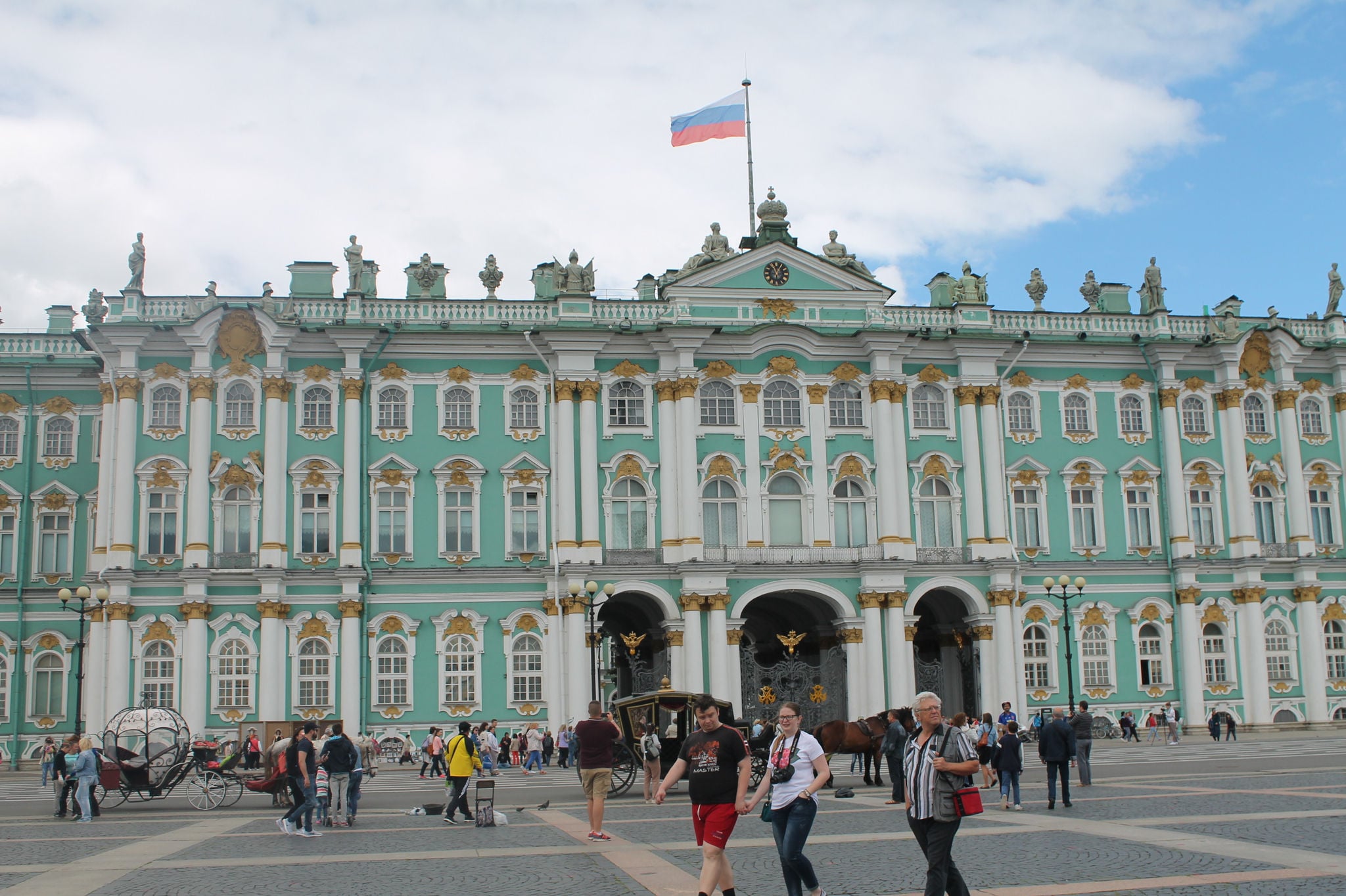
The Winter Palace - viewed from the entrance hall.
A feast for the eyes: a masterpiece.
I strolled leisurely across the marble pavement of Palace Square, admiring an exceptionally luxurious space that houses the pinnacle of artistic creation by giants. Each passing moment evoked memories of Russia and humanity from the distant past. My senses were captivated, and my soul trembled with strange emotions as I stood before these architectural masterpieces and immortal works of art created by great minds. This treasure trove has been preserved for thousands of years in the creative history of humankind.
In 1764, Empress Katherine II of Russia, also known as Catherine the Great, purchased a large collection of paintings and sculptures from a European collector with a huge sum of money. Initially, she kept her favorite works in a private royal space called "Ermitazh," meaning "retreat," located in the Winter Palace in Saint Petersburg. As the Empress's collection grew larger and richer over time, the Hermitage Museum was officially established and opened to the Russian public at the beginning of the 19th century. Initially, the only building housing the Empress's collection was the Hermitage Small. Later, the Hermitage Museum gradually expanded to include several buildings along the Palace embankment and surrounding areas. In addition to Hermitage Small, the museum also includes Hermitage Large, Hermitage New, the Hermitage Theatre, and the Winter Palace, the former main residence of the Russian Tsars. In recent years, the Hermitazh Museum has also expanded to the General Staff building on Palace Square, opposite the Winter Palace and the Menshikov Palace.
In the center of the courtyard, opposite the main gate, stands the 47.4-meter-high Alexander Column, erected in 1834 to honor Emperor Alexander I and the Russian army that defeated Napoleon Bonaparte in the Patriotic War of 1812. The Hermitage Museum as a whole is a magnificent architectural icon, combining Baroque, Rococo, and Neoclassical styles across a total area of 233,345 m² . The main building of the museum is the Winter Palace with over 1,000 rooms, including 400 exhibition rooms. In addition, visitors can admire architectural masterpieces such as the Jordan Staircase, Peter's Hall, Pavilion Hall, The Raphael Loggias, the Nicholas II Library, and the Army Gallery…

Museum visitors
Admire priceless artifacts.
Pham Trung, a Vietnamese postgraduate student in Saint Petersburg, was our guide on a tour of the Hermitazh Museum. To illustrate the museum's immense scale, Trung shared an interesting statistic: Hermitazh houses approximately 3 million artifacts; if visitors spent one minute in front of each artifact for eight hours a day, it would take them 11 years to see them all, and the total distance traveled would be about 24 kilometers.
It is impossible for anyone to attempt to describe every single topic, author, work, and artifact at the Hermezh Museum. The exhibition space is too vast, and the collection is enormous, encompassing diverse schools, styles, and eras throughout humanity's artistic history. Here, we have been able to admire priceless artifacts from ancient civilizations. We were astonished when standing before a limestone stela by a potter from the 18th century BC; a statue of the god Urartu from the ancient Near Eastern civilization of the 7th-5th centuries BC; the Pazyryk horseman style of animal art from the 3rd century BC; or a Buddha statue from the Indian civilization of the 2nd century AD. At Hermezh, visitors can also immerse themselves in the masterpieces of great painters from various periods: the Renaissance with Leonardo da Vinci and Tiziano Vecelli; the Style with El Greco; the Baroque with Caravaggo and Diego Velázquez; Classical school with Nicolas Poussin…
At the Hermitage Museum, the Tsarist dynasties also collected masterpieces by great painters and sculptors of their time. We had the opportunity to admire the works of major names in world art. No one could resist opening their senses to receive the aesthetic pleasure from the magnificent paintings and sculptures of Thomas Gainsborough, Jean Honoré Fragonnard, Francisco Goya, Claude Monet, Pablo Picasso, Henri Matisse, or Wassily Kandinsky…
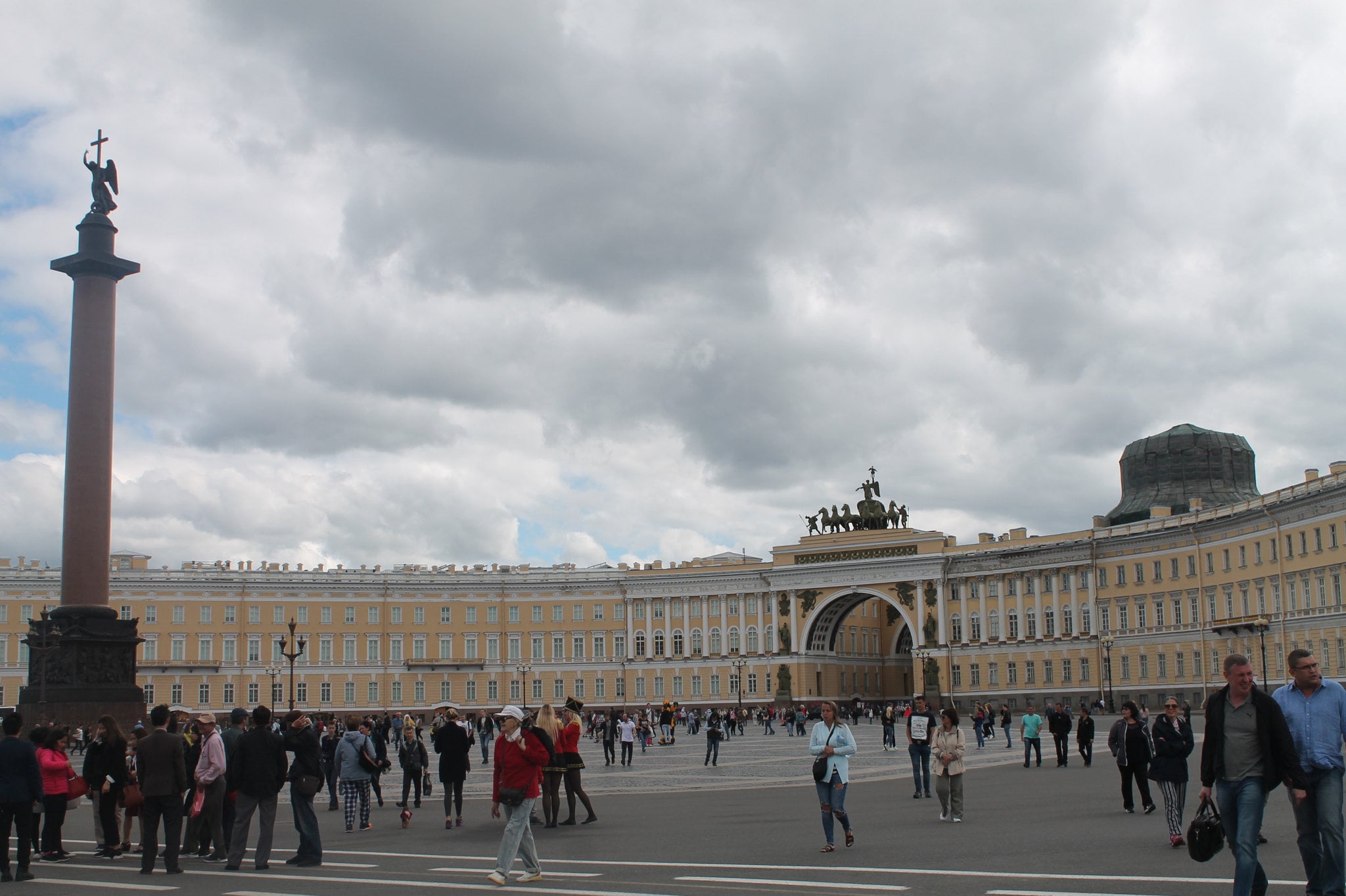
Palace Square in front of the Hermitage Museum
The Russian Empire has always paid tribute to the great Tsars of its dynasty. In Peter Hall, the museum dedicates a space to commemorate Peter the Great, the founder of St. Petersburg. The hall is lavishly decorated with solid gold ornaments and exquisite craftsmanship. Giant murals depict his military victories, revolutionary reforms, and collections of armor and weapons that bear the marks of history, offering insight into the reign of Peter the Great. Next is the Army Gallery, which houses a collection of portraits of famous Russian generals; a reminder of the military might and glorious history of the Russian Empire…
As I strolled through the Hermitage Museum, a question echoed in my mind: What was Empress Katherine II of Russia thinking centuries ago when she made the brilliant decision to establish this magnificent museum to preserve the finest examples and intellectual achievements of world art? Perhaps she did this to satisfy her absolute power and boundless passion for art. She also did it to affirm the prosperity and cultural prestige of her reign. Whatever her motivation, the Empress initiated the preservation of invaluable assets for Russia, thus creating opportunities for art lovers worldwide to visit this extraordinary museum. For Vietnamese people like myself, experiencing the Hermitage evokes admiration for her grand vision and a deep gratitude to Catherine the Great. Because, within the overall historical and cultural landscape of the ancient and fascinating city of Saint Petersburg, which is as captivating as millions of pages of history that cannot be turned to reveal them all, Hermitage stands out as an extremely impressive and incredibly fascinating page…
Not only is it the second largest art museum in the world, after the Louvre in France, the Hermitage is also a symbol of the power, aesthetics, and intellect of the Russian emperors, beginning with Empress Katherine II of Russia, also known as Catherine the Great.
Source: https://baolamdong.vn/chiem-nguong-bao-tang-ermitazh-442140.html



















































































Comment (0)