
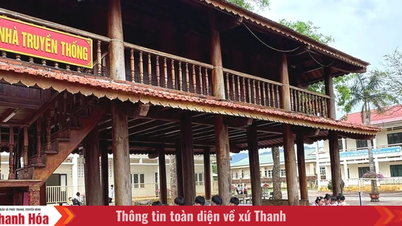
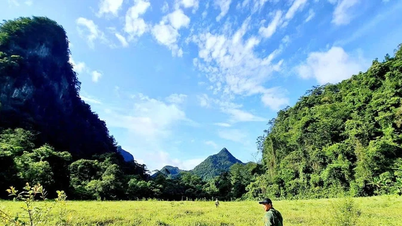
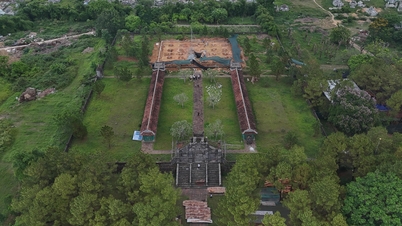
The Tran Nhat Duat temple is located right at the foot of Van Trinh mountain, in Quang Ngoc commune.
The talented general
Historical records state that when Tran Nhat Duat was born, four characters, "Chieu Van Dong Tu," were inscribed on his arm. At the age of 12, he was granted the title of Chieu Van Vuong by King Tran - one of the youngest royal titles of the Tran dynasty. No historian speaks of Tran Nhat Duat without showering him with praise. In particular, during the second (1285) and third (1288) resistance wars against the Yuan-Mongol invaders, Tran Nhat Duat was truly an outstanding general.
History has repeatedly mentioned his commanding role in the Battle of Ham Tu Gate in 1285. At that time, Ham Tu included all the ships, generals, and forces sent by Thoat Hoan, led by Marshal Toa Do, the fierce general O Ma Nhi, and dozens of seasoned generals. Ordered to set out with over 10,000 troops, Tran Nhat Duat's army had grown to over 50,000 men with nearly four hundred warships of various sizes upon reaching Ham Tu. King Chieu Van, deeply moved, pointed to the river and swore: "I will utterly defeat the enemy at this stretch of river. I swear to fight the enemy to the death here. Remember this!" The shouts of "Kill the Mongols!" echoed across the river, and the morale of our army was unstoppable. According to the Complete Annals of Dai Viet: "In defeating the Yuan invaders, Nhat Duat achieved more than anyone else." Ham Tu had immense significance for the overall victory of the second resistance war. And together with other forces, they shattered the southern defenses of Thang Long, paving the way to liberate the capital city.
During the third resistance war against the Mongol invaders (1288), the renowned general Tran Nhat Duat also continuously achieved many outstanding victories, making a great contribution to the complete victory of our nation. He had the honor of sharing the responsibility with the National Commander-in-Chief Hung Dao King Tran Quoc Tuan to wipe out the Mongol invaders and maintain the independence of the Fatherland.
Tran Nhat Duat was a great military strategist. In battles, he skillfully employed tactics of influencing the enemy's morale. At the same time, he consistently pursued a policy of friendship among nations, without discrimination against ethnic minorities; he formed alliances with oppressed peoples with the goal of fighting a common enemy.
"As a noble prince who served under four dynasties and held command of three major garrison districts..." (Complete Chronicle of Dai Viet), with over 50 years as a general, Prince Chieu Van Tran Nhat Duat is a shining example of talent in governing the country and fighting invaders.
The "founder" of traditional Vietnamese folk singing.
Besides his military talent, Tran Nhat Duat was also very proficient in the languages, customs, and traditions of neighboring countries and ethnic minorities within Vietnam. Historical records recount that he often rode an elephant to Ba Gia village ( Hanoi ) – a settlement of the Cham people – to learn about their language and culture, and then visited Tuong Phu pagoda to converse with Song Dynasty monks. He was so fluent in Chinese that Chinese envoys insisted he was from Zhen Ding (a culturally significant region of China, near Beijing), even though he clearly stated he was Vietnamese.
He was particularly passionate about music , composing many songs, lyrics, and dances. "At his residence, there wasn't a single day without a singing performance or games, yet no one thought he was so engrossed in pleasure that he forgot his work" (Hanoi of a Thousand Years, Tran Quoc Vuong - Vu Tuan San, 1975).
During the second war against the Mongol invaders, Quang Hop commune, Quang Xuong district (now Quang Ngoc commune, Thanh Hoa province) held a crucial position, serving as a strategic base to receive King Tran's retreating troops into Thanh Hoa to prepare for a counterattack. Its mission was to defend the Yen and Ly rivers, especially the main headquarters – Ngoc Son mountain. From here, with a strong army and capable generals, Tran Nhat Duat and King Tran advanced northward by both land and sea routes, launching a general offensive to drive the Mongol invaders out of the country.
After the second victory against the Mongol invaders, King Tran rewarded the nobles and generals. Prince Chieu Van Tran Nhat Duat was appointed Governor of Thanh Hoa, and the Van Trinh region became his personal fiefdom. It was also here that he gave birth to the Van Trinh folk singing style (singing and acting simultaneously) - one of the first styles of Ca Tru singing.
The unique feature of Văn Trinh folk singing, besides its established patterns, is the richness of the melodies and songs that the people have created and enriched throughout their transmission. Perhaps this is why, according to legend, poets and scholars traveling the North-South highway, when stopping in the Văn Trinh region, were captivated and enchanted by the melodious sounds of the zither and the smooth singing of the female singers, leaving them forever mesmerized and longing for more.
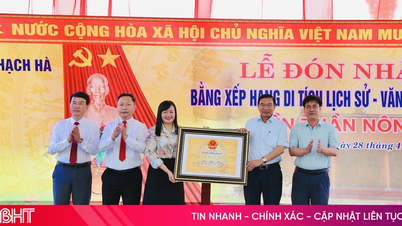
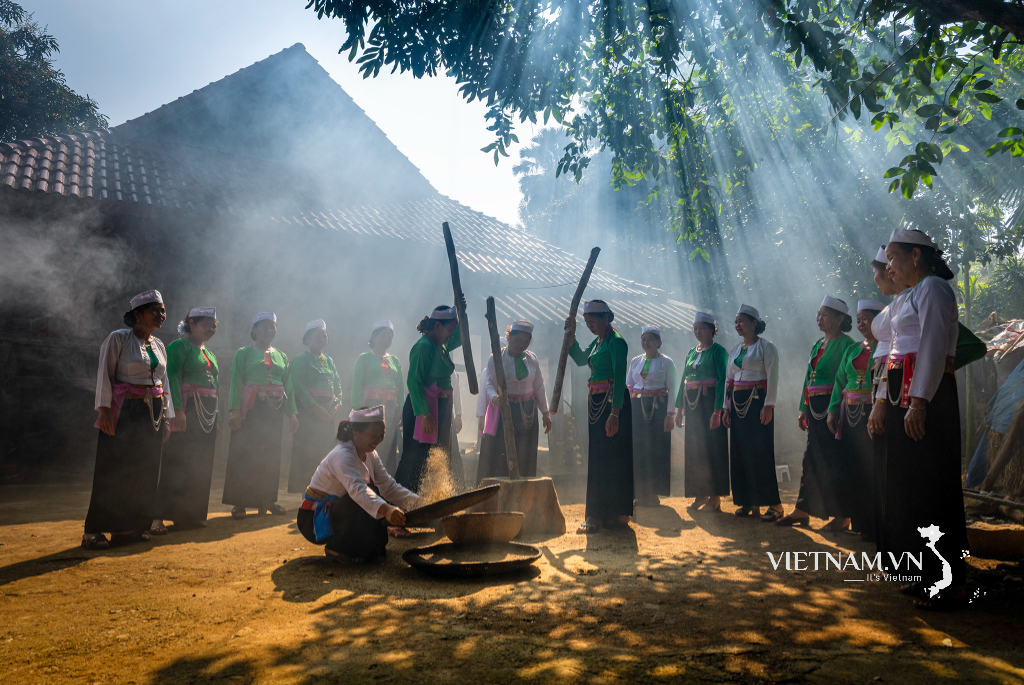
Visiting the Tran Nhat Duat temple in Quang Ngoc commune, we were introduced by the temple caretaker, Le Van Hue, to the fact that the temple was recognized as a provincial-level historical and cultural relic in 2004, and 20 years later, the Van Trinh folk singing was recognized as a national intangible cultural heritage. At the Van Trinh Mountain festival and the temple of King Tran Nhat Duat (held on the 8th day of the 8th lunar month every year), alongside the traditional rituals, folk singing is an indispensable part of the festivities.
Seventy-four years have passed since the Tran Dynasty's second victory over the Yuan-Mongol invaders, yet stories of a multi-talented general like Prince Chieu Van and the traditional folk singer Van Trinh continue to be recounted and preserved by the people.
Text and photos: Chi Anh
Source: https://baothanhhoa.vn/chieu-van-vuong-tran-nhat-duat-and-dat-thanh-256106.htm




![[Video] Sunset at Lap An Lagoon – Where the sun sets over the fishing nets](https://vphoto.vietnam.vn/thumb/1200x675/vietnam/resource/IMAGE/2026/05/31/1780192137701_beach-landscape-sea-water-nature-grass-745871-pxhere-com.jpeg)













![[Video] Sunset at Lap An Lagoon – Where the sun sets over the fishing nets](https://vphoto.vietnam.vn/thumb/800x450/vietnam/resource/IMAGE/2026/05/31/1780192137701_beach-landscape-sea-water-nature-grass-745871-pxhere-com.jpeg)



































![[Video] Sunset at Lap An Lagoon – Where the sun sets over the fishing nets](https://vphoto.vietnam.vn/thumb/402x226/vietnam/resource/IMAGE/2026/05/31/1780192137701_beach-landscape-sea-water-nature-grass-745871-pxhere-com.jpeg)
























Comment (0)