

Monkeypox can be transmitted from animals to humans and from person to person through direct contact via: direct contact with skin lesions, bodily fluids (pus or blood from wounds); respiratory droplets; contact with contaminated objects and items (bedding, towels, clothing, etc.); mother-to-child transmission; and sexual intercourse.

Monkeypox is an acute, potentially epidemic infectious disease caused by the monkeypox virus.
Stages and symptoms of monkeypox
1. Incubation period
Monkeypox has an incubation period of 6 to 13 days (ranging from 5 to 21 days). Infected individuals are asymptomatic and non-contagious.
2. The onset phase
This phase lasts from 1 to 5 days, with the main symptoms being fever and generalized peripheral lymphadenopathy. Patients may also experience headache, fatigue, chills, sore throat, and muscle pain. The virus can be transmitted to others during this phase.
3. Full-blown stage
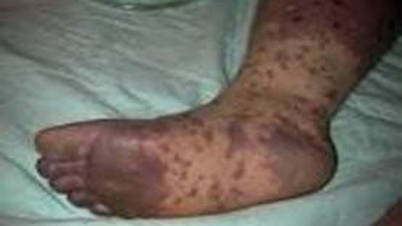
- The typical symptom is a skin rash that usually appears 1 to 3 days after the fever, with the following characteristics:
- Location: The rash tends to be centrifugal, commonly found on the face, palms, and soles of the feet. It can also occur in the mouth, eyes, and genitals.
- Progression of the rash: sequentially from macules (flat lesions) to papules (firm, slightly raised lesions), vesicles (clear fluid), pustules (yellow fluid), and dry, scaly crusts that peel off and may leave scars.
4. Recovery phase
The symptoms will last from 2 to 4 weeks and then resolve on their own.
However, individuals with underlying health conditions, children, or those with weakened immune systems are at risk of complications such as sepsis, encephalitis, bronchopneumonia, corneal infection, and vision loss.
Monkeypox prevention
To proactively prevent monkeypox outbreaks, the following preventive measures are recommended:
1. Cover your mouth and nose when coughing or sneezing to reduce the spread of respiratory secretions. Do not spit indiscriminately in public places.
2. Wash your hands frequently with soap and clean water or hand sanitizer.
3. Individuals experiencing an acute rash of unknown origin accompanied by one or more suspected symptoms should proactively contact a healthcare facility for timely monitoring and advice. They should also self-isolate and avoid sexual contact.
4. Avoid close contact with people infected with monkeypox, and avoid direct contact with wounds, bodily fluids, droplets, and contaminated objects and items. If someone in your home or workplace is infected or suspected of being infected, notify the health authorities for timely advice and treatment; do not attempt self-treatment.
5. Individuals traveling to countries where monkeypox is endemic (Central and West Africa) should avoid contact with mammals (dead or alive) such as rodents, marsupials, and primates that may carry the monkeypox virus. Upon returning to Vietnam, they should proactively report to local health authorities for advice.
6. Ensure food safety; adopt a healthy lifestyle, increase physical activity, and improve health.
FACULTY OF NATURAL SCIENCES, INTERNATIONAL TECHNOLOGY, AND TECHNOLOGY
Source: https://soyte.cantho.gov.vn/tin-tuc-su-kien/chu-dong-phong-benh-dau-mua-khi-334525
![[Image] Hanoi's urban life under the challenge of a "scorching hot" environment](https://vphoto.vietnam.vn/thumb/1200x675/vietnam/resource/IMAGE/2026/05/25/1779706979265_nang-nong-t5-2026-minh-duy-7-4636-jpg.webp)


![[Image] Close-up view of the interchange connecting the two expressways and Long Thanh Airport.](https://vphoto.vietnam.vn/thumb/1200x675/vietnam/resource/IMAGE/2026/05/25/1779703378210_ndo_br_z7863716673926-224453a31600126cce10622af6290afd-4549-jpg.webp)









































































Comment (0)