

 |
| Youth union members and young people participated in the "Green Sunday" campaign to clean up the area around Hue train station. Photo: Minh Nguyen |
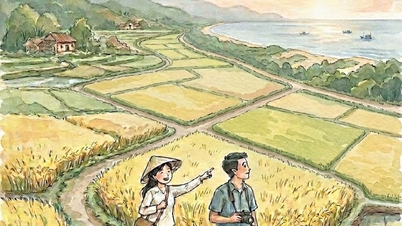
1. Immediately after the liberation of our homeland, we, then ten-year-old students attending the village school, were quickly gathered into the Young Pioneers organization, even though some, like me, were not initially members. Before that, my friends and I in Da Le Thuong village (Thuy Phuong, Huong Thuy) only knew how to go to school, stay indoors, and wander around in our free time. Starting in the summer of 1975, when our homeland was liberated, we were gathered into the organization, where we played together, participated in collective activities, held meetings, marched, and worked, and everyone was joyful and enthusiastic.
There were many activities organized for children, but what I remember most, along with the parades on important holidays chanting revolutionary slogans, was the morning exercise movement. Every day, around 4 a.m., the whole village of Chùa would be filled with the sound of the bell signaling the start of the day. As for me, hearing the bell, I would spring up like a jack-in-the-box and, half-asleep, head to the crossroads near my house to join my friends. The whole group would then gather at the village temple courtyard to begin their morning exercises.
On weekdays, after the exercise session, we dispersed. On weekends, however, there was an additional community service session with the older members of the Youth Union and Association, following the principle of "doing what you can." We kids were usually assigned tasks like sweeping the streets, collecting cow and buffalo dung, clearing bushes, picking leaves for green manure, and other chores. At that age, when we were still too young to understand the world, those early morning community service sessions, cleaning up the village, became a beautiful, joyful memory filled with fond recollections.
2. Young people today can hardly imagine what the suburban villages of Thua Thien Hue looked like in the early days after liberation, with their winding dirt roads, overgrown bushes that weren't regularly cleared, dusty in the summer and muddy in the winter. Moreover, many roads and residential areas were overflowing with all kinds of waste, not only from cattle but also from people. Before that, most people in many rural areas didn't have the habit of building toilets. Therefore, wasteland and roads became places for defecation. Our cleaning work at that time was therefore not easy and carried a profound humanitarian significance.
Reading the history of the Party Committee of Loc Tri commune (Phu Loc district), I learned that one of the revolutionary government's actions immediately after its establishment was to instruct all villages and hamlets to suspend all activities to carry out a general sanitation campaign, from inside their homes to the village roads and alleys. All families had to dig garbage pits. Individuals had to have private bathrooms. The youth, students, and women's liberation groups participated in cleaning public areas and organizing the digging of many public garbage pits. The Cau Hai market area was cleaned and reorganized. Afterwards, it was sprayed with disinfectant to eliminate flies, mosquitoes, and pests. The entire commune launched a campaign to ensure people ate cooked food, drank boiled water, slept under mosquito nets, and actively prevented and controlled dengue fever.
It wasn't just in Thuy Phuong or Loc Tri; the general sanitation of villages had become a widespread movement throughout the province. Years of protracted war had devastated the villages, leaving them desolate and neglected, in need of restoration. Furthermore, ingrained habits and a lack of awareness regarding personal and community hygiene needed to be gradually eradicated through revolutionary movements—simple, familiar, yet profoundly meaningful.
3. Five years have passed since the "Green Sunday - Let's Act to Make Thua Thien Hue Greener, Cleaner, and Brighter" movement, launched by the Provincial People's Committee. It has been implemented synchronously from the provincial level to the grassroots, maintained regularly every week, and has become a regular, well-established activity, spreading widely throughout the community and society, contributing to changing the face of both urban and rural areas. Many movements, models, projects, and tasks have been launched, implemented, and carried out effectively, with practical significance, suitable for localities and units, making an important contribution to protecting and preserving the environment of Thua Thien Hue.
At 60 years old, with all my experiences, I feel a sense of similarity and closeness between today's "Green Sunday" movement and the labor activities organized by the Youth Union and other organizations half a century ago. Hue no longer has dilapidated residential areas, and rural areas have transformed in a modern direction. Houses are spacious and roads are clean and beautiful, no longer showing signs of stagnant water. However, awareness of environmental hygiene, despite significant progress, remains a recurring issue. Therefore, "Green Sundays" are still very much needed to keep Thua Thien Hue green, clean, and beautiful.
Revolution is understood as change. And with today's "Green Sunday," as well as the village sanitation movements launched and implemented half a century ago, I envisioned a revolution that is both continuous and transformative, aiming to change mindsets and habits towards a clean and beautiful community. It began with the milestones of March 26th and April 30th, after the liberation of the South and the reunification of the country, and continues to be preserved and spread.
Source


![[Image] Close-up view of the interchange connecting the two expressways and Long Thanh Airport.](https://vphoto.vietnam.vn/thumb/1200x675/vietnam/resource/IMAGE/2026/05/25/1779703378210_ndo_br_z7863716673926-224453a31600126cce10622af6290afd-4549-jpg.webp)











































































Comment (0)