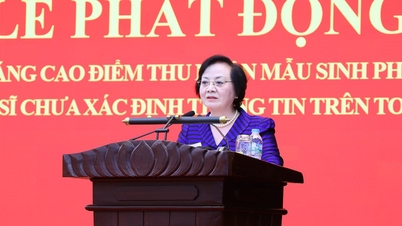
On the morning of April 11th, after listening to National Assembly deputies discuss three draft laws: the Law on Civil Status (amended); the draft Law amending and supplementing a number of articles of the Law on Notarization; and the draft Law amending and supplementing a number of articles of the Law on Legal Aid; the Minister of Justice explained and clarified some contents.
Regarding regulations on the scope of transactions requiring notarization, Minister Hoang Thanh Tung informed that, according to current laws and decrees, in principle, the Notarization Law does not specify which types of transactions must be notarized. Instead, it follows the regulations of specialized laws such as the Land Law, the Real Estate Business Law, the Housing Law, and other laws that stipulate transactions requiring notarization.

According to the draft law's proposed plan, the government suggests reducing the number of transactions requiring notarization from 22 to 16, and narrowing it down to only those stipulated in the law. This approach would streamline administrative procedures and facilitate convenience for citizens.
Currently, the Ministry of Justice is compiling regulations from specialized laws to publicly publish this list on the Ministry of Justice's electronic portal.



Regarding the explanation of the jurisdiction for notarizing real estate transactions by province/city (Article 44), Minister Hoang Thanh Tung affirmed that this regulation is still necessary. In the context of a centralized national notarization database still under construction and not yet fully interconnected, maintaining jurisdictional authority helps notaries verify property and identity more effectively, thereby preventing fraud and deception related to this type of high-value asset.
Furthermore, the draft law introduces a significant reform: narrowing the scope of jurisdiction. District jurisdiction will only apply to direct transactions involving real estate. Indirect transactions, such as power of attorney agreements and the transfer of real estate purchase and sale contracts, will no longer be restricted by administrative boundaries but can be conducted at any notary office nationwide.
Once the national interconnected database system is complete, the government will consider abolishing the regulations on geographical districts entirely.
Regarding comments on deposit transactions, Minister of Justice Hoang Thanh Tung clarified: This is not a type of transaction that is required to be notarized, but only falls under the category that must be notarized depending on the district if the parties so desire.
Regarding off-site notarization, the drafting agency proposed maintaining the current law. According to Minister Hoang Thanh Tung, the current regulations already fully cover specific groups such as the elderly, those receiving inpatient treatment, and those under temporary detention. Maintaining these regulations helps ensure a balance between the rigor of the notarization process and convenience for the public.
Earlier, National Assembly Deputy Pham Van Hoa (Dong Thap) suggested that remote notarization could be implemented to save people's time and effort. Regarding this issue, Minister Hoang Thanh Tung stated that international experience shows that when implementing remote notarization, caution is advised, a step-by-step approach should be taken, and the process should be adapted to the available capabilities and technological advancements.


"We acknowledge this feedback and will report it to the Government for further guidance in the coming period when conditions permit, and we will implement it step by step," Minister Hoang Thanh Tung said.
Source: https://www.sggp.org.vn/chua-bo-cong-chung-truc-tiep-theo-dia-hat-post847529.html


![[Photo] Prime Minister Le Minh Hung presides over the thematic session on promoting science and technology development and innovation.](https://vphoto.vietnam.vn/thumb/1200x675/vietnam/resource/IMAGE/2026/06/23/1782207872934_ndo_br_dsc-1724-jpg.webp)