

- Xiêm Cán Pagoda - a tourist destination rich in Khmer culture.
- Minh Pagoda - A Heritage of the Minh Huong People
- Pothi Thlang Pagoda: A pillar of faith and well-being.
National unity and revolutionary defense
According to documents from the Ca Mau Provincial Museum, Rach Cui Pagoda was built in 1921 on a 4.6-hectare plot of land donated by Mr. Tran Ca Xa, to serve as a religious center for approximately 80 Khmer households, along with Kinh and Hoa residents living in Rach Cui at that time. Rach Cui Pagoda's Khmer name is "Chumpasath," meaning "Tower of Reunion."
The popular name "Rach Cui Pagoda" is associated with the spirit of unity: people of many ethnic groups came together to build and nurture the ideal of national liberation . Initially, the pagoda was built with local trees and leaves. After being destroyed by bombs and bullets several times during the war, the local ethnic communities joined hands to rebuild it. This unity has created the special soul of the pagoda: it is both a place of worship and a common home for the community.
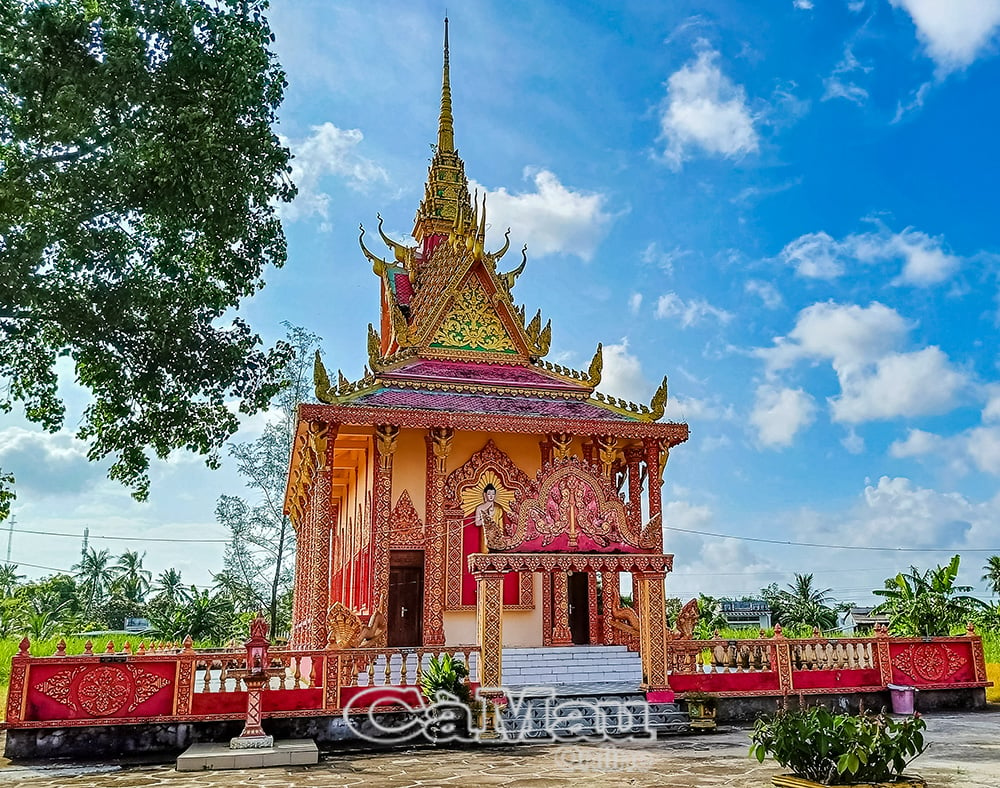 The main temple was built in the traditional architectural style.
For over 100 years, Rach Cui Pagoda has had 13 abbots and senior monks as its head monks. While many Khmer pagodas in Tra Vinh and Soc Trang are known for their magnificent architecture, Rach Cui Pagoda stands out for its role as a revolutionary base during the two wars of resistance against the French and the Americans.
According to historical records, from the 1960s, the pagoda became a key revolutionary activity center of the National Liberation Front of Ca Mau province. In 1965, the Patriotic Monks' Solidarity Association of Ca Mau province was established right at the pagoda. Under the leadership of patriotic monks such as Venerable Thach Xem, Venerable Kim Vol (Chin Tien), and revolutionary cadres, the pagoda served as a place to propagate the Party's and the Front's policies, as well as a place to shelter and protect cadres and organize secret meetings of the local revolutionary movement.
Notably, this is where the remains of Venerable Hữu Nhem, Vice Chairman of the National Liberation Front of South Vietnam, were preserved and a memorial service was held in 1966 – an event that demonstrated the solidarity and courage of the people of Rạch Cui.
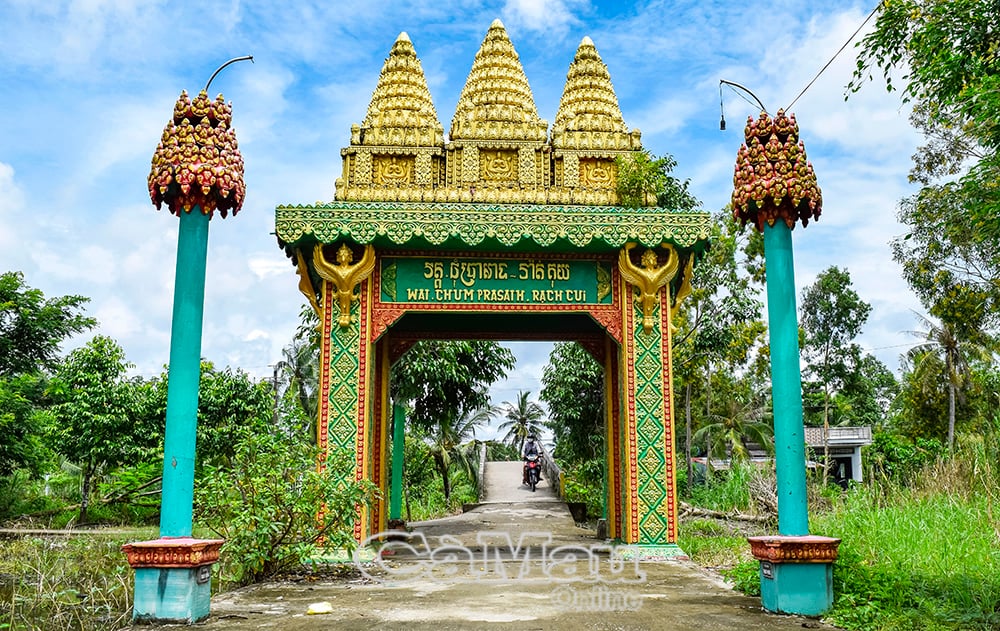 Rach Cui Pagoda sits peacefully amidst the waterways of Ca Mau.
Many researchers of Southern Khmer culture have affirmed: "During the resistance war, Khmer temples were not only religious centers but also places where the strength of national unity converged." Rach Cui Temple is the most typical example of this assertion in Ca Mau.
Architectural space with a strong sense of identity.
The temple was solidly constructed starting in 2004 and the new main hall was completed in 2018. Despite undergoing renovations, the architectural appearance still retains the essence of traditional Khmer architecture: soaring spires, gables decorated with the mythical Naga serpent, Key Nor patterns, and the mythical Krud (Garuda) bird – symbols associated with the Khmer people's belief in protecting Buddhism.
The main hall is laid out in a rectangular shape, with the entrance facing east, reflecting the belief that the Buddha resides in the west and saves humanity from the east. Inside, only one statue of Shakyamuni Buddha is worshipped, but there are 19 statues in various poses: sitting, standing, lying down... a vivid characteristic of the Buddhist statue system in Khmer Theravada temples.
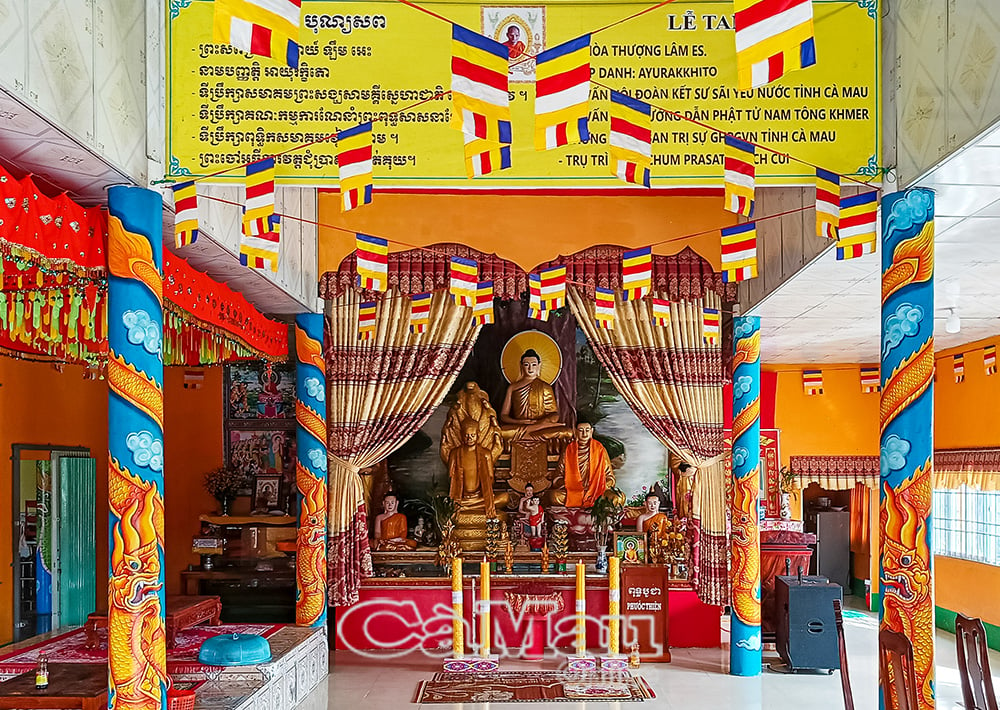 The worship space inside Rach Cui Pagoda.
The walls are adorned with murals depicting the life of the Buddha, familiar stories such as "The Birth," "Enlightenment," "Turning the Wheel of Dharma," and "Nirvana," rendered by local Khmer artisans in vibrant colors, reflecting the depth of Southern Vietnamese folk art. Not far from the main hall is an 8-meter-high stupa containing the ashes of monks, nuns, and Buddhist followers, showcasing the enduring tradition of gratitude and spiritual culture of the Khmer community.
Community cultural and religious activity center
More than just a temple, Rach Cui is also a community cultural institution. Every year, three major traditional Khmer festivals take place here, attracting large numbers of Khmer, Kinh, and Hoa people: Chol Chnam Thmay Tet (April), Sene Dolta (August 29 - September 1 in the lunar calendar), and Ok Om Bok (October 15 in the lunar calendar).
What is particularly noteworthy is that the festivals at Rach Cui Pagoda always attract a large number of Kinh and Chinese people, creating a harmonious cultural exchange atmosphere – a unique characteristic of this southernmost region of Vietnam.
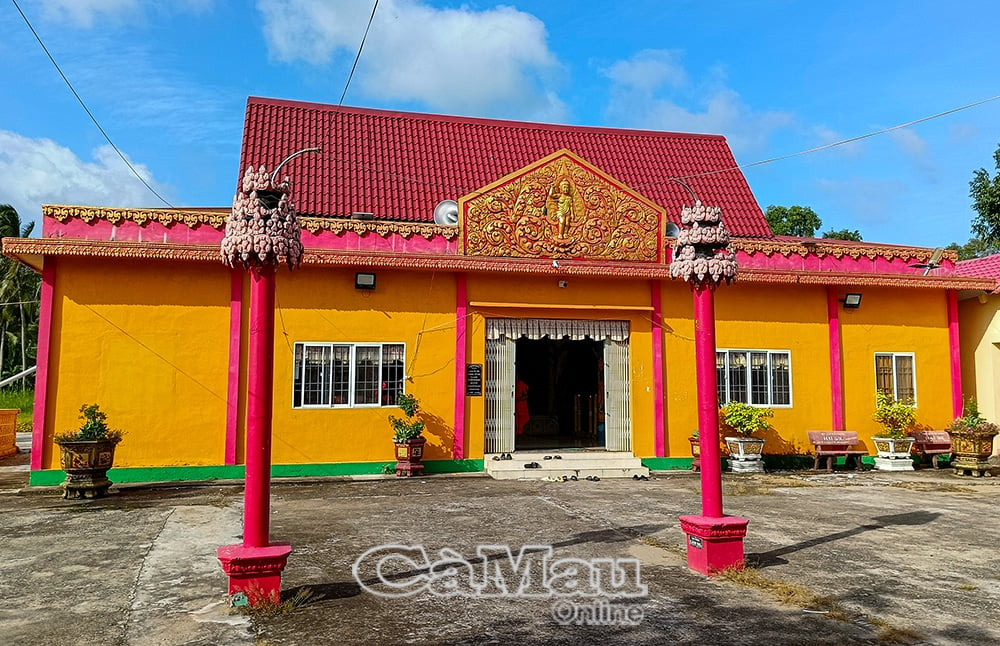 Sala Chhnganh is a place where funeral rituals are performed for the community.
In the context of Ca Mau's efforts to build a cultural environment and strengthen ethnic unity, Rach Cui Pagoda continues to be a "spiritual anchor" for the community, contributing to enriching the cultural landscape of Southern Vietnam. This is a place that marks over a century of preserving Khmer culture, a witness to revolutionary history, and a symbol of the close ties between the three ethnic groups in the southernmost region of the country.
Dang Minh
Source: https://baocamau.vn/chua-rach-cui-bieu-tuong-cua-doan-ket-va-sum-hop-a124773.html


![[Photo] Prime Minister Pham Minh Chinh attends the Conference on the Implementation of Tasks for 2026 of the Industry and Trade Sector](/_next/image?url=https%3A%2F%2Fvphoto.vietnam.vn%2Fthumb%2F1200x675%2Fvietnam%2Fresource%2FIMAGE%2F2025%2F12%2F19%2F1766159500458_ndo_br_shared31-jpg.webp&w=3840&q=75)











































Comment (0)