|
Mr. Pham Nhat Vuong, Chairman of the Board of Directors of Vingroup . Photo: VIC. |
The closure of VinSmart, the transfer of VinMart, and the withdrawal from VinEco previously demonstrated Vingroup's willingness to adjust its investment portfolio to focus on priority areas. Over the past seven months, the conglomerate owned by billionaire Pham Nhat Vuong has continued to make new moves in infrastructure, electric vehicles, and real estate.
Withdrawal of the proposal to build a North-South high-speed railway.
One of the notable decisions was Vingroup's withdrawal of its investment proposal for the North-South high-speed railway project. Previously, the group's expression of interest in participating in the project had attracted significant attention because it was one of the largest infrastructure projects in the country to date.
However, in December 2025, Vingroup submitted a document requesting the withdrawal of its previous investment registration. The company stated that this decision was aimed at focusing resources on other key projects currently underway, such as the Olympic Sports Urban Area project (now the Hanoi International Sports Urban Area) and the Hung Vuong national stadium, the Ben Thanh - Can Gio and Hanoi - Quang Ninh high-speed railway lines, etc.
The withdrawal means Vingroup is no longer pursuing a project that was once considered a major milestone if the private sector had invested in it.
The North-South high-speed railway project has a preliminary total capital of approximately 1.7 million billion VND, equivalent to 67 billion USD. The line is 1,541 km long, starting at Ngoc Hoi station (Hanoi) and ending at Thu Thiem station (Ho Chi Minh City), passing through 20 provinces and cities. This is one of the strategic infrastructure projects expected to create new growth momentum for the economy . Last July, the Government planned to start construction of the North-South high-speed railway in December 2026 and complete the project by 2035.
Restructuring VinFast
Last May, VinFast announced a restructuring plan related to its domestic manufacturing operations.
According to the announced plan, VinFast's domestic manufacturing plants and some related assets will be transferred to another legal entity, while VinFast will focus on technology, product development, branding, and distribution systems.
This is a significant change because manufacturing has been one of VinFast's core pillars since the automaker inaugurated its production complex in Hai Phong in 2019.
Ms. Thai Thi Thanh Hai, Deputy General Director of VinFast, stated that the restructuring is not about VinFast withdrawing from the automotive industry, but rather about changing its operating model. After restructuring, VinFast will outsource production to domestic partners instead of directly operating the factory.
According to company leaders, the new model helps the company reduce financial costs and depreciation pressure, thereby supporting its goal of becoming profitable from 2027 onwards.
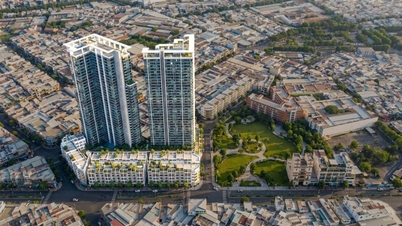
Vinhomes halts land expansion.
Recent news that has drawn attention is the announcement by Mr. Pham Thieu Hoa, Chairman of the Board of Directors of Vinhomes, that the company will completely cease expanding its land bank for projects in Vietnam, following instructions from Vingroup Chairman Pham Nhat Vuong.
According to the company's leadership, Vinhomes will focus on developing existing projects and projects that are in the process of completing investment procedures.
This decision came as a surprise because land accumulation has long been considered a cornerstone of Vinhomes' development strategy. Over the past decade, the company has continuously expanded its presence in many localities, developing a series of large-scale urban developments.
By the end of 2025, Vinhomes will own approximately 29,500 hectares of land. In addition, the company has nearly 20 projects currently undergoing investment procedures with a total area of over 20,000 hectares.
According to company leaders, the existing land bank is sufficient for Vinhomes to develop for the next 5-7 years. Instead of continuing to expand, the company will focus on efficiently exploiting its existing projects.
To date, Vingroup remains the largest private enterprise in Vietnam. Vingroup's core business segments currently include Technology - Industry, Trade and Services, Infrastructure, Green Energy, Culture, and Social Philanthropy.
In 2026, billionaire Pham Nhat Vuong's business aims for revenue of approximately 485,000 billion VND and after-tax profit of 35,000 billion VND.
Source: https://znews.vn/chuyen-dong-lon-o-vingroup-post1660751.html


![[Photo] General Secretary and President To Lam receives Palestinian Ambassador Saadi Salama](https://vphoto.vietnam.vn/thumb/1200x675/vietnam/resource/IMAGE/2026/06/25/1782365384740_a1-bnd-9423-8322-jpg.webp)

![[Image] Ho Chi Minh City: Ma Lang area, Chicken-Rice Market about to change its appearance](https://vphoto.vietnam.vn/thumb/1200x675/vietnam/resource/IMAGE/2026/06/25/1782377698627_ndo_br_m1-jpg.webp)


![[Image] Schools organize meetings and introduce teaching models to students admitted to grade 10.](https://vphoto.vietnam.vn/thumb/1200x675/vietnam/resource/IMAGE/2026/06/25/1782368077271_ndo_br_z7970052192242-1ec8daeb77a6eed1a4e9f58c564ddd3e-jpg.webp)