

Researchers estimate that there are nearly 44 million cubic kilometers of water in the Earth's crust, more than the water in ice caps and glaciers on the surface.
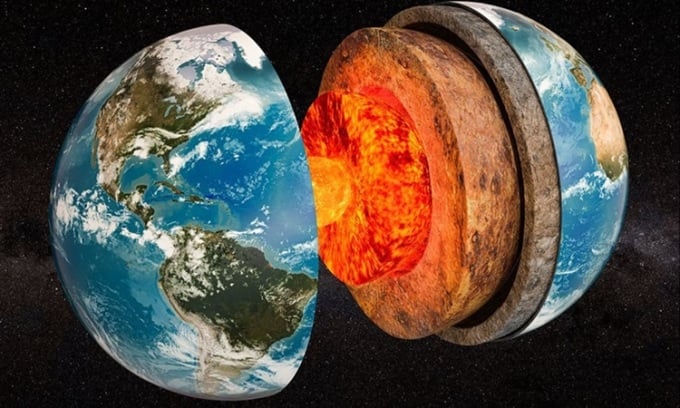
A simulation of the Earth's layers. Photo: AlexLMX
A 2021 study in the journal Geophysical Research Letters found that the amount of water stored beneath the Earth's surface in soil or pores in rocks, called groundwater, is greater than in ice caps and glaciers. "There are approximately 43.9 million cubic kilometers of water in the Earth's crust," said Grant Ferguson, a hydrogeologist at the University of Saskatchewan and lead author of the 2021 study. For comparison, ice in Antarctica contains about 27 million cubic kilometers of water, in Greenland 3 million cubic kilometers, and in glaciers outside of Antarctica and Greenland 158,000 cubic kilometers, according to Live Science .
The Earth's oceans remain the largest water reservoir, containing 1.3 billion cubic kilometers, according to research. Beyond the oceans, groundwater is the largest global water reserve. A 2015 study in Nature Geoscience estimated 22.6 million cubic kilometers of water in the shallow layers of the Earth's crust, meaning water at depths up to 2 kilometers below the surface. In contrast, a 2021 study examined groundwater in the top 10 kilometers of the Earth's crust.
This inconsistency stems from previous estimates of groundwater beneath the top 2 km of the Earth's crust, which focused only on crystalline rocks with low porosity, such as granite. The 2021 study includes more porous sedimentary rocks than crystalline ones. Overall, the 2021 study shows a doubling of the amount of groundwater present at depths of 2 to 10 km below the Earth's surface, from approximately 8.5 million km³ to 20.3 million km³. The new estimate also identifies groundwater in shallow layers at nearly 23.6 million km³.
According to Ferguson, the crust is typically 30-50 km thick, much thicker than the depths examined in the 2021 study. They focused on the uppermost layer of the crust because that part is relatively brittle, and therefore possesses many fractured rocks that can hold water. Below a depth of 10 km, the crust becomes less porous and less likely to hold water.
Groundwater aquifers, primarily freshwater, are located near the surface and are used for drinking water and irrigation. Conversely, groundwater at greater depths is quite saline and cannot easily circulate or flow to the surface, thus remaining isolated from the rest of the planet's water, according to Ferguson. However, this isolation of groundwater means that in some places, saltwater is stored for extremely long periods, potentially providing valuable insights into Earth's past.
Furthermore, ancient water may have supported microbial ecosystems that are still active today. Such deep-sea biological communities could help shed light on how life evolved on Earth and how it developed on other worlds .
An Khang (According to Live Science )
Source link



































































































Comment (0)