Billion-dollar projects
With a preliminary total investment of over 194,000 billion VND (approximately 7.94 billion USD), the Lao Cai - Hanoi - Hai Phong railway project is the second largest railway project after the North-South high-speed railway (67.3 billion USD). Preparations for the project are being urgently accelerated to meet the deadline for the commencement of the entire line by the end of December 2025, as directed by the Prime Minister. To expedite the review process and ensure submission to the National Assembly at the upcoming February session, the investment procedures are being expedited. It is expected that after the National Assembly convenes and issues a resolution approving the investment policy, the feasibility study report will be approved in the third quarter of 2025 to complete the technical design, select a contractor for one construction package, and commence the project by the end of 2025.
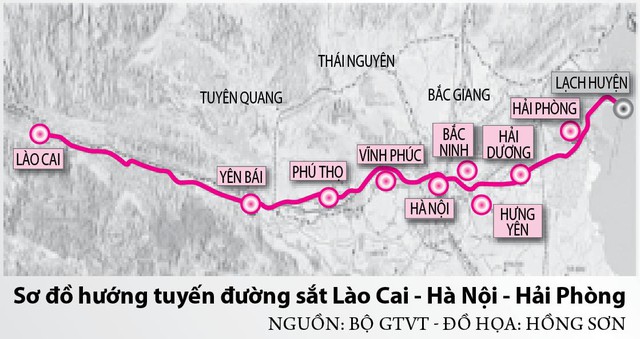
According to the plan proposed by the Ministry of Transport , the Lao Cai - Hanoi - Hai Phong railway line will have a total length of over 403 km, including a main line of 388.1 km and two branch lines totaling 15 km (a branch line connecting Nam Dinh Vu station to Dinh Vu terminal area is 7.3 km long; and branch lines connecting to Yen Vien station are 7.7 km long). The project will pass through nine provinces and cities: Lao Cai, Yen Bai, Phu Tho, Vinh Phuc, Hanoi, Bac Ninh, Hung Yen, Hai Duong, and Hai Phong. The starting point is in Lao Cai City, at the point where the rails connect across the border between the new Lao Cai station and Ha Khau Bac station (China). The end point is at Lach Huyen terminal area, Hai Phong City.
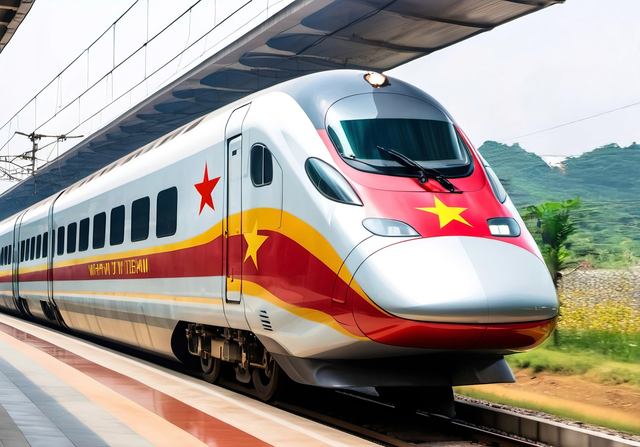
The next 10 years present a golden opportunity for the railway sector, with hundreds of billions of USD invested, fundamentally transforming the face of Vietnam's railway industry.
PHOTO: PROGRESSING THE USE OF AI
The project involves the construction of a Class 1, double-track railway with a 1,435 mm gauge; a design speed of 160 km/h for passenger trains and 120 km/h for freight trains on the main section from Lao Cai station to Nam Hai Phong station; and 80-120 km/h for connecting sections and branch lines. The ticketing system utilizes advanced magnetic card technology, capable of integrating and linking multiple ticket types, providing convenient payment options for users; and has the potential to develop and apply new technologies in the future.
The Ministry of Transport has proposed a preliminary total investment of over 194,000 billion VND, with funding expected from the Export-Import Bank of China (China Eximbank). Of this, approximately 60,000 billion VND will be counterpart funding, used for items such as project management costs, consulting, compensation, support, and resettlement. Approximately 134,000 billion VND will be borrowed from the Chinese government for construction costs; equipment and vehicles; design consulting and construction supervision costs; and contingency funds. The project is expected to be implemented over 6 years from the date the loan agreement comes into effect.
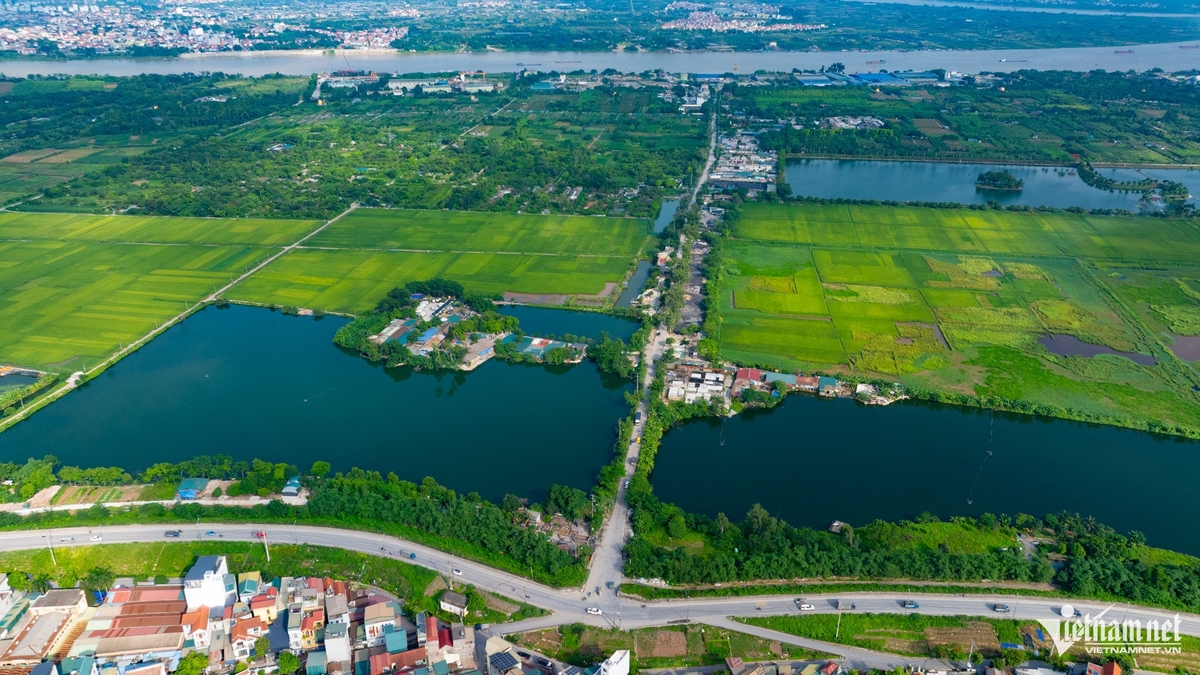
Regarding the proposed route, it aims to "ensure the shortest and straightest possible path," minimize land acquisition, avoid densely populated areas, and reduce the impact on existing structures. It also ensures convenient connectivity with urban centers and important functional zones, linking to the Hanoi regional railway hub and the railway connecting to China.
2 important "backbones"
According to Deputy Minister of Transport Nguyen Danh Huy, this railway line is one of the two most important "backbones" in Vietnam's railway development strategy, alongside the North-South railway line. It is also a strategic transportation infrastructure project within the "Two Corridors, One Belt" economic initiative between Vietnam and China, and the "Belt and Road" initiative between China and ASEAN. With its corridor encompassing major urban centers, economic zones, industrial parks, international border gates, and international seaports in the north, the Lao Cai - Hanoi - Hai Phong route is also the shortest route for goods from southwestern China to international seaports. Simultaneously, it connects industrial parks, economic zones, and tourist areas with the international border gate in Lao Cai and the international seaport in Hai Phong; and connects with the international railway network through China and Europe.
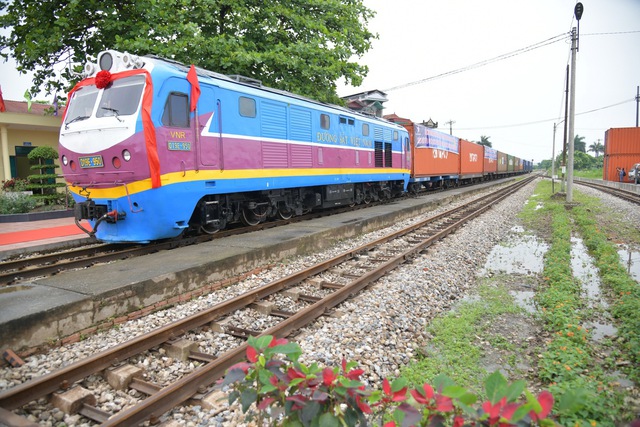
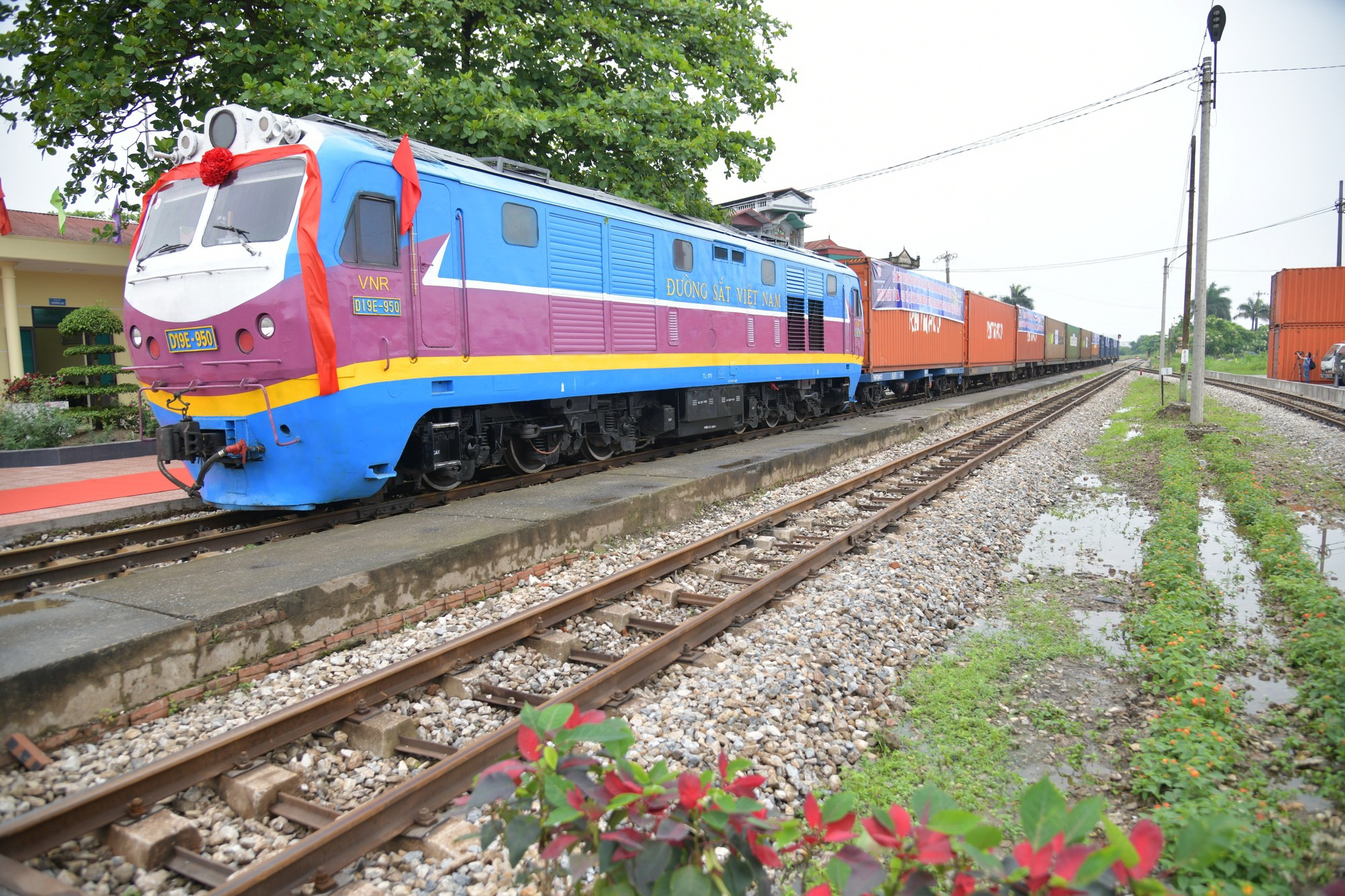
Cao Xa Station (Hai Duong) inaugurated its international train service to China on May 2, 2024.
PHOTO: VIET HUNG
Dr. Phan Le Binh, Head Representative of OCG Consulting Office in Japan, assessed the project as having strategic significance in the socio-economic development of the northern mountainous provinces. "The goal is to transport both passengers and goods, but if the main focus is on freight transport, it will help facilitate the flow of goods from Hai Phong seaport through key economic zones to the north and across the border into China. Not only will it relieve the burden on road transport, but this route will also increase the volume of goods transported along the Hai Phong - Hanoi axis to the north by handling large volumes, reducing transportation costs, and decreasing emissions…," Dr. Binh stated.
However, given its enormous scale, nearly $8 billion, Mr. Binh believes the project faces many significant challenges that need to be anticipated, such as controlling construction progress, avoiding prolonged cost overruns, challenges related to land clearance, and the rugged terrain of the northern mountainous region...
Ready for the railway industry
Gradually achieving technological self-reliance and developing the railway industry, while reducing dependence on foreign countries, is identified as a key objective in the investment plan for building high-speed railways. This is an urgent requirement if we want to modernize the railway industry, which is over 100 years old. Currently, the railway only has two industrial facilities: the Gia Lam and Di An train factories, which function to build, upgrade, renovate, repair, and maintain various types of carriages for passenger and freight transport. Mastering modern technology is a long and challenging journey, but it remains highly feasible.
The Vietnam Railway Authority (Ministry of Transport) is studying the development of a plan to guide the development of Vietnam's railway industry until 2030, with a vision to 2045. The plan aims to provide overall guidance on railway industry development, the level of technological mastery, and localization; and to propose mechanisms and policies for the development of the railway industry and supporting industries.
Mr. Dang Sy Manh, Chairman of the Board of Directors of Vietnam Railways Corporation (VNR), assessed that the Lao Cai - Hanoi - Hai Phong railway line connecting China, along with the historic North-South high-speed railway project approved by the National Assembly at the end of 2024, has realized the major policy of the Party and State on developing a modern, synchronous, and sustainable railway infrastructure. According to VNR leaders, the railway industry is preparing to seize the wide-ranging opportunities in the railway industry. In recent years, the railway industry has upgraded all old carriages to high-quality carriages. Railway enterprises have also received and manufactured some equipment for China's railways according to orders, and are researching equipment for domestic urban railway lines…
Lessons from South Korea show that, after receiving high-speed rail technology transfer from France, South Korea managed and operated its first high-speed rail line, 417 km long, from Seoul to Busan, starting in 2004. Based on this foundation, South Korea researched, mastered the technology for manufacturing, and put into operation the KTX-Sancheon high-speed train with a commercial speed of 300 km/hour in 2022.
Mr. Manh believes that to develop the railway mechanical engineering industry, it is necessary to clearly identify the future market, determining which parts can be localized immediately, which parts require technology transfer, temporary import, and then gradually progress to research and production. In principle, developing into an industry requires a market; it's impossible to produce products solely for one project. Therefore, it's necessary to clearly identify which products serve the domestic market and which can be exported…; only then can research and production expansion be considered. Vietnam is fully capable of mastering and localizing the manufacturing of railway carriages, power supply systems, information and signaling systems, as well as being completely self-sufficient in operation, maintenance, and the production of some replacement components. In addition, many other domestic enterprises have expressed interest and are ready to participate in the railway supporting industry when the line is completed.
North-South high-speed railway
build.
According to the Ministry of Transport's proposal, the Lao Cai - Hanoi - Hai Phong railway line will transport both passengers and goods on the same route. The distance between stations in the major hub area will be more than 5 km. The project includes 30 stations, of which 3 are train stations, 13 are mixed-use stations, and 14 are technical stations; the average distance between stations is 13.4 km.
The planned design speed is 160 km/h on the main section from Lao Cai Station to Lach Huyen Port Station, 80 km/h for the section from Lao Cai to the rail junction and branch lines, and 120 km/h for the railway section passing through the Hanoi railway hub, coinciding with the Eastern Ring Road.
To ensure investment efficiency, the project is planned to be divided into two phases. Phase 1 (until 2030) involves completing the construction of the entire Lao Cai - Hanoi - Hai Phong route as a single-lane road, with complete land clearance. Phase 2 (after 2050) involves completing the construction of the entire route as a double-lane road and constructing the branch section from South Hai Phong to South Dinh Vu.
Thanhnien.vn
Source: https://thanhnien.vn/co-hoi-vang-cho-duong-sat-18525020400302932.htm




















































































Comment (0)