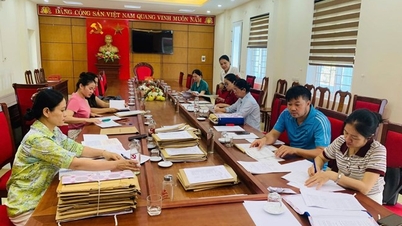
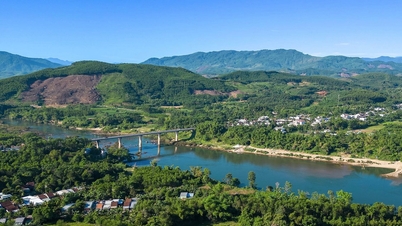
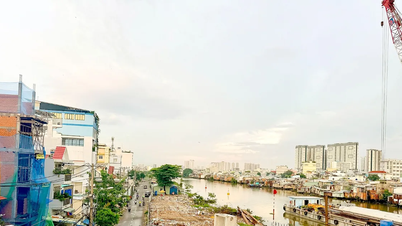
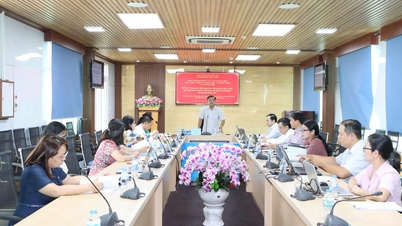
This place will always remember you and me.
(Dedicated to former Hai Duong Newspaper staff )
Goodbye, we'll be apart tomorrow.
Footprints that have gone this way never return.
The flowers still bloom by the roadside, evoking so many memories.
The evening breeze blew relentlessly.
Goodbye, we'll be apart tomorrow.
The rows of crape myrtle trees still paint the sky purple.
The old banyan tree, its roots hanging down in anticipation.
The petals of the phoenix flower fall gently in the wind.
Goodbye, we'll be apart tomorrow.
The lovely room no longer felt warm with human presence.
The boisterous laughter and chatter have become a thing of the past.
The staircase is sad, empty without your footsteps and mine.
Goodbye, we'll be apart tomorrow.
Oh, my whole youth!
Please wrap it up as a "dowry" of the past.
Sending greetings to tomorrow, waiting on the horizon.
Let's say goodbye, it doesn't necessarily mean we're going our separate ways.
Why are there so many endless waves in my heart?
Each leafy canopy and branch calls out with longing.
This place forever
Missing you…
Hey friends!
HA CU
Hai Duong City, May 2025
The poem "This Place, I Will Always Remember You and Me" by journalist and poet Ha Cu, a member of the Vietnam Journalists Association , a member of the Vietnam Writers Association, and former Editor-in-Chief of Hai Duong Newspaper, was born in a special context. From the beginning of May 2025, Hai Duong Newspaper and Hai Duong Radio and Television Station merged to form Hai Duong Newspaper and Hai Duong Radio and Television Station.
Having dedicated over three decades to journalism, pursuing various careers, he couldn't help but feel a sense of melancholy, regret, and nostalgia, which he expressed in poetry as a heartfelt farewell.
The poem consists of 5 stanzas, each with 4 lines, each line containing 8 words, with varied rhythms. Throughout the poem, one line is repeated many times : "Goodbye, tomorrow we will be far apart," which moves the reader with its distinctive rhetorical style, adding to the poem's melody and creating a particularly lively and captivating effect in the text.
Upon closer reading, the poem is full of emotion. The dominant tone is like waves that stir the heart. It begins with a message that is wistful, anxious, and poignant:
Goodbye, we'll be apart tomorrow.
Footprints that have gone this way never return.
The flowers still bloom by the roadside, evoking so many memories.
The evening breeze blew relentlessly.
The line is repeated four times at the beginning of each stanza. This cyclical, wave-like repetition creates a harmonious rhythm for the poem and enhances its aesthetic value. Each repetition opens up new spaces, new images, and new thoughts, but all are filled with longing and regret for beautiful memories that have passed and will never return.
The lyrical quality of the poem is primarily created by a system of words including exclamations and words expressing emotions with varying nuances and intensity: "Goodbye, I miss you so much, my friends..." Then, words like "Longing, yearning, sadness, nostalgia..." express the writer's feelings of longing and nostalgia. But most impressive is the artistic space of the poem – a space full of nostalgia with lush, fresh nature, with flowers and plants, with the evening breeze, and with the vibrant colors of the streets in summer.


Goodbye, we'll be apart tomorrow.
The rows of crape myrtle trees still paint the sky purple.
The old banyan tree, its roots hanging down in anticipation.
The petals of the phoenix flower fall gently in the wind.
It was a warm space with charming offices, the sound of cheerful laughter, and staircases still bearing the imprint of footsteps... But that space was also filled with longing. The scenery was as melancholic as the human heart, so the flowers blooming by the roadside were full of "nostalgia," the evening breeze "whispered endlessly," the rows of crape myrtle trees still bloomed but "dyed the entire sky purple" like the faithful and longing heart, and "the phoenix flower petals falling in the wind" like tears of parting. Most touching was the banyan tree in front of the gate, planted by the poet himself years ago, its "roots drooping in anticipation." So many years have passed, yet the tree still stands there as a witness, enduring the rain and sun, enduring the changing times and the vicissitudes of history. The space here is so pure, warm, and full of love, stirring countless threads of affection in the reader's heart.
All of it became a memory.
But the poem is not just about nostalgia and regret. By the fourth stanza, after the initial moments of intense passion, the poet's emotions seem to settle down, delving into deeper meaning.
Goodbye, we'll be apart tomorrow.
Oh, my whole youth!
Please wrap it up as a "dowry" of the past.
Sending greetings to tomorrow, waiting on the horizon.
The poem is rich in sentiment, gradually becoming brighter and warmer. For those who reminisce about the past, the poet once had "a time of youthful exuberance" with noble ideals and a desire for dedication and devotion. Those youthful years have become the "dowry" of the past sent to "tomorrow."
In the final stanza, the poem undergoes another "shift".
Let's say goodbye, it doesn't necessarily mean we're going our separate ways.
Why are there so many endless waves in my heart?
Each leafy canopy and branch calls out with longing.
This place forever
Missing you…
Hey friends!



Although the heart still holds the lingering memories of "endless waves" and the poignant calls of "the canopy of leaves and branches" of this place, and the heartfelt yearning: "Friends!", if before it was: "Goodbye, tomorrow we will be far apart," now it is "Goodbye, not necessarily a faraway part." The poem is full of hope. The poem has "tragedy" but not "sadness."
A truly moving poem filled with beautiful sadness. The "revolution" to streamline the political system is an inevitable trend to adapt to the new situation. The poem not only encapsulates the love for a place and a lifetime of work of the author, but also the shared feelings of many others involved. The poet has spoken for many generations facing the vicissitudes and changes.
NGUYEN THI LANSource: https://baohaiduong.vn/co-nhung-dot-song-long-gia-biet-414413.html



![[Photo] Strengthening character and expertise: Intense training for artillery soldiers.](https://vphoto.vietnam.vn/thumb/1200x675/vietnam/resource/IMAGE/2026/06/30/1782815602541_lu-368-1875-4571-jpg.webp)