

Unmanned boats, which originated during World War II, are making a comeback because they are not only effective in suicide attacks but also used in reconnaissance missions.
At 5:30 a.m. on March 25, 1941, two extremely powerful explosions were heard in Souda Bay in the Mediterranean Sea, and two ships sank as a result. The first, the British heavy cruiser York, was riddled with holes underwater and slowly sank into the depths. World War II was effectively over for the ship. The second explosion left a large hole in the side of the Norwegian oil tanker Pericles as it attempted to tow another stranded vessel. The tanker broke in two and sank rapidly. Italian MTM (Motoscafo Turismo Modificato) unmanned explosive boats successfully destroyed the enemy ships.
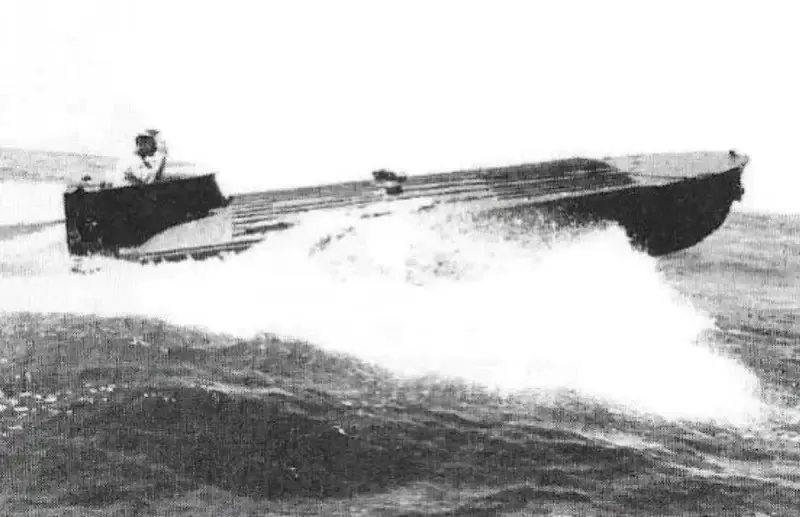 |
| An exploding boat during World War II. (Source: topwar.ru) |
Italians are pioneers.
Experience using destroyers and torpedo boats showed that the most effective attacks were close-range assaults, where the brave ship commander ordered an attack on the target by firing torpedoes at the enemy from the shortest possible distance. With such attacks, the American destroyer Samuel B. Roberts launched torpedoes at the Japanese heavy cruiser Chokai, and the British destroyer Acast, overcoming enemy artillery fire, pierced the German battle cruiser Scharnhorst with a single torpedo.
However, approaching enemy warships was too dangerous for the attacking vessel and its crew. Therefore, the concept of attacking ships with suicide boats, striking them from the surface, emerged. The Italians were the first to use unmanned explosive boats to attack the enemy, even though German engineers had invented them as early as World War I.
Initially, these were boats equipped with 95-horsepower engines and a displacement of 1 ton. The driver would bring the boat into combat mode, maneuver the steering wheel, and jump overboard, attempting to climb onto a wooden life raft as quickly as possible to avoid hydrostatic shock from the explosion. The boat would ram the target vessel at 33 knots, after which the explosive charge would cut it in two. At the necessary depth, the hydrostatic fuse of the 300 kg warhead would be activated in the bow section. Such a complex plan would create a large hole in the target vessel below the waterline.
Italian explosive-laden boats successfully attacked the British fleet in the Gulf of Suda, but the subsequent attack on the port of La Valeta failed miserably. The British learned a valuable lesson from the first attack and reinforced their guard. When six MTM boats approached the harbor, they were spotted by searchlights, and a barrage of machine gun and anti-aircraft fire rained down on the Italians. The operation resulted in 15 dead, 18 wounded, and the attackers captured.
On the other hand, while the Italians had ideas for attacking their enemies, they were unable to protect their own fleet. The Italian fleet, despite its enormous resources, suffered devastating defeats at the hands of the British in World War II at the Battles of Calabria and Cape Spada, three battleships were lost in a British air raid on Taranto, and in the Battle of Cape Matapan, three beautiful heavy cruisers were sunk.
Strengths and weaknesses of suicide boats
A well-planned and surprise attack by an unmanned explosives boat would be extremely dangerous. In 1948, the MTM explosives boat, purchased by Israel from Italy, sank the Egyptian escort ship Emir al Farouk and damaged its minesweeper.
However, its weaknesses are quite serious. The chances of a suicide boat surviving detection are zero. Unmanned boats, even small ones, are easily destroyed even with light weapons if detected. They are merely weapons of destruction used by the weak in a war against the strong, and by the poor in a war against the rich.
Let's compare a suicide boat to a torpedo. Torpedoes are superior in every way! They are faster, undetectable by radar, cannot be shot down by small arms, and have self-guided warheads. A torpedo creates a huge hole underwater for its target, while a suicide boat requires a rather complex design. In fact, the only drawback of a torpedo compared to a suicide boat is the need for a submarine to operate it. Therefore, countries that previously used suicide boats have since started buying submarines and stopped developing unmanned suicide boats.
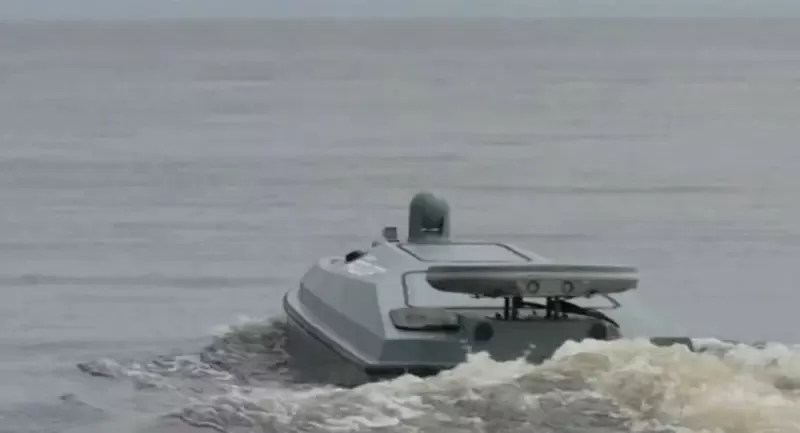 |
| Small suicide boat equipped with a camera. (Source: topwar.ru) |
The revival
The resurgence of unmanned explosive boats began with the outbreak of the Russia-Ukraine conflict. Because the Ukrainian Navy was quickly pushed out of the encirclement by the Russian Black Sea Fleet, the burden of fighting the Russian fleet fell to the Ukrainian intelligence services. This structure included sabotage units equipped with Magura V5 unmanned boats.
According to Ukrainians, the unmanned boats are a Ukrainian development, but some experts believe that their components are manufactured in the US and UK, with only assembly taking place in Ukraine. This is difficult to verify, as the Americans clearly don't need suicide boats since they already have a strong fleet, and the British have no information about the development of such weapons in the United Kingdom.
So, suicide boats may be being developed in Türkiye. The developer is Meteksan Savunma, and the manufacturer is ARES Shipyard. On the company's website, Meteksan Savunma Chairman Selcuk Kerem Alparslan indicates that this type of boat is being supplied to the Turkish Navy and its partners to change the game at sea.
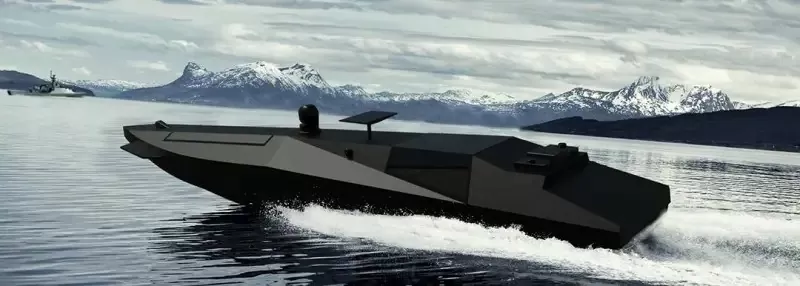 |
| Suicide boats were developed by Türkiye. (Source: topwar.ru) |
Therefore, it can be said that unmanned suicide boats like the Magura V5 did not originate from the US or the UK, but rather from Türkiye. In any case, these explosive-laden unmanned boats, far less technically complex than warships, have become a much more difficult target to destroy and have plagued many Russian warships in the Black Sea during the current conflict.
In the Middle East, since October 2023, Houthi forces in Yemen have regularly attacked ships from unfriendly nations transiting the Red Sea, including using unmanned suicide boats. The last known incident occurred on June 12th, when Houthi forces attacked the Greek cargo ship Tutor, flying the Liberian flag, using suicide boats. One boat struck the stern of the ship, rendering it immobile. Another then struck the center of the hull, causing the cargo ship to flood.
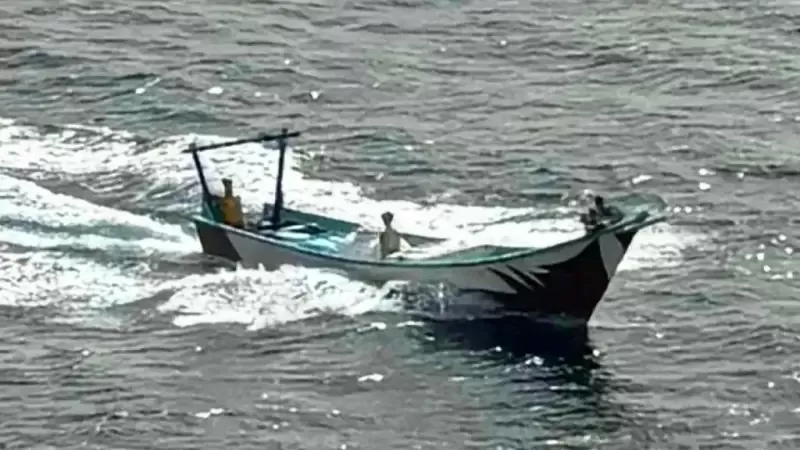 |
| Boats used by Houthi forces in the June 12, 2024 attack in the Red Sea. (Source: The Warzone) |
However, recent information suggests that the combat effectiveness of suicide boats has diminished. After all, even with significant scientific advancements, modern unmanned boats still retain all the flaws of the Italian explosive boats from World War II. They are quite easy to detect and, once detected, can be destroyed. In fact, combating suicide boats doesn't require new weapons and technology, but simply the normal operational organization on warships and in naval bases. Unmanned boats are not torpedoes, so they will be detected by regular patrols at sea.
Does Russia need unmanned boats?
To conclude the story about the unmanned boats, the question remains: does the Russian Navy need such weapons?
The answer is both yes and no. According to a Russian military expert, since Ukraine has exhausted its naval forces in the Black Sea, there simply are no longer any targets for Russian suicide boats.
However, in a protracted war not only with Ukraine but also potentially with NATO adversaries, Russian developers of unmanned explosive boats still have much work to do. During an attack, instead of separating torpedo launches from the unmanned boats, they can combine both for greater effectiveness. When approaching the enemy at a certain distance, the suicide boat and torpedo can separate and launch towards the target along different trajectories, ideally winding. After releasing a 1.5-2 torpedo, the unmanned boat's speed increases dramatically. Modern electronics can automatically and accurately guide the suicide boat and torpedo. Thus, the enemy will have to fight simultaneously with two completely different attack vehicles.
Furthermore, unmanned boats are not only used in attack but can also be used in reconnaissance variants. And this is where they could be useful for the Black Sea Fleet.
Detecting suicide boats with radar is more difficult than detecting reconnaissance aircraft (or reconnaissance UAVs). Detecting suicide boats from the air requires air power, which Ukraine has virtually no air force left. Therefore, unmanned reconnaissance boats still have a place in the Russian navy.
Source: https://baoquocte.vn/xuong-tu-sat-co-thuc-su-nguy-hiem-279268.html




























































































Comment (0)