


The ancient village
Chiêm Sơn is an ancient village recorded in Dương Văn An's book "Ô Châu cận lục" from the years 1553-1555. The village formerly belonged to Mậu Hòa commune, Duy Xuyên district, and is now part of Duy Trinh commune, Duy Xuyên district.
The village has many particularly important historical sites, closely linked to the cultural exchange and interaction between Champa and Dai Viet. From the Chiem Son Lady's Shrine and the rituals of worshipping the Lady to the Nguyen Dynasty relics such as the Vinh Dien Mausoleum (Hieu Van Empress of Sai Vuong Nguyen Phuc Nguyen), the Vinh Dien Mausoleum (Doan Hue Phi, wife of Thuong Vuong Nguyen Phuc Lan, mother of Hien Vuong Nguyen Phuc Tan)...
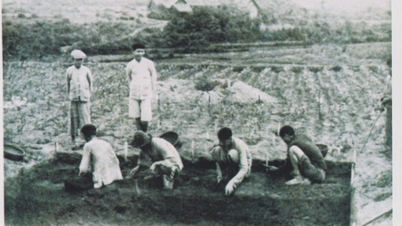
According to the elders of Chiêm Sơn village, the history of the village's founding records the merits of the ancestors in establishing the village name, setting up hamlets, temples, bridges, etc. Three prominent founding families are Nguyễn Công, Nguyễn Văn, and Nguyễn Đình.
The Nguyen Cong clan, with its founding ancestor Nguyen Ta Hien, before 1945, clan leader Nguyen Cong Kien still possessed a catalog from the 6th year of Thai Duc (1783) and a genealogical record from the 16th year of Minh Mang (1835).
The Nguyen Van clan has a founding ancestor, Nguyen Van Minh, whose descendants preserved a book of genealogical records from the year Giap Tuat (1754) and a long summary from the 8th year of Thai Duc (1785).
The Nguyen Dinh clan has its founding ancestor, Nguyen Dinh Tu. In addition, the village has several other clans that are considered descendants of the clan.
According to Dr. Tran Dinh Hang, Director of the National Institute of Culture and Arts in Hue , documents from surveys conducted before 1945 show that in Chiem Son village there were 14 royal decrees from the Nguyen dynasty bestowed upon Cao Cac, the village guardian deity, Thai Duong Phu Nhan (Lady Chiem Son), and the Chief Commander Tran Van Phu.
Notably, in the 5th year of Duy Tan's reign (1911), Lady Chiem Son was elevated from the goddess of Thai Duong Phu Nhan to the goddess of Nhan/Trinh Uyen Duc Bao Trung Hung. In the 9th year of Khai Dinh's reign (1924), she was further honored with the title of Trai Tinh Trung Dang Than.

Deepest source
Villagers have passed down ancient legends about an extraordinary phenomenon, known as the Divine Legend of Chiêm Sơn Village. It is said that the statue of the Goddess spontaneously emerged on the water's surface at Tây An wharf, in the sacred forest of Mậu Hòa village. People from neighboring villages witnessed her miraculous appearance and came to ask to take her statue to worship, but they were all unable to carry it. At that time, the people of Chiêm Sơn village also came to ask to take her statue to worship, and she agreed (there is a legend that says it was eight shepherd children).
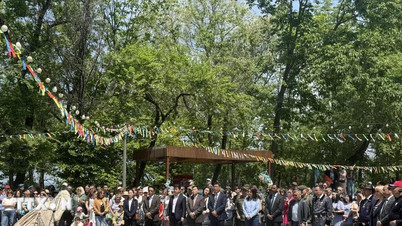
People wanted to invite the Goddess to the shrine of Ông (Lord Cao Các), but the rope broke when they reached Bàu Đưng. Knowing that the Goddess wished to stay, the villagers requested permission to build a shrine and organize solemn and respectful annual ceremonies. Notably, a grand ceremony is held every three years, featuring traditional opera performances dedicated to the Goddess.
Following the principle of sacrificing for peace and prosperity, during the Lady's Festival, villagers offer local produce with various symbolic meanings. The offerings must include freshwater crabs, whole garlic plants, cabbage plants with roots and flowers, stewed snakehead fish, and especially a roasted civet.
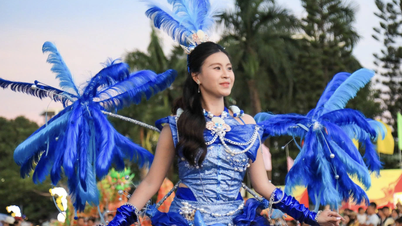
The sacredness of the totem and animistic beliefs have helped to decipher and clarify the symbolic meaning of the offerings. It is precisely because of this profound sacred origin that the Lady Shrine has become the focal point of the traditional Lady Chiêm Sơn festival.
Strong cultural imprint
The statue of Lady Chiêm Sơn, worshipped in the main hall, is 56cm tall, with legs 54cm wide when crossed, a body thickness of 13cm, a head height of 18cm, arm length of 28.8cm, and foot length of 17cm.

Dr. Tran Dinh Hang believes that the unique feature of the statue of the Goddess, which has been largely Vietnamized thanks to the painting techniques used over time, is that it is still surrounded and supported by seven Naga serpent heads forming a canopy above and below, seated on the serpent's back, resembling a sacred mount.
Recently, villagers have been trying to restore the original statue to its original form, with many of its features such as long ears, a large nose, and thick lips – an idol quite unfamiliar to Vietnamese people.

Dr. Tran Dinh Hang explains: "Snakes, dragons, and their various transformations are the most concise symbols of the agricultural community's aspiration for a bountiful harvest."
While the dragon was prominently symbolized in the feudal royal world of the North, in the indigenous culture of the South, it was the serpent god Nagar that represented it.
It can be said that the seven Nagar serpent heads in the statue of Lady Chiêm Sơn are a rare landmark in the far north, between the two civilizations influenced by dragons and serpents.
From the snake deities surrounding the statue of Lady Chiêm Sơn, the Vietnamese rice-farming people of the Thu Bồn River delta symbolized the three snake deities as the Three Water Generals, who were widely worshipped and revered in villages along the Cái River, extending to Thanh Hà village and Cù Lao Chàm in Hội An. During the Nguyễn dynasty, they were bestowed the title of Phục Ba General.
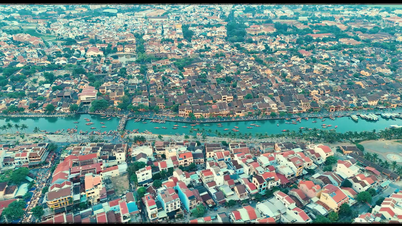
With its system of sacred sites stretching from Tra Kieu to Ba Thu Bon (in Thu Bon and Trung An), Ba Chiem Son, connecting to Ba Chua Ngoc on Mount An, and Bo Bo Phu Nhan in Cu Lao Cham…, the Cai - Sai Thi - Thu Bon river system is full of sacredness and mystery, demonstrating its particularly important role in the history and culture of Quang Nam province.
Source










































![[Video] Sunset at Lap An Lagoon – Where the sun sets over the fishing nets](https://vphoto.vietnam.vn/thumb/1200x675/vietnam/resource/IMAGE/2026/05/31/1780192137701_beach-landscape-sea-water-nature-grass-745871-pxhere-com.jpeg)


































Comment (0)