

In an era where personal image is closely tied to commercial value, every action of an artist in real life can create a ripple effect on hundreds of people behind the scenes. A scandal is no longer just a personal setback, but can become a "domino effect" that triggers a crisis for an entire film project.
Filmmaking has never been a one-star's playground. Behind every film lies money, time, box office pressure, and the hard work of an entire team spanning many years. Just one scandal at the wrong time can cause everything to collapse in a matter of days.
A ticking time bomb
Mr. Luong Cong Hieu - the producer of "Battle in the Air," "Em and Trinh," and "Mat Biec " - spoke with Tien Phong newspaper about the pressures producers face when artists are involved in scandals or personal controversies during the film's release period.
According to Mr. Cong Hieu, the film industry is heavily dependent on "golden timing." Once a film's release date is confirmed, the entire system behind it is activated almost simultaneously: media campaigns, promotional schedules, screening times, sponsorship deals, distribution systems, and plans for working with theaters.




Every day of delay costs money. Every last-minute change triggers a chain reaction of damage. "If we have to postpone a film, cut roles, replace actors, or change the promotional campaign, the damage isn't just in the cost, but also in losing a prime release date," he said.
What's more worrying, according to the producers of *Battle in the Air* , is the breakdown of audience trust. In many cases, the public finds it difficult to distinguish between the artist's individual mistakes and the efforts of the entire team behind the scenes.
The most painful thing for filmmakers is that years of hard work by hundreds of people can be completely overshadowed by a single negative social media post. At that point, the efforts of the director, screenwriter, cinematographer, or post-production team are almost completely obscured, as all the attention is focused on the actor's personal scandal.
When scandals erupt close to release dates, media crises can swallow up both the artistic message and commercial value of a film. A project that should have been judged by its quality content is dragged into a vortex of no contrived nature.
The arrest of beauty queen Nguyen Thuc Thuy Tien before the release of the film "Chot Don" was considered a major shock to the production team. The fact that the producers had to use AI to replace the actress shows the unpreparedness and crisis pressure the film crew faced. At the time, a representative of the crew described the feeling as "like walking down the street and a tree falling on you."
A project that is forced to use AI or extreme post-production solutions to replace actors is no longer a creative choice, but a sign that the film crew is trying every means to save its chances of release.
Changing an actor's face in a film raises a host of issues related to legal matters, image rights, character emotions, post-production costs, and final product quality. If handled poorly, audiences will notice the awkwardness, and the media will continue to focus on the scandal instead of the film's value.
In the case of Miu Le and "Blood Moon Party 8 ," the scandal involving the female artist erupted when the film was in its final stages of theatrical release. Although the impact wasn't as direct as in the case of "The Final Order," the losses were still considered very significant.


Without going into specific cases, Mr. Luong Cong Hieu stated that a film can suffer losses of tens, even hundreds of billions of dong simply because an artist is involved with banned substances.
"It's like a ticking time bomb," he said.
Because in the entertainment industry, scandals don't disappear. They just wait for the right moment to explode. According to him, the difference now lies in the speed of social media dissemination and the increasingly stringent reactions from the market.
In particular, cases involving banned substances are considered the most serious risk group, as they not only affect personal image but also entail legal issues, the possibility of film release, reactions from regulatory agencies, and waves of public boycotts.
"This is no longer just a matter of artist ethics. It's about the financial, legal, and operational risks to the entire industry," he emphasized.
Variables affecting the survival of the project.
In the entertainment industry, an artist's image is considered a kind of "professional asset." However, unlike many other types of assets, this value can plummet extremely quickly after just one scandal or inappropriate behavior.
Film researcher Nguyen Anh Tuan (Vietnam Institute of Culture, Arts, Sports and Tourism) knows that in many Asian entertainment industries such as South Korea and China, management companies apply very strict regulations to control the image of artists.
Some companies even prohibit artists from dating during their contract, and forbid them from revealing images of smoking, drinking alcohol, or developing romantic relationships with people from the same company.
"Vietnam isn't that strict yet. However, actor contracts in many current film projects clearly stipulate the obligation to maintain a positive image throughout the film's lifespan, from theatrical release to distribution on OTT platforms, because an artist's image can directly affect ticket sales," Mr. Tuan said.


According to experts, many young artists today lead extravagant lifestyles and possess considerable financial resources, but sometimes lack behavioral control, creating significant pressure on producers and crews.
A film producer revealed that they were under stress for almost a year after discovering an actor had used illegal substances after filming was complete. The crew only dared to ask acquaintances to intervene and get the artist to stop, and only truly breathed a sigh of relief when the film was safely released.
For producers, risks from artists are no longer just "occupational hazards," but variables that can determine the survival of an entire project.
You can't use emotions to "defuse a bomb."
According to experts, the film industry cannot continue to deal with these "ticking time bombs" through emotions or a "witch hunt" mentality. What the market needs is not emotional frenzies on social media, but a more professional and transparent governance mechanism for the entertainment industry.
First, the contract needs to clearly include clauses on professional ethics and regulations for handling serious violations, especially those involving banned substances, violations of the law, or actions that significantly affect the film's release.
These terms must specifically stipulate the producer's rights, such as suspending the partnership, replacing actors, claiming compensation, or adjusting the promotional campaign if risks arise.
Furthermore, for large projects, producers need to establish a risk assessment process before casting. According to experts, this is not about prying into private lives, but rather evaluating an individual's suitability for the commercial responsibility they will undertake.
Furthermore, if any inspections are involved, they should be conducted transparently, on a clear legal basis, and with the consent of all parties involved, avoiding any infringement on the artists' privacy.
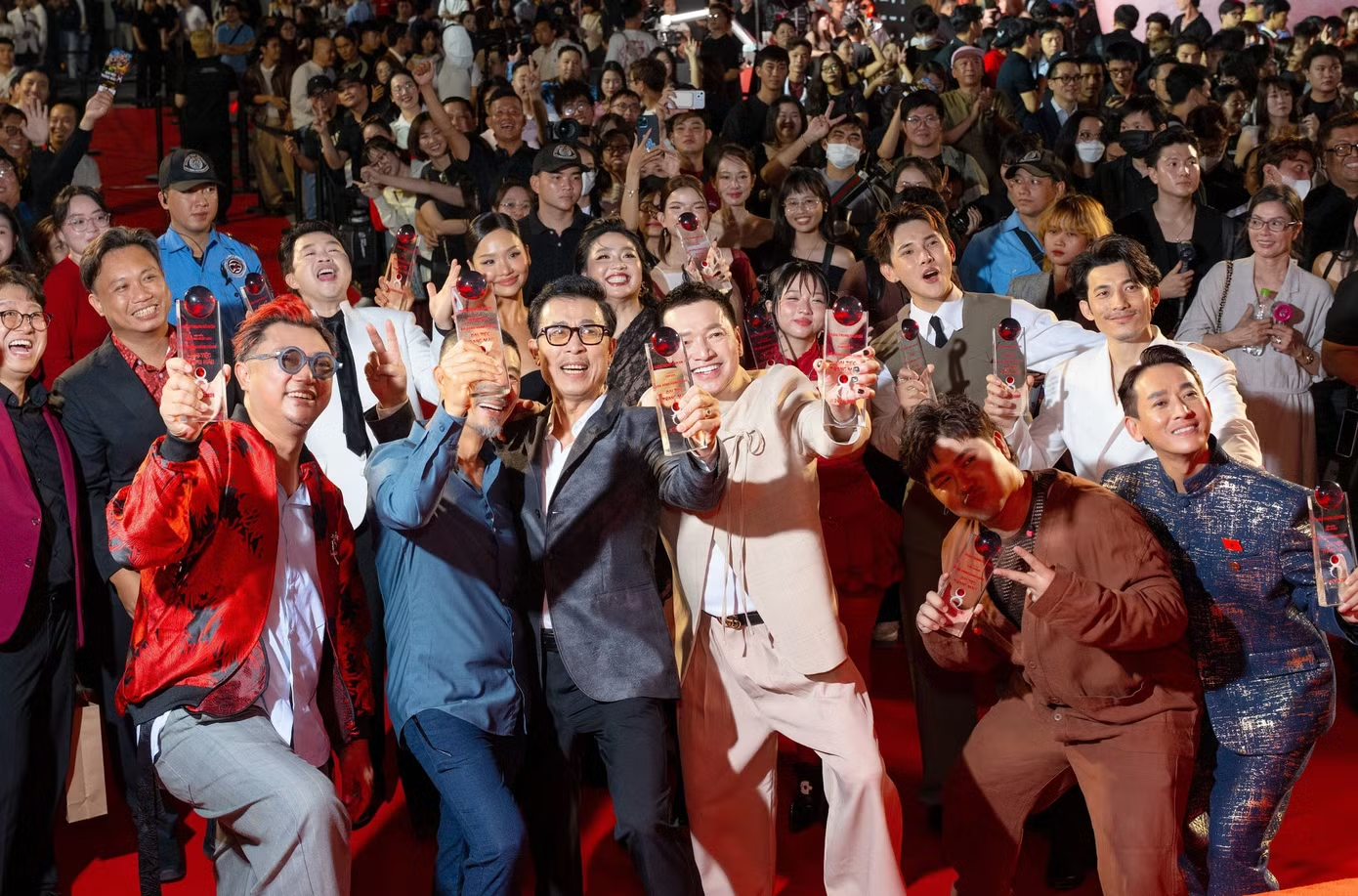
"Filmmaking is a creative industry, but it cannot operate on naivety. A film costing tens or hundreds of billions of dong cannot simply rely on the belief that everyone will always behave correctly," said Mr. Luong Cong Hieu.
According to him, after a series of recent incidents, the Vietnamese film market is likely to enter a new phase, where artists will not only be judged by their talent or popularity, but also by their personal discipline, professional reputation, and ability to protect the commercial value of their projects.
Meanwhile, Mr. Nguyen Anh Tuan argued that filmmaking is inherently a very high-risk field, because even a single act of misconduct can cause an investment project worth tens of billions of dong to collapse in a short period of time.
"A film can take years to complete, but just one scandal can drag everything down in a few days," Mr. Tuan remarked.
According to experts, this is also why Vietnam needs to quickly develop suitable production insurance models for the film industry, in order to minimize losses from risks outside of artistic expertise.
Source: https://tienphong.vn/con-ac-mong-cua-nha-san-xuat-phim-viet-post1843289.tpo







































































































Comment (0)