

Immediately after the 90-day tariff postponement, shrimp businesses breathed a sigh of relief and quickly contacted partners to expedite the delivery of signed contracts within this period. On the other hand, businesses also hoped that more US partners would stock up before the retaliatory tariffs officially took effect after 90 days. Furthermore, they hoped for import tariffs that wouldn't differ too significantly between shrimp exporting countries to the US, allowing Vietnamese shrimp to maintain its market share.
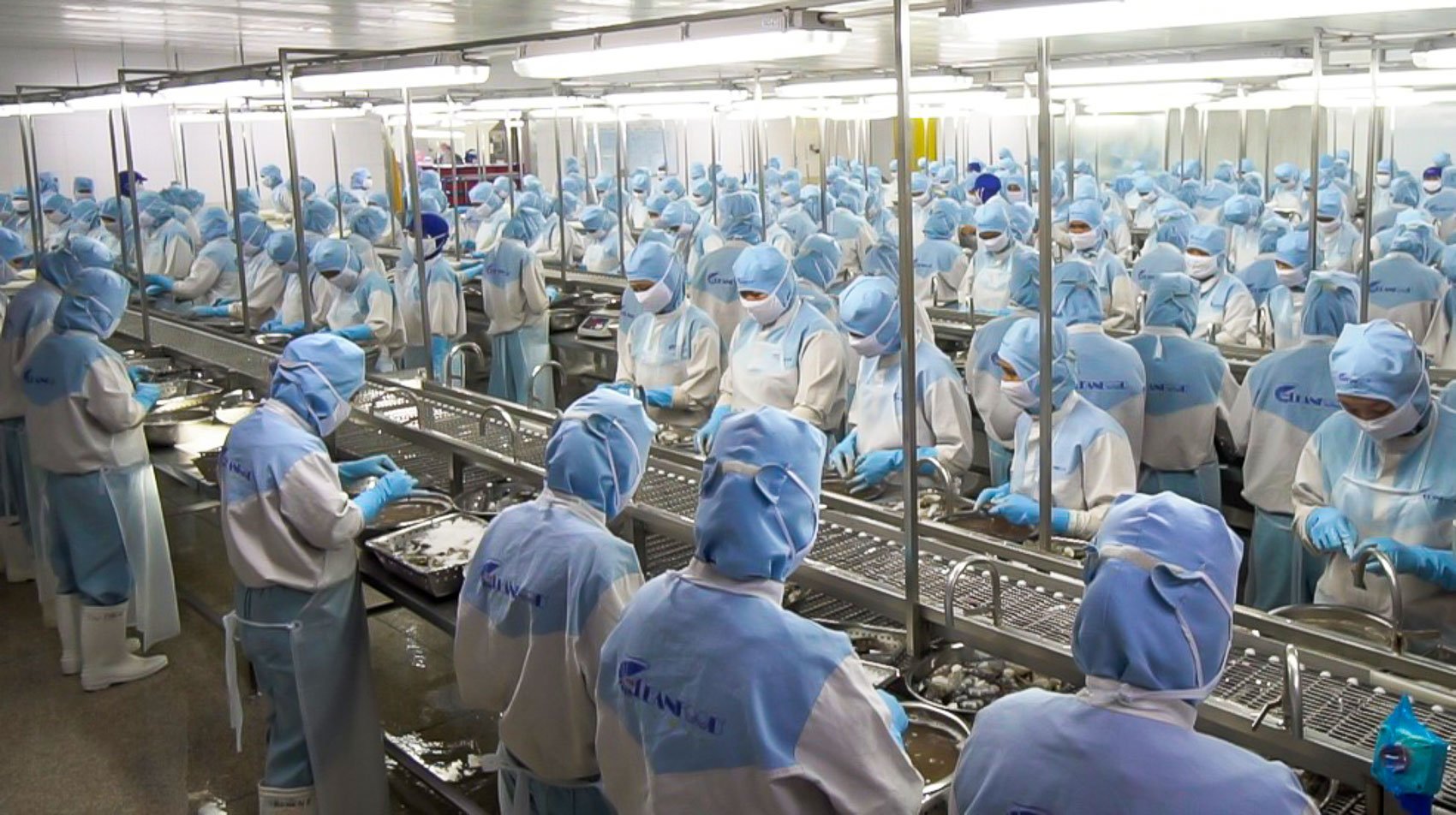 |
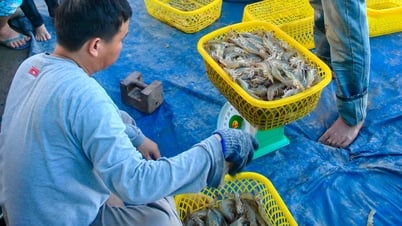
| Despite having developed contingency plans, shrimp businesses still hope that the next developments regarding retaliatory tariffs will be at an acceptable level to ensure Vietnamese shrimp can maintain its position in the US market. Photo: TICH CHU |
Regarding the question of whether US partners will stockpile goods during the 90-day tariff waiting period, the director of a shrimp industry business stated that currently, the US side and its partners are awaiting the final decision from the Trump administration. Therefore, whether partners will stockpile goods or not is still unclear; it all depends on the final decision on tariff policy. Furthermore, if contracts are signed at this time, businesses only have about 30 days to process and deliver the goods. This is without considering that domestic shrimp prices are high, but supply is not abundant, making it difficult for businesses to secure sufficient raw shrimp within this short period. Therefore, for now, businesses are focusing on delivering goods within this timeframe to complete existing contracts, and will then consider further options.
While awaiting the final decision on reciprocal tariffs, businesses have also developed their own scenarios and countermeasures. “In the worst-case scenario, if the 46% tariff on Vietnamese shrimp remains unchanged, while other countries have tariffs around 20%, how will businesses handle it?” Our question received a quick and somewhat witty response from the businesses: “We will temporarily pause our operations in the US market to focus on other major markets, such as China, Japan, the EU, South Korea, Australia, and Canada…”
However, businesses remain confident that the final tariff rate on Vietnamese shrimp in the US market will certainly not be as high as it is currently, because according to their analysis, the 46% tariff is more of a hypothetical scenario than a reality. Therefore, some predict that the highest possible final tariff rate will only be around 23%. In that case, if Vietnam's remaining competitors are subject to a 20% tariff, Vietnamese shrimp will still have a chance to compete in this market. Further explaining this, businesses say that Vietnam's biggest competitors in the US market are Ecuadorian and Indian shrimp, thanks to their price advantage. While Indian and Ecuadorian shrimp are cheaper, they mainly export raw products due to labor shortages and a lack of advanced processing technology. Meanwhile, Vietnamese shrimp businesses have invested heavily in advanced processing, meeting the standards for export to high-end distribution systems in the US, resulting in higher value. This is a significant difference.
This shows that the issue isn't necessarily about high or low taxes, but rather the difference in reciprocal taxes between Vietnam and its competitors. In other words, if Vietnam is subject to high taxes, but its competitors are similarly taxed, the competition isn't significantly unequal. Competition in the US market is fierce because it has the lowest profit margins of all markets. However, the US remains a very large consumer market. Because of this large volume, there is a high price tolerance – meaning that if a product is of higher quality, it can still sell for 10% more. Therefore, businesses always strive to maintain and secure this market to stabilize production, retain employees, maintain revenue, manage cash flow, and keep pace with the market.
Although predictions suggest a very low likelihood of shrimp businesses abandoning the US market, each company has its own contingency plan should they be forced to do so. Some businesses have even prepared for the complete loss of the US market five years ago, but they also acknowledge that abandoning it will inevitably impact their revenue and profits for a certain period, as it remains a major market for Vietnamese shrimp, accounting for up to 30% of Vietnam's total shrimp exports.
There is still time for businesses to devise appropriate countermeasures for immediate goals and prepare the next steps for a long-term strategy. Hopefully, everything can remain at an acceptable level as expected by businesses so that the shrimp industry can overcome difficulties and affirm its position in the global market.
PROTEIN
Source: https://baosoctrang.org.vn/kinh-te/202504/con-tom-va-kich-ban-sau-90-ngay-6187dc1/


![[Photo] General Secretary To Lam presents the Military Merit Order and Party Badge to senior leaders.](https://vphoto.vietnam.vn/thumb/1200x675/vietnam/resource/IMAGE/2026/03/30/1774878643606_a1-bnd-5651-8284-2398-1124-jpg.webp)














![[Photo] General Secretary To Lam attends the ceremony commemorating the 75th anniversary of the founding of the Central Military Hospital 108.](https://vphoto.vietnam.vn/thumb/1200x675/vietnam/resource/IMAGE/2026/03/30/1774866343623_a1-bnd-5435-7415-jpg.webp)
![[Photo] The moment of seasonal change at Thong Nhat Park](https://vphoto.vietnam.vn/thumb/1200x675/vietnam/resource/IMAGE/2026/03/30/1774870546141_ndo_br_b773e4e7b1a230fc69b313-jpg.webp)



























































Comment (0)