


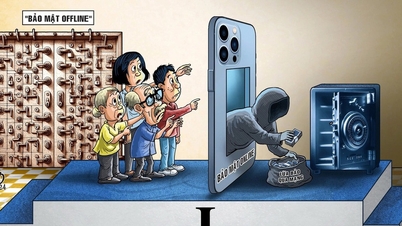
Personal information can be leaked through many channels: from internal personnel or through cyberattacks - Illustration: Quang Dinh
Speaking to Tuổi Trẻ newspaper, Mr. Trịnh Nguyễn Thiên Phước, technology director of Gianty Vietnam, said that cross-border online fraud is becoming increasingly sophisticated, especially in the Golden Triangle region. AI and Big Data technologies will play a crucial role in early detection and prevention of fraudulent activities.
"AI can analyze transaction data in real time, recognize voices in fraudulent calls, and monitor content on social media to detect phishing websites. This technology not only helps warn users but can also automatically block suspicious transactions, lock accounts, or stop phishing campaigns before they spread," Mr. Phuoc explained.
Furthermore, AI helps optimize the fraud reporting portal by screening, classifying, and prioritizing serious cases. AI chatbots can automatically guide victims, reducing the workload for authorities, while AI systems can link data from multiple fraud cases to support rapid investigations.
Mr. Phuoc proposed: "Technology companies, banks, and network operators need to cooperate closely to share data and deploy monitoring and early warning technologies." He also recommended establishing specialized committees or associations, and providing continuous training to agencies and departments, much like a "cyberfire prevention and control" unit.
In addition, Mr. Phuoc proposed the Bounty Hunter model to encourage security professionals to participate in hunting down cybercriminals through a transparent reward mechanism, contributing to improving the effectiveness of online fraud prevention.
According to Mr. Hoang Xuan Huong, Director of Technology at VNetwork cybersecurity company, with their current technological capabilities, Vietnamese network operators can fully record subscribers connecting from base stations in areas identified as targets of cybercriminals. This data can then be combined with voice recognition technology from relevant authorities and used by AI to analyze and block common fraudulent calls.
"The simplest solution is that after each call, there's a notification asking if it's a scam or not. With a certain number of reports, the network operator can use the call history and content to create keywords to block subsequent calls," Mr. Huong shared.
Meanwhile, according to Mr. La Manh Cuong, General Director of Opswat Vietnam, organizations storing sensitive information such as banks, government agencies, telecommunications service providers, and financial institutions need to enhance their capacity to protect user data.
According to Mr. Cuong, many successful scams in reality stem from the fact that fraudsters obtain the victim's citizen identification number, full name, address, phone number, and even transaction history. Personal information can be leaked through various channels, from internal personnel to cyberattacks.
To prevent this risk, Mr. Cuong suggested that organizations need to implement multi-layered data protection solutions, in which Data Loss Prevention (DLP) technology plays a crucial role in monitoring, controlling, and preventing data leaks.
DLP technology can help detect and prevent unauthorized data access, encrypt sensitive data, limit data access, and detect data leaks via email, USB, and cloud.
Identifying common types of scams
Exploiting greed and lack of knowledge, scammers launch schemes to entice financial investments, especially in "cryptocurrency," with promises of huge profits. They advertise and lure people into participating in fake exchanges and websites that they create.
A team of employees posing as financial experts, stockbrokers, or representatives of reputable brokerage firms gathers "investors" into advisory groups via Zalo and Telegram. After attracting many people and receiving money, the virtual trading platform will close down or disappear, leaving investors with nothing.
Romance scams are equally common. Scammers approach victims through social media, dating sites, or forums with fake profiles featuring stolen photos of attractive people.
They create a fake romantic relationship through flirting, sharing touching stories, or making promises, then lure victims into sending sensitive images for blackmail or convince them to invest in fake Forex trading platforms.
The "easy job, high pay" scam is trapping many people, especially those looking for work. The key to this scam lies in requiring an advance payment before starting work.
Some more sophisticated scams involve paying the victim an initial amount but then requesting personal account information, credit card numbers, or bank details under the pretext of payment or account creation, thereby luring users into the trap.
Source: https://tuoitre.vn/cong-nghe-ai-vu-khi-chong-lua-dao-truc-tuyen-20250228085003302.htm

![[Photo] Prime Minister Pham Minh Chinh presides over a meeting on private sector economic development.](/_next/image?url=https%3A%2F%2Fvphoto.vietnam.vn%2Fthumb%2F1200x675%2Fvietnam%2Fresource%2FIMAGE%2F2025%2F12%2F20%2F1766237501876_thiet-ke-chua-co-ten-40-png.webp&w=3840&q=75)


![[Photo] Prime Minister Pham Minh Chinh presides over the conference announcing the establishment of the International Finance Centre in Vietnam.](/_next/image?url=https%3A%2F%2Fvphoto.vietnam.vn%2Fthumb%2F1200x675%2Fvietnam%2Fresource%2FIMAGE%2F2025%2F12%2F21%2F1766309817714_ndo_br_dsc-3400-jpg.webp&w=3840&q=75)






























































































Comment (0)