

The Philippines is continuously employing tactics to lower prices.
In April, Vietnam's rice exports were booming, with a volume of 1.1 million tons but a value of only $493 million. According to the Vietnam Food Association (VFA), the sharp increase in exports was due to the very low price of Vietnamese rice, averaging only $468 per ton in the first four months of the year, the lowest in the last five years and a decrease of about $40 compared to the average price in 2015. Because of the low export price, the price of rice at times dropped to around 10,000 VND/kg, while the price of fresh paddy at the field was around 5,000 VND/kg.
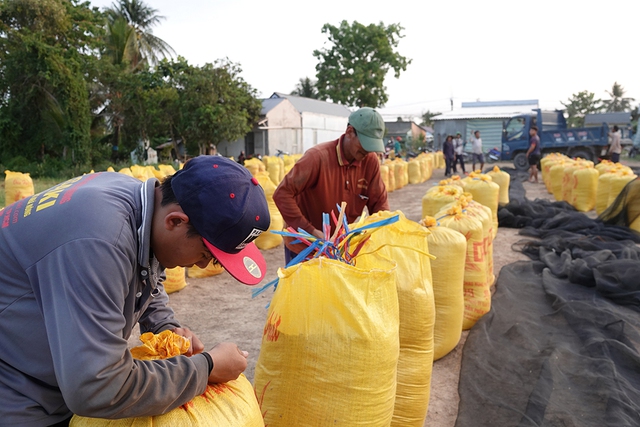
Policies for rice reserves and market diversification need to be developed to reduce dependence on other rice varieties.
PHOTO: DUY TAN
However, thanks to favorable export conditions in April, Vietnamese rice prices have rebounded. Mr. Nguyen Vinh Trong, Director of Viet Hung Co., Ltd. ( Dong Thap ), said: currently, the export price of DT8 fragrant rice is around 530 USD/ton, an increase of 15-20 USD compared to the end of April. As a result, domestic rice prices have also increased by 700-800 VND, reaching 12,500 VND/kg. The strongest increase was for ST25 rice, which rose by about 50 USD to 690 USD/ton. "But the price increase hasn't been significant yet, and the market has become sluggish again. The reason is that the Philippines, Vietnam's most important market, has not yet granted import permits (SPS) for June, causing the market to slow down, and other countries are buying cautiously to wait for better prices," Mr. Trong said.
Furthermore, according to businesses, the Philippines has announced it will reduce rice imports to 150,000 tons per month in the next three months, or even temporarily suspend imports. However, in reality, over the past four months, the Philippines has imported 1.6 million tons of rice, of which 1.5 million tons came from Vietnam. Experts and the US Department of Agriculture have stated that the Philippines does not have sufficient rice supply to meet national consumption and food security needs. "The Philippines is projected to import a record 5.5 million tons of rice in 2026 and increase to 5.6 million tons in 2027. The Philippines' demand for rice is soaring due to its rapidly growing population and rice being a staple food," the US Department of Agriculture emphasized.
Ms. Phan Mai Huong, co-founder of the rice market website SS Rice New, said that the Philippines is one of the world's most rice-loving countries. Even many fast food items, typically eaten with bread or potatoes, are still sold with rice in the Philippines. Therefore, although the Ministry of Agriculture and the government are striving to restrict rice imports to encourage domestic production, the reality is that their rice quality is not good, and most consumers still choose to buy imported rice. Vietnamese rice is the segment that best suits their tastes and income levels. That's why Vietnamese rice has held an absolute advantage in this market for many years. The above evidence shows that in the short and medium term, the Philippines will still be heavily dependent on rice supplies from Vietnam.
How to win the rice price war?
Given that Vietnam's largest rice importer has repeatedly issued statements restricting rice imports, many believe Vietnam needs to diversify its markets. From a broader perspective, Ms. Phan Mai Huong acknowledged that Vietnam's rice exports have historically relied heavily on a few key markets. Therefore, when facing difficulties in certain markets, we often discuss market diversification and targeting new markets. However, Southeast Asian countries are actually the world's largest rice consumers. Besides major rice-importing countries like the Philippines, Indonesia, Malaysia, and Singapore, exporting countries like Thailand and Cambodia also have a demand for imported rice.
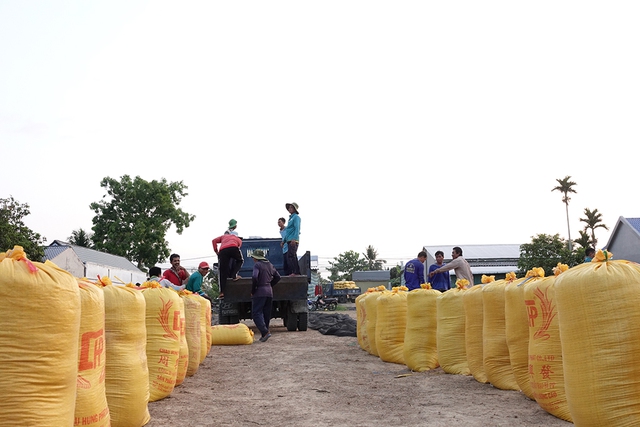
Vietnamese rice prices fluctuate erratically according to the Philippine market.
PHOTO: DUY TAN
"Previously, we were hampered by the mindset of 'carrying firewood back to the forest,' so no one thought about selling rice to Thailand. However, even in Vietnam, many Vietnamese people prefer imported rice. In Thailand, Hom Mali rice has superior quality but is very expensive, so only a segment of the population can afford it, while the majority still prefer common white rice of lower quality; meanwhile, the vast majority of people still need high-quality rice (sticky, fragrant) that is more affordable. This is a segment where Vietnamese fragrant rice varieties have an advantage," Ms. Mai Huong suggested.
Some Thai businesses have stated that Thai consumers are very keen to use Vietnamese rice varieties such as ST25 or DT8. The problem is that Thailand does not allow the import of bulk rice. Therefore, Vietnamese businesses can export branded packaged rice products (5-10 kg) to this market. "If we effectively exploit the Southeast Asian market in this way, it will open up a huge market opportunity for Vietnamese rice. This also requires businesses to continue investing and changing their export strategy from bulk rice to packaged, branded products," Ms. Mai Huong recommended.
Mr. Do Ha Nam, Chairman of the VFA, also shared that, because Vietnamese rice exports have depended on a few markets, especially the Philippines, when unfavorable information emerges, the market becomes sluggish and prices drop sharply as businesses rush to sell off their inventory. "The solution is to gradually enhance the proactive role of farmers in the rice value chain. This includes promoting mechanisms that allow farmers to store rice through linkages with cooperatives or directly in the warehouses of export businesses. Cooperatives and businesses can coordinate with banks to build appropriate loan mechanisms for farmers after harvest. Only when farmers have the ability to store and proactively choose the time to sell their rice will they truly reap the rewards of their own labor," Mr. Nam suggested.
In addition, Mr. Do Ha Nam also suggested that while Vietnam has many high-quality fragrant rice varieties favored by the world, the Vietnamese rice brand in the international market is not yet truly commensurate with that quality. It's time for Vietnam to invest so that consumers can recognize its rice by its own name and value. To achieve this goal, relevant agencies need to ensure the purity of the varieties, implement consistent quality control, build a traceability system, and develop brands for each specialty rice line.
China takes advantage of importing cheap rice.
In terms of market overview, the US Department of Agriculture forecasts that global rice production this year will decrease by 5 million tons compared to last year, to 537.8 million tons. Notably, the sharpest declines are seen in India (2 million tons), Myanmar, and the US (1 million tons each). In addition, global rice reserves are expected to decrease by 3.6 million tons to 192.9 million tons. China has best capitalized on the recent low rice prices to increase its reserves, adding 3 million tons to reach 108 million tons, accounting for 56% of total global reserves. According to experts, this is how China has smoothly weathered past food price surges, most recently the price spike in 2023-2024.
Meanwhile, rice consumption increased by 3.8 million tons to 541.4 million tons. Demand surged in India and Africa, particularly in sub-Saharan Africa, where rice has become a vital staple food. Besides the Philippines, many other countries increased their rice imports significantly, including China (3.3 million tons), Malaysia (1.6 million tons), Nigeria (2.9 million tons), Ivory Coast (1.8 million tons), and Senegal (1.3 million tons).
Source: https://thanhnien.vn/cuoc-chien-gia-gao-185260520211609908.htm
![[Photo] National Assembly Chairman Tran Thanh Man working with the Standing Committee of the Law and Justice Committee](https://vphoto.vietnam.vn/thumb/1200x675/vietnam/resource/IMAGE/2026/05/21/1779378929214_ndo_br_1-4610-jpg.webp)
![[Photo] General Secretary and President To Lam presides over a working session with the Central Policy and Strategy Committee on the development of the materials industry.](https://vphoto.vietnam.vn/thumb/1200x675/vietnam/resource/IMAGE/2026/05/21/1779359935432_a3-bnd-3129-1412-jpg.webp)
















![[Video] Hanoi plans to select two communes with 700,000 inhabitants to pilot the socialist model.](https://vphoto.vietnam.vn/thumb/402x226/vietnam/resource/IMAGE/2026/05/21/1779373741887_z7851174239346-8a83e741648b3fa19f4e711ad18c6234-jpg.webp)



























































Comment (0)