

On a sunny day, I joined dozens of members of the press and media delegation from various countries to visit the museum located at Intel Corporation's headquarters in Santa Clara, Silicon Valley (California, USA). What caught our eye was a large portrait of Gordon Moore (1929-2023) displayed prominently on the front facade of the Intel headquarters building.
When Dr. Moore passed away at the age of 94 in March 2023, Apple CEO Tim Cook wrote: " The world has lost a giant, Gordon Moore, one of the founders of Silicon Valley and a true visionary who helped pave the way for the technological revolution."
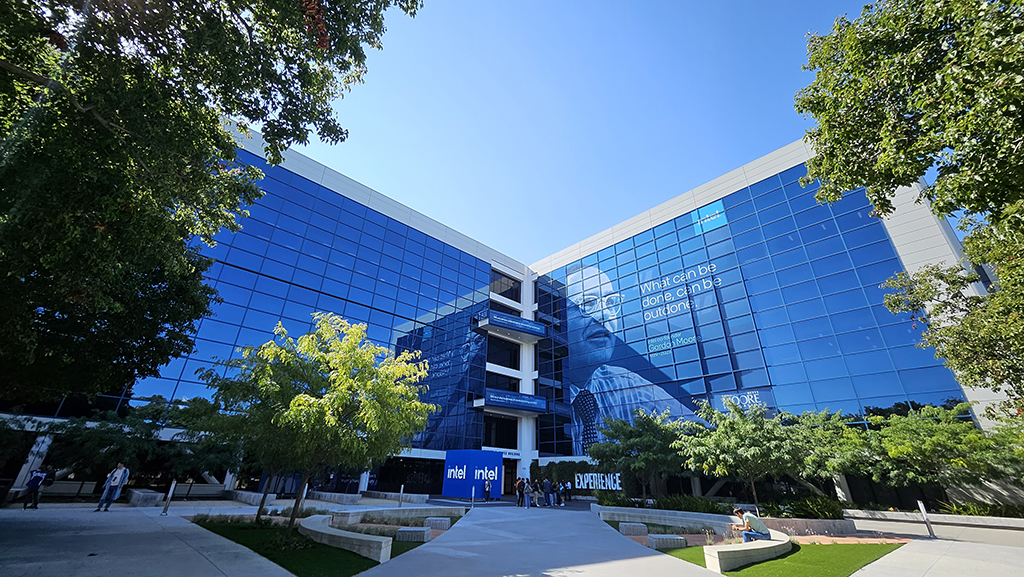
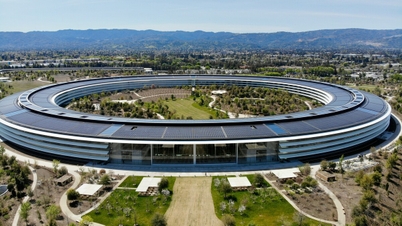
Intel headquarters in Santa Clara
Tim Cook's statement is not an exaggeration. Not only did Dr. Gordon Moore co-found Intel Corporation in 1968, but he also formulated Moore's Law, laying the crucial foundation for semiconductor chips for over half a century. Published in 1965, Moore's Law states that the number of transistors per square inch doubles every 24 months. This increase in transistors leads to increased chip performance. Moore's Law not only paved the way for Intel's development but also for the entire Silicon Valley technology industry.
From the foundations of Silicon Valley
Nevertheless, nearly 20 years before Intel was founded, Silicon Valley began to embrace its first platforms, building on existing foundations for military purposes.
In 1951, to build a financial foundation for the development of Stanford University (located in Silicon Valley) and to provide employment opportunities for local students after graduation, Professor Frederick Terman proposed leasing Stanford's land to create an office complex for businesses, known as the Stanford Industrial Complex (later the Stanford Research Park). At that time, Professor Terman focused on attracting high-tech companies, and many businesses flocked to the area, later becoming major names in the technology industry.
In 1956, William Shockley, co-inventor of the first active transistor, moved from New Jersey to Mountain View in Silicon Valley to start the Shockley Semiconductor Laboratory, which played a crucial role in the technological development of Silicon Valley. Therefore, both scientists Frederick Terman and William Shockley are often referred to as the "fathers of Silicon Valley."
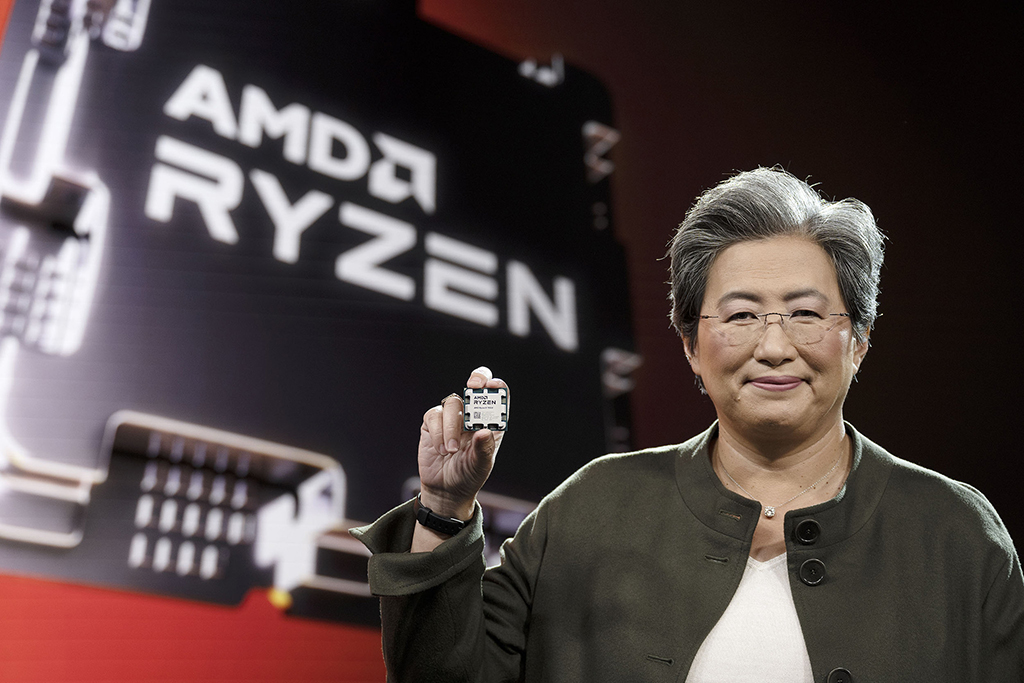
AMD introduces the Ryzen 7000 series of CPUs.
However, these factors alone were not enough to propel Silicon Valley forward! Along with the human resources from Stanford University and the technological achievements of its inventors, Silicon Valley also benefited from the convergence of venture capital funds in the early 1970s, which fueled the growth of many startups. Thanks to venture capital resources, in December 1980, Apple launched its initial public offering (IPO) and reached a market capitalization of $1.5 billion – an impressive figure at the time. By the 1980s, Silicon Valley had become the world's largest hub for venture capital. This was accompanied by the presence and expansion of a banking system, a network of lawyers and law firms… to comprehensively support startups in the region.
Towards competition that goes beyond limits.
Exactly one year after Intel was founded, AMD Corporation was also established in 1969 and later became Intel's key rival for many years. As the two "giants" in the production of central processing units (CPUs) for personal computers, Intel and AMD spent decades competing on CPU performance, with Moore's Law always being a crucial basis.
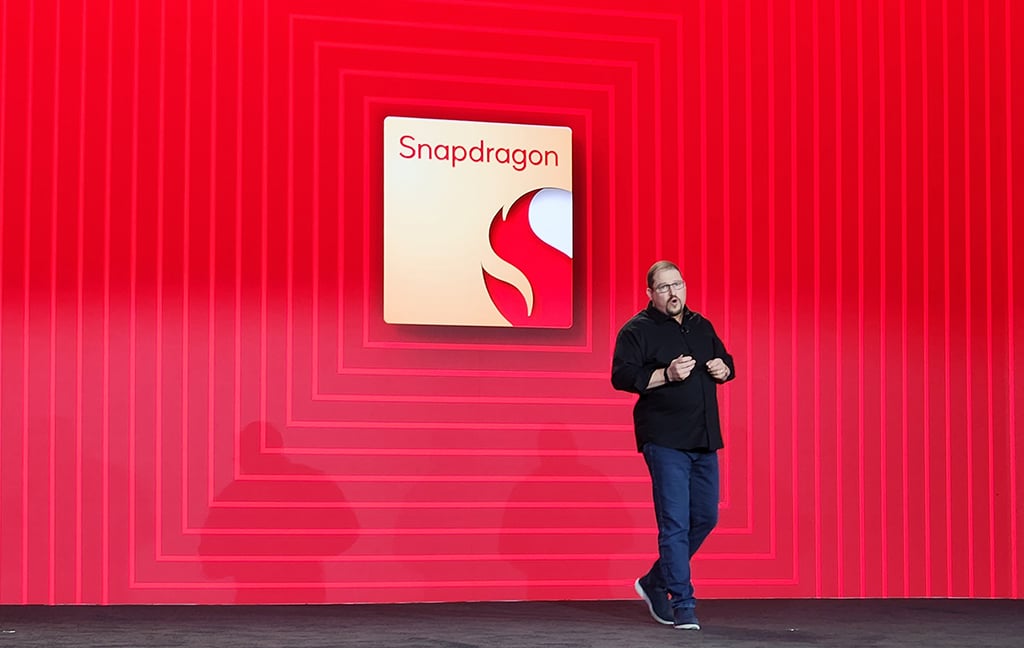
Qualcomm launched its Snapdragon mobile platform series in November 2022.
In recent years, with the explosion of artificial intelligence (AI) technology, the need for improvements to push semiconductor chips beyond their limits has become even more urgent. In August 2022, attending an AMD event in Texas (USA), I witnessed the launch of the latest generation of Ryzen 7000 Series processors, which feature a manufacturing process of only 5 nm (transistor size of 5 nm) to increase the number of transistors per unit area.
Less than a year later, at the Intel Innovation event held in September 2023 in San Jose, California, Intel CEO Pat Gelsinger announced that the company was upholding Moore's Law by replacing the chip die material with glass, thereby increasing the number of transistors on a semiconductor chip. This is seen as a measure for Intel to maintain Moore's Law in chip development even beyond 2030.
However, the competition isn't limited to just Intel and AMD. Another major player is Qualcomm. After years of focusing on processors for smartphones and tablets, Qualcomm is gradually expanding into processors for highly mobile laptops. In December 2019 in Hawaii (USA), before the Covid-19 pandemic, Qualcomm introduced the Snapdragon 8c platform with a 7nm process for laptops. Then, in November 2022, also in Hawaii, the third-generation Snapdragon 8cx platform was launched for laptops with a 5nm process. Most recently, at the end of 2023, the Snapdragon X Lite, the "younger sibling" of the Snapdragon 8cx, was released with a 4nm process.
But that's not all; the explosion of AI also opened up opportunities for NVIDIA – a company co-founded by Jensen Huang, a veteran of AMD and a Stanford graduate. In September 2022, NVIDIA introduced the H100 graphics processor (GPU) priced at over $30,000 (over 700 million VND). Despite the high price in a context where businesses were tightening their belts, NVIDIA unexpectedly achieved great success because the H100 met the needs of AI development as ChatGPT exploded globally. In the third quarter of 2023 alone, NVIDIA sold over 500,000 H100 GPUs. NVIDIA's market value skyrocketed to over $1 trillion. NVIDIA also partnered with Microsoft to produce ARM-based CPUs for laptops.
Beyond product competition, billionaire Jensen Huang also introduced Huang's Law, which states that semiconductor chip performance will increase 25 times in 5 years, compared to only about 10 times in the same period according to Moore's Law. This is considered to open up even higher limits in the race for supremacy in the Silicon Valley era.
Source link

![[Photo] The General Secretary, President and his wife meet with Vietnamese-Chinese friendship leaders.](https://vphoto.vietnam.vn/thumb/1200x675/vietnam/resource/IMAGE/2026/04/15/1776264829725_vna-potal-tong-bi-thu-chu-tich-nuoc-to-lam-gap-mat-nhan-sy-huu-nghi-viet-nam-trung-quoc-8703641-3130-jpg.webp)
![[Photo] National Assembly Chairman Tran Thanh Man attends the opening session of IPU-152](https://vphoto.vietnam.vn/thumb/1200x675/vietnam/resource/IMAGE/2026/04/16/1776277863731_ctqh5-jpg.webp)
![[Photo] Mrs. Ngo Phuong Ly meets and exchanges views with Mrs. Peng Li Yuan](https://vphoto.vietnam.vn/thumb/1200x675/vietnam/resource/IMAGE/2026/04/16/1776277858080_phu-nhan-1-jpg.webp)
![[Photo] My Son at night: A thousand-year-old heritage site amidst the Milky Way](https://vphoto.vietnam.vn/thumb/1200x675/vietnam/resource/IMAGE/2026/04/15/1776261039184_ndo_br_chon6-jpg.webp)








































































Comment (0)