

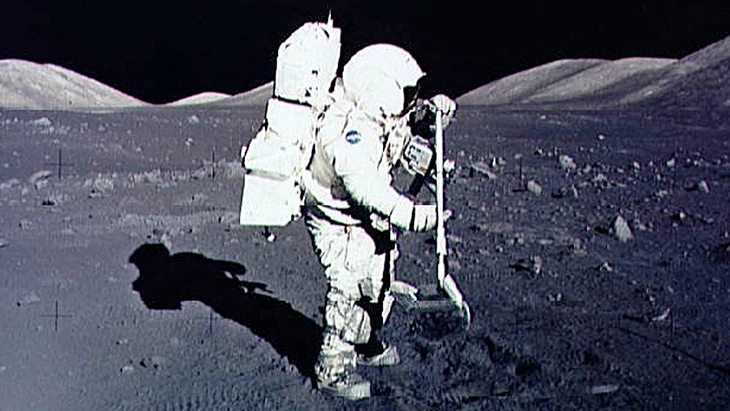
Astronaut Harrison Schmitt collected lunar rock samples during the Apollo 17 mission in December 1972 - Photo: AFP/nASA
Recently, the US National Aeronautics and Space Administration (NASA) officially banned Chinese citizens from participating in all space programs, even if they have a US visa.
This decision has deprived Chinese students, researchers, and contractors of access to NASA facilities, networks, and documents, and highlights the escalating space race between the US and China.
$19 million/kg
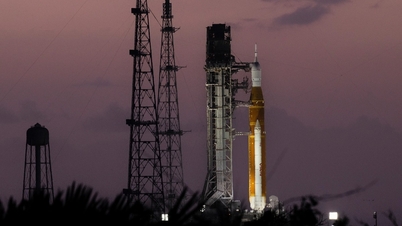
Both the US and China are working to send astronauts to the moon in the next few years. NASA plans to launch the Artemis 2 mission early next year, sending astronauts to orbit the moon and return to Earth, followed by the Artemis 3 mission to land humans on the moon's south pole in 2027 (which would also be the first human landing on the moon since the Apollo 17 mission in December 1972).
Meanwhile, China has pledged to land its first manned spacecraft on the moon by 2030, and has recently announced significant progress on the necessary equipment, including the Long March 10 rocket and the Lanyue lunar lander.
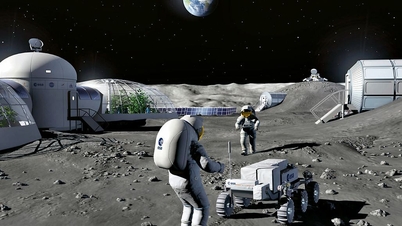
These two countries are leading missions to explore the Moon's south pole, aiming to land at strategic locations to build bases and access resources such as water ice and sunlight—essential elements for sustaining a long-term presence on the lunar surface.
The Conversation website suggests that the nation that arrives first could gain influence in shaping the future rules governing space and the lunar economy , particularly for private companies. This has sparked discussions about a "strategic infrastructure race" or even a "trade war" in space.
This race isn't limited to just countries. In early September, Forbes reported that Interlune, a US-based startup, is "racing to be the first to mine helium on the Moon."
Helium can be applied in many fields, from quantum computing to nuclear fusion. Helium-3 is a rare and non-radioactive isotope on Earth, but is more common on the Moon, valued at $19 million per kilogram.
One ton of helium-3 is capable of generating 1.5 times more energy than the Soviet Union's Tsar Bomba nuclear weapon.
Start-ups are also developing methods for extracting water and minerals on the Moon to produce rocket fuel or build structures there, such as Starpath and iSpace. Other companies, like AstroForge, want to mine precious metals from asteroids, aiming to reduce the need for resource extraction on Earth.
A tense race
Senior NASA officials acknowledge that the world is witnessing a "second space race." NASA Administrator Sean Duffy stated that China is aiming to land astronauts on the moon before the United States.
"The Chinese want to get back to the moon before us. That's not going to happen. America has been a leader in space in the past, and we will continue to be a leader in the future," he said on September 10.
The timelines set by the U.S. for its moon landing plan seem to put Washington in the lead, but in a hearing before the U.S. Senate Commerce Committee in early September, experts concluded that there is a real possibility the U.S. could lose to China in the moon race.
One of the reasons cited is the rapid development of SpaceX's Starship spacecraft (which will serve as the lunar lander for the Artemis 3 mission), along with the need for multiple refueling missions to get Starship to the Moon.
Several U.S. senators have warned that China's dominance of lunar resources could pose a serious threat to U.S. strategic and technological interests.
Conversely, Chinese officials argue that U.S. concerns have been exaggerated. Last year, Li Yingliang, director of the Technology Bureau of the China Manned Space Administration, said that space exploration should be considered a "common mission of humanity."
However, Beijing also makes no secret of its ambition to build a permanent base on the Moon and develop long-range, manned space missions.
For many years, the U.S. Congress has restricted NASA's cooperation with China, citing national security risks. Washington's suspicion of Beijing has grown as China's space program has made rapid progress.
Valuable resources
The Moon is known to be rich in valuable resources such as rare earth minerals, titanium, iron, and especially helium, which plays a crucial role in many industries, from advanced electronics to medical technology.
According to some estimates, the total value of these resources varies widely from billions to trillions of USD. Analysts note that while the Moon could be a lucrative source of income, it would be a very long-term investment, as the technology needed to extract and transport resources from the Moon back to Earth is still far from being developed.
Source: https://tuoitre.vn/cuoc-dua-khai-thac-helium-3-tren-mat-trang-20250914232545838.htm











































































Comment (0)