

In When a child is drowning, the first thing to do is to restore their oxygen supply. What are the "5 golden breaths" to save a drowning child?
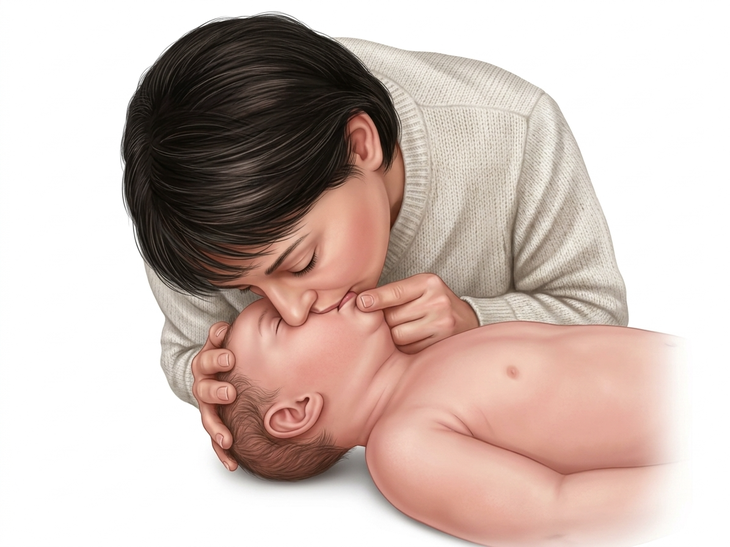
Drowning accidents: Remember the "5 golden breaths"
Even children who know how to swim can drown. In many drowning cases, if proper first aid is administered in the first few minutes, the child still has a chance of survival.
Many parents think that once their children have learned to swim, they are safe. But swimming in a pool is very different from swimming in a river, pond, canal, or the sea. Underwater, there may be strong currents, deep holes, whirlpools, or areas prone to landslides that children are unaware of.
Cold water can easily cause cramps, especially when children panic and try to swim against the current to reach the shore, quickly becoming exhausted. When choking on water and losing composure, children can sink very quickly even if they were previously good swimmers.
A very dangerous mistake nowadays is that many people still "shake the baby upside down," carrying the child around in the hope that the water in the lungs will drain out. In reality, this method is not correct according to current resuscitation guidelines. The water that drains out mainly comes from the stomach, not the lungs.
Shaking the child's head also increases the risk of fluid aspirating into the airways, making suffocation worse. Most importantly, it wastes the "golden time" for respiratory resuscitation. Even a few minutes of prolonged oxygen deprivation to the brain can cause severe damage.
In drowning cases, the first thing to do is to restore oxygen to the child. First, artificial respiration is necessary. According to the CDC and the American Heart Association, the latest drowning emergency care, along with the European Council on Resuscitation's 5-breath protocol, has brought artificial respiration back to the top priority in drowning emergency care, instead of overusing the "only" protocol. "Cardiac compression" is typically reserved for people who have suffered a heart attack or stroke.
Unlike many cases of cardiac arrest in adults due to heart disease, drowning is a condition where the body is deprived of oxygen first, and then the heart stops beating. Therefore, in drowning resuscitation, early mouth-to-mouth resuscitation plays a very important role.
As soon as you get the child ashore, quickly call for help to call emergency services (115), and begin first aid immediately.
When performing artificial respiration, remember the 5 golden breaths.
The initial "five golden breaths" rescue technique for drowning victims needs to be performed correctly and calmly. It consists of four steps:
Step 1: Place the child on their back on a hard surface, with their head and body straight.
The rescuer kneels beside the child's head. If the wet clothing is too thick and covers the chest, it can be quickly loosened to allow for easier observation of the rib cage.
Step 2: Clear the airways.
Place one hand on the child's forehead and gently tilt the head back. Use two fingers of the other hand to lift the chin. This movement prevents the tongue from falling back and blocking the trachea. Do not bend the child's neck forward as this will narrow the airway.
If you see mud, algae, food particles, or mucus in your mouth, quickly remove them with a finger wrapped in a clean cloth. Do not try to remove them further if you cannot see the foreign object, as this may worsen the blockage.
Step 3: Mouth-to-mouth resuscitation.
For children over 1 year old: Hold the child's forehead with one hand, tilting their head slightly back. Use the thumb and index finger of that hand to seal both nostrils. The rescuer takes a normal breath, not too deep. Seal their mouth completely over the child's mouth to prevent air from escaping.
For children under 1 year old: A separate nose plug is not necessary. The rescuer's mouth will cover both the child's nose and mouth simultaneously because the child's face is still small.
How to blow: Blow slowly and evenly for about 1 second each breath. Do not blow too hard. Keep your eyes on the child's chest. The most important sign that you are blowing correctly is when the child's chest rises gently with each breath.
If the chest doesn't rise: You need to adjust your posture, tilt your head back and lift your chin, check your mouth for any foreign objects, and then blow again.
After each breath: Lift your mouth, release your hand covering your nose (if it's an older child), allow your chest to deflate naturally before taking the next breath.
The rescuer repeated the rescue breaths five times in a row.
Things to avoid: Don't shake the water out. Don't press on the stomach. Don't blow too hard or too fast. Don't waste time trying to "get the water out".
Just blow enough to make your chest rise; that's all you need to do.
After the first five breaths: If the child begins to cough, breathe on their own, or move, continue monitoring and take them to the hospital promptly.
Step 4: Chest compressions.
If the child remains unconscious and is not breathing on their own, begin chest compressions in cycles of 30 chest compressions + 2 breaths and call 115 as soon as possible.
The most important thing in drowning emergency care is to get oxygen to the brain as quickly as possible. In many cases, just a few proper breaths in the first few minutes can save a child's life.
Continue this treatment until medical personnel arrive or the child shows signs of recovery.
Even if a child regains consciousness after drowning, they should still be taken to a medical facility for monitoring because respiratory failure or pulmonary edema may develop later.
Prevention is the most important thing.Parents must absolutely not allow children to swim in rivers, ponds, lakes, or the sea without adult supervision. The supervisor must always be close enough to reach and touch the child if necessary. At home, water containers, fish tanks, and water reservoirs must have secure covers. Areas with deep rivers, strong currents, ferry terminals, or landslide-prone areas should have clear warning signs. In addition to learning to swim, children also need to learn "survival swimming" skills such as learning to float, staying calm when falling into the water, knowing how to call for help, and not panicking. A moment of carelessness can cost a child's life. But sometimes, just a few minutes of calm, knowing how to perform the "five golden breaths," can save a life teetering on the brink of death. |
Source: https://baotayninh.vn/cuu-tre-bi-duoi-nuoc-ra-sao-147527.html





![[Image] Close-up view of the interchange connecting the two expressways and Long Thanh Airport.](https://vphoto.vietnam.vn/thumb/1200x675/vietnam/resource/IMAGE/2026/05/25/1779703378210_ndo_br_z7863716673926-224453a31600126cce10622af6290afd-4549-jpg.webp)































































































Comment (0)