

A place where wisdom converges.
In his speech at the 120th anniversary celebration of Hanoi National University, General Secretary and President To Lam placed higher education in the position of a hub for national intellect, solving major national problems through technology.
For many years, we've talked about universities using familiar concepts like training, research, learning outcomes, and rankings. But this message reveals a different approach: universities must become "centers of innovation," places where scientific arguments are formed for national development decisions. This is no longer the mindset of an education system solely focused on exams, but the mindset of a nation that wants to compete through knowledge.
One of the notable points in the General Secretary and President 's speech was the requirement for universities to "dare to lead, dare to experiment, and pave the way for new models." This is not just an expectation for a single university, but reflects the need for innovation in the entire Vietnamese higher education system in an era of competition based on technology and creativity.
Therefore, the "pioneering" spirit emphasized this time is not just a requirement for innovation in governance or training methods, but more fundamentally, a change in university thinking in the new era.
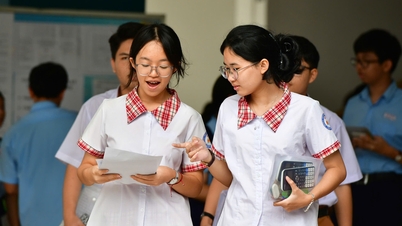
In the era of AI and digital transformation, what society needs is not just students who excel at memorizing knowledge, but individuals with critical thinking skills, creative thinking, adaptability, and the courage to propose new ideas. This is also the core value of modern higher education.
When General Secretary and President To Lam emphasized the formation of a training-research-innovation ecosystem linked to the Hoa Lac High-Tech Park, it showed that education is being placed in direct connection with science and technology, competitiveness, and the future of the national economy. Universities are no longer outside the development process, but must become a link in the national innovation chain.
Over the years, the gap between the classroom and the labor market has remained a frequently discussed issue. There have been periods when students followed programs heavily focused on theory, while businesses needed practical skills and adaptability. Many research projects, even after completion, remained on paper, lacking the ability to be applied in practice.
This is especially important as Vietnam enters a new competitive landscape in artificial intelligence, big data, semiconductor industry, green transformation, and the digital economy. In this competition, advantages in cheap labor or natural resources will gradually diminish. Ultimately, national development capacity will depend on the quality of its people and their level of knowledge.
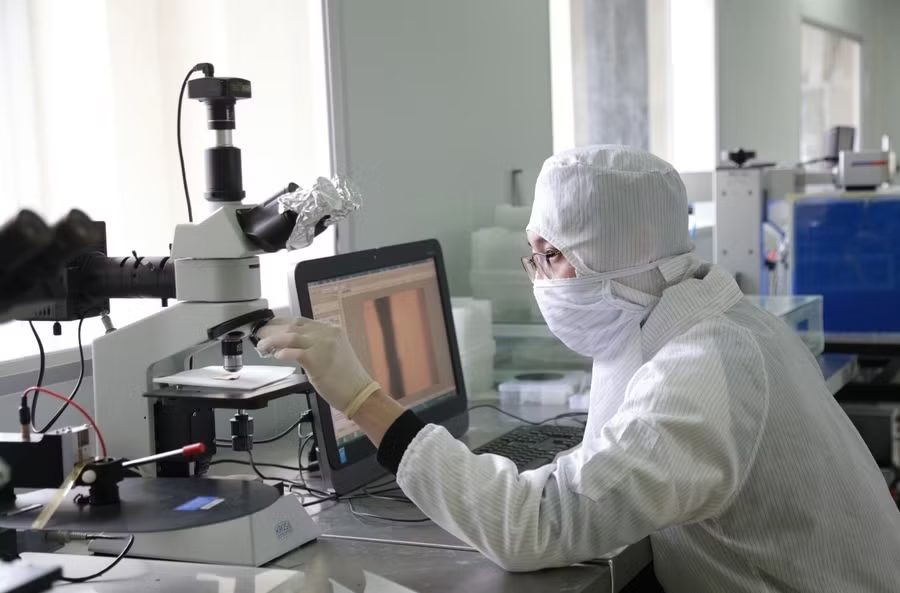
Universities face the opportunity for transformation.
The 120th anniversary milestone not only holds historical significance for an educational institution but also serves as a reminder of the transformation of Vietnamese higher education through various stages of national development. While in the past universities primarily focused on training personnel, today that role has expanded significantly: universities must become a direct part of national competitiveness through research, innovation, and the development of high-quality human resources.
This also represents a major shift in educational development thinking. To meet new demands, universities need to innovate more strongly, from governance models and training methods to research mechanisms and the development of an academic culture. Because ultimately, a strong university is not measured by the size of its facilities, but by its ability to create new knowledge and make a real contribution to society.
Innovation in higher education must stem from a clear, actionable mindset, encompassing everything from development roadmaps and performance-based governance mechanisms to investment in scientific infrastructure, attracting talent, and expanding international connections. This demonstrates that the spirit of innovation cannot remain merely a slogan, but must permeate every lecture hall, every lesson, and every research project every day.
Ultimately, the greatest value that the speech reveals lies not in ranking goals or the scale of development, but in the perspective on the role of knowledge in the nation's future. A country may lack many resources, but if it loses faith in education and the power of its people, it will be difficult to create sustainable development momentum.
Therefore, what Vietnamese higher education needs to aim for is not only training human resources, but also building a university system strong enough to nurture a spirit of openness, preserve intellectual dignity, and contribute to the country's development through the power of knowledge and creativity.
Source: https://giaoducthoidai.vn/dai-hoc-duoc-dat-vao-trung-tam-suc-manh-tri-thuc-quoc-gia-post778041.html


















































































Comment (0)