

Few people know that, despite being a track and field athlete, Mạnh is visually impaired due to a congenital condition called nystagmus (involuntary eye movement). For him, the path ahead isn't a clear track, but a blurry, shapeless expanse. Each step he takes is accompanied by a touch of hesitation, then reinforced by unwavering faith.
Overcome your own limitations.
In the memories of Vu Tien Manh (born in 2000 in Phu Tho ), his childhood in the countryside was not very peaceful; sad stories about differences still linger. Seemingly unintentional teasing from his peers often hurt the visually impaired boy, leaving him with feelings of inferiority and self-pity. But instead of withdrawing, Manh gradually learned to confront, accept, and see it as an indispensable part of his journey to adulthood.
 |
| Whether it's sunny or rainy, athlete Vu Tien Manh still trains regularly. |
In 2013, as a student, Mạnh was first introduced to sports activities for people with disabilities by his school. He recalled, in a calm voice but unable to hide a hint of emotion: "Before that, I never thought that visually impaired people like me could play sports." At that time, sports for people with disabilities in Vietnam were not really developed. Options were limited, training conditions were lacking, and opportunities were almost nonexistent.
Vu Tien Manh's journey wasn't marked by easy progress, but rather by a series of quiet days of adaptation and overcoming his own limitations. For a visually impaired person, starting in athletics wasn't just about learning to run, but also about learning to believe. Believing in the guide, believing in the sensations of his body, and more importantly, believing that he could move forward even without seeing the finish line. Repetitive training sessions, stumbles, and missteps weren't failures, but an inevitable part of the training process.
In the early days, everything was uncertain. His family objected, his parents worried about injuries, and he himself couldn't yet envision what the future held. But after he achieved success and brought home medals, along with encouragement from his teachers, his parents gradually accepted and supported his pursuit of professional sports.
Glory and the nameless voids
In a conversation with us, Vu Tien Manh recalled: “In 2016, I moved to Hanoi – a large, unfamiliar city where I had to manage everything myself. I studied academics, learned massage and acupressure, worked part-time in the evenings to make ends meet, and still maintained my sports training. This went on for many years. I went to school during the day, worked at night, and woke up early in the morning to go running.” Manh's family provided some support, but it wasn't enough. His parents in the countryside were farmers with limited income. He had to cover all the expenses in Hanoi himself.
 |
| Vu Tien Manh became the first visually impaired athlete from Vietnam to conquer the full marathon distance (42.195km). |
During training, things don't always go smoothly. There are days when his body is tired, his spirits are low, and coordination with his instructor isn't perfect. But instead of giving up, Mạnh chooses to adjust and patiently start again. For him, progress doesn't come from leaps forward, but from being a little better each day than the day before.
About three years later, when things gradually stabilized, Mạnh was able to stop his part-time job to focus entirely on training and competing. This was not just a career change, but also a crucial turning point, helping him adapt to the intensity of professional competition, gradually improve his performance, and establish his position in sports.
Contrary to many people's perceptions of the dependence of the visually impaired, Vu Tien Manh's life is a testament to absolute self-reliance. Aside from specialized training sessions requiring the assistance of a guide, he handles all aspects of daily life as efficiently as a sighted person. This sense of independence has been cultivated since a very young age.
In sports, glory always comes with pressure. Manh has been through his fair share of ups and downs, from standing on the podium to receiving medals to bitter defeats. But there's one memory that, whenever he recalls it, still brings a hint of sadness and regret to his eyes.
That was the time he and his teammates crossed the finish line first. At that moment, everyone was certain the gold medal was theirs. But reality was different: his guide had taken a step faster. Just one misstep, however small, was enough for the referee to declare a foul according to international rules. The result was immediately annulled. "That time, we lost the gold medal. It's a very unforgettable memory," Mạnh said.
Light the fire with your running steps.
Not just running for himself, Vu Tien Manh also wanted to expand that path to others like him. From running with the community, receiving encouragement and help from many people, he began to think about creating a dedicated environment for the visually impaired. The Blind Runners Club was thus born. Currently, the club has nearly 40 visually impaired runners and about 30 volunteers. These numbers aren't large, but they're enough to create a close-knit network. For the volunteers, the greatest joy isn't material gain, but the feeling of happiness from participating in the community and becoming the "eyes" for the runners in the club.
 |
| Vu Tien Manh (right) and his guide conquer the Hung Temple Marathon 2025. |
Nguyen Anh Duong, 24, currently living and working in Hanoi, has been a volunteer at the club for two years. She shared: “I feel very happy to be with the club. Seeing the athletes being supported and motivated makes me feel the meaning of what I am doing.” Although they are not professionals and are not paid, those who stay are very special, Mạnh affirmed.
With its positive values spreading throughout the community, the Blind Runners Club was honored to be among the top 10 most influential clubs at the Vietnam Runners Awards. Notably, in 2025, the club continued to receive recognition with the "Club of the Year" award from the Ho Chi Minh City Athletics Federation.
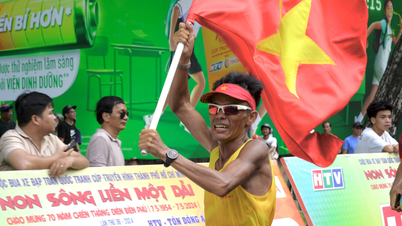
Amidst the hustle and bustle of life, Vu Tien Manh maintains a very simple philosophy: Sports don't need to be complicated. "Just 20-30 minutes a day is enough to improve your health," he says. For him, running isn't just about physical training; it's also a way to maintain mental stability and avoid being overwhelmed by invisible pressures. After 11 years of continuous training and effort, in 2023, Vu Tien Manh became the first visually impaired Vietnamese person to complete a full marathon (42.195km) at the Halong Bay Running Race. Besides that, he has also won many valuable medals, including 3 silver medals at the 2023 Southeast Asian Para Games, and 10 gold and 40 silver medals at the Vietnamese National Paralympic Championships.
Through his persistent runs on the track, Vu Tien Manh has pushed himself beyond his limits day by day. More than just the journey of a visually impaired athlete, each step he takes spreads faith and determination to those around him, especially the disabled community. Amidst quiet training sessions, Manh perseveres, moving forward despite numerous challenges. For him, as long as he has the strength, he will run; as long as there is an opportunity, he will strive. And it is this perseverance that has, is, and will continue to ignite powerful, yet silent, sources of motivation within the community.
Source: https://www.qdnd.vn/phong-su-dieu-tra/cuoc-thi-nhung-tam-guong-binh-di-ma-cao-quy-lan-thu-17/vu-tien-manh-va-buoc-chay-cua-niem-tin-1041808




![[Image] Nearly 125,000 Hanoi students completed the Literature exam for the 10th grade entrance exam.](https://vphoto.vietnam.vn/thumb/1200x675/vietnam/resource/IMAGE/2026/05/30/1780117233041_ndo_br_thiet-ke-chua-co-ten-2-png.webp)












































































Comment (0)