

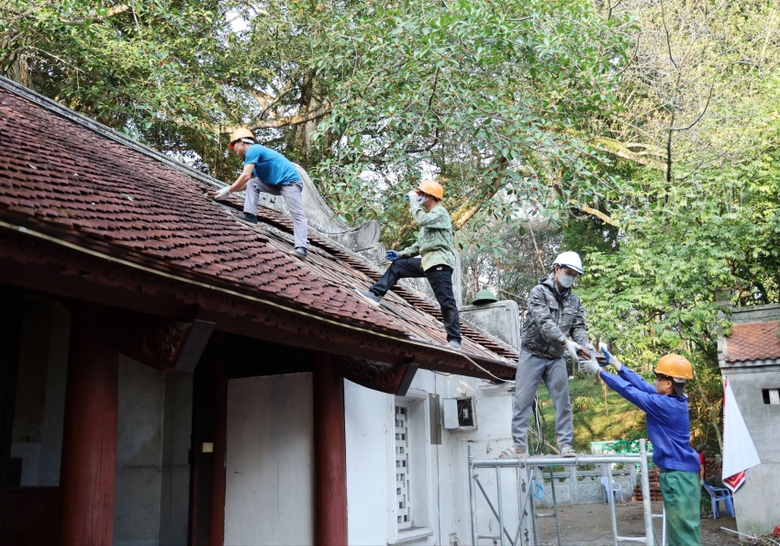
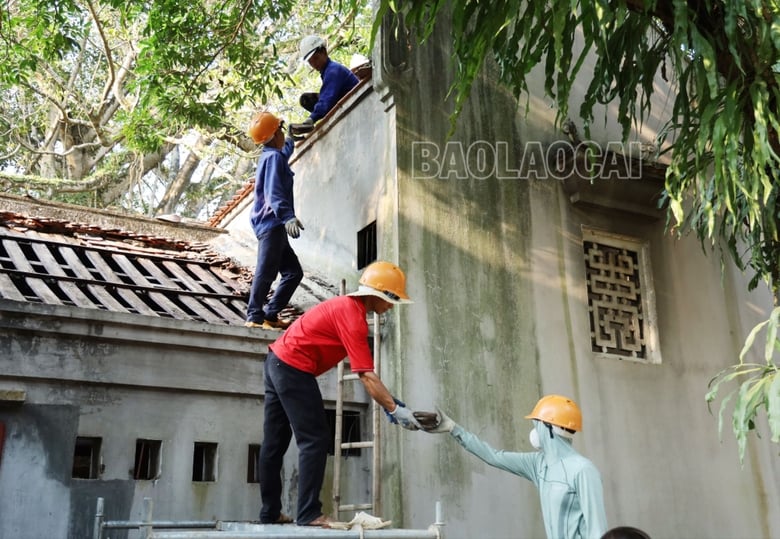
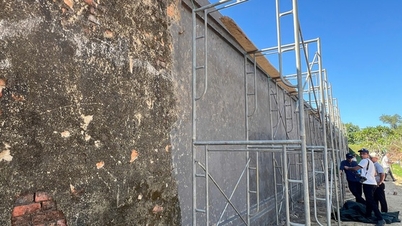
Despite being on holiday, the construction unit, a joint venture between Vietnam Civil and Cultural Works Construction Joint Stock Company and Thai Minh Investment and Construction Consulting Joint Stock Company, maintained a workforce of 17 to 20 workers to continue the dismantling of the old structure, including the main temple, the left wing, and the right wing.
According to Mr. Nguyen Khanh Hoa, the technical manager: In addition to ensuring workplace safety, the dismantling work requires meticulous execution to ensure the original condition is preserved for reuse in other projects. Workers are actively working even on holidays to avoid falling behind schedule.

To ensure the restoration and preservation of the Thượng Temple and Am Temple complex, the city of Lào Cai has announced a temporary suspension of visits, worship, and rituals at the Thượng Temple and Am Temple from April 16th to August 31st, 2024 (corresponding to the 8th to 28th day of the 7th lunar month). Simultaneously, the City's Relics Management Board has completed the relocation of statues and religious artifacts, creating the most favorable conditions for the construction unit to proceed with the dismantling.
This renovation involved completely rebuilding the Upper Temple and the Am Temple, resulting in an expansion of the temple's area. Specifically, for the Upper Temple, the main temple building's area increased from 151 m² to 251 m² ; the left and right side buildings increased from 51 m² each to 74 m² ; the temple courtyard expanded from 230 m² to over 300 m² ; and the inner ceremonial gate and many other auxiliary structures were renovated. For the Am Temple, the area increased from 58.7 m² to 103 m² .
Construction began on April 15th and is expected to be completed around August 10th, 2024. The project to restore and renovate the Thuong Temple and Am Temple is managed by the City's Relics Management Board, with a total budget of approximately 47 billion VND, sourced from donations and social contributions.
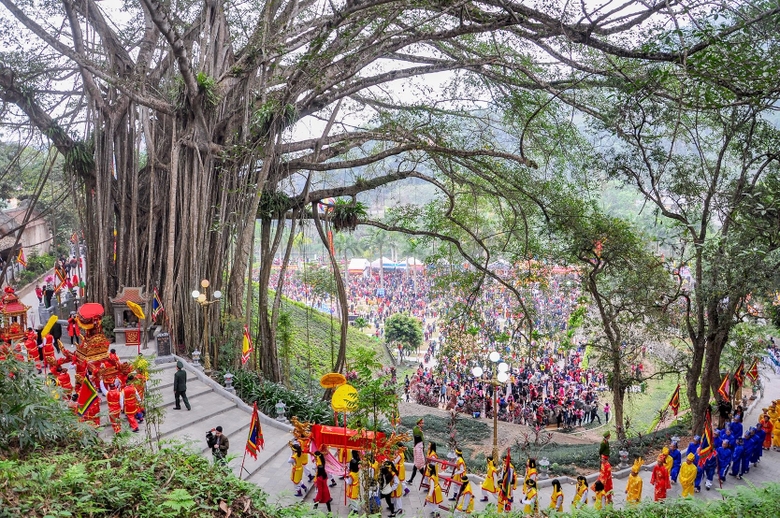
The Upper Temple, dedicated to National Hero Tran Quoc Tuan (Hung Dao Dai Vuong), who made significant contributions to the defense of the nation's borders, is located on Hoa Hieu Hill in Lao Cai Ward, Lao Cai City. The temple was built during the Le Dynasty, in the Chinh Hoa era (1680-1705), in the shape of the Chinese character "Công". In 1996, the Upper Temple was classified as a National Historical and Cultural Monument. In 2012, the banyan tree at the Upper Temple was also recognized as a Vietnamese Heritage Tree. Every year, Lao Cai City organizes the Upper Temple Festival on the 15th day of the first lunar month, attracting thousands of visitors who come to pay their respects and show their reverence for the national hero Tran Quoc Tuan.
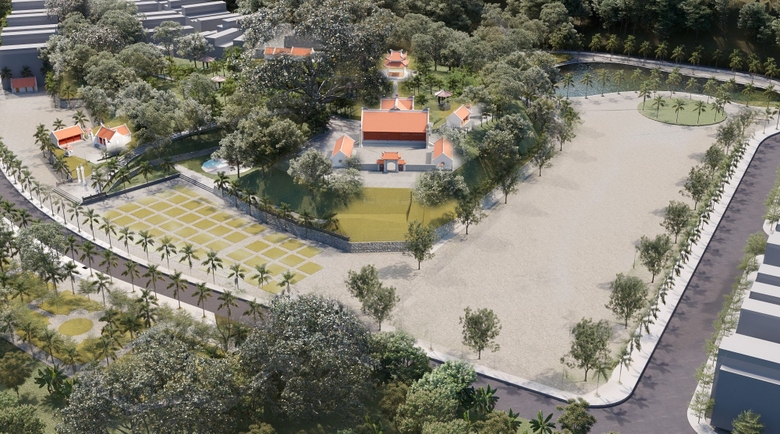
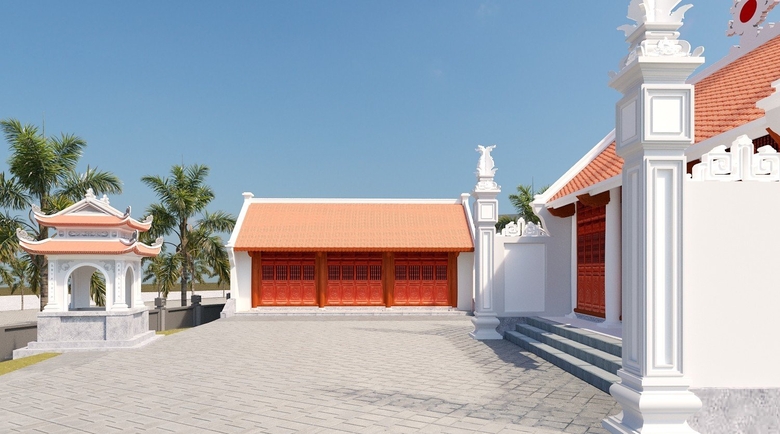
Mr. Ngo Ngoc Ha, Head of the Lao Cai City Relics Management Board, said: "The Upper Temple has undergone many renovations and restorations. This major renovation marks the 100th anniversary of the temple's relocation to its current position. After the renovation, the Upper Temple and the Am Temple are larger and more beautiful, meeting the needs of visitors from all over for sightseeing and worship, while still preserving the ancient architecture of the Tran Dynasty."
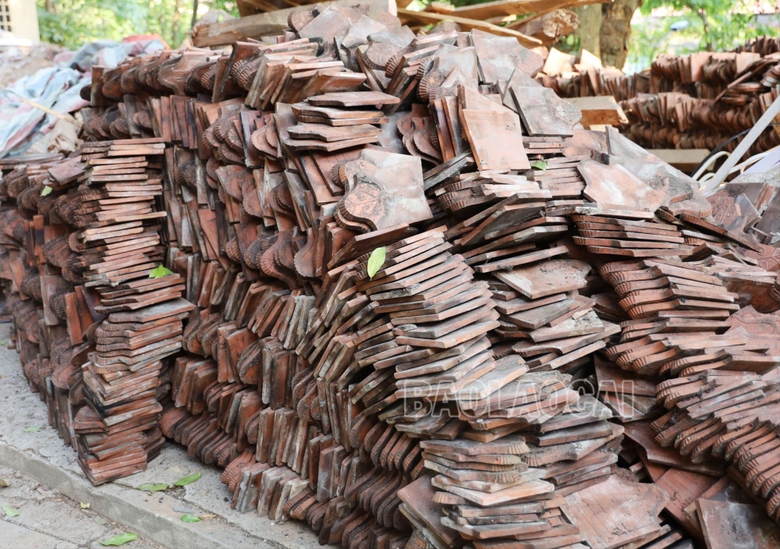
Due to the unique nature of the structure, the dismantling process differs from other structures and requires manual labor. Workers carefully remove each roof tile, truss, purlin, and other structural component, ensuring their original condition is preserved. After the dismantling is complete, the city's Heritage Assessment Council will evaluate which parts can be reused and which parts should be preserved for future reuse.
After the demolition is complete and all requirements are met, construction of the next planned items can proceed.
Source

![[Photo] General Secretary and President To Lam presides over the meeting to approve the draft report on the results of the second inspection by the Politburo of the Standing Committee of the Hanoi City Party Committee.](https://vphoto.vietnam.vn/thumb/1200x675/vietnam/resource/IMAGE/2026/05/26/1779789811432_a2-bnd-4430-9620-jpg.webp)

































































Comment (0)