A woman in her 70s, living in a small alley in Hanoi's Old Quarter, has been selling clam porridge from a mobile stall for decades, resolutely refusing any subsidies or money from anyone. Every morning, she still diligently gets up early to cook a pot of porridge and sits selling it until noon.
Another man, nearly 45 years old, came from the provinces to Hanoi and has been working as a motorbike taxi driver for over 15 years. He has a wife and two children. To support his family and pay for his children's education, he needs to earn at least 17 million VND per month, so he drives for 14-15 hours almost every day.
There are also working-class couples from Central Vietnam who came to Hanoi with an initial combined income of less than 20 million VND per month. They worked overtime for many years, lived extremely frugally, and saved every penny to buy land and build a house.
These kinds of people don't appear in success forums or glamorous inspirational stories, but they are the very force that keeps this city running.
This city isn't just made up of the most prominent or successful people. It's also kept alive by the street vendor selling sticky rice at the corner from dawn, the street sweeper working while the streets are still asleep, the delivery drivers under the scorching sun, and the air conditioner repairman working on rooftops in the sweltering midday heat.
These people may not be exceptionally brilliant, but they are the ones who keep this city lit, alive, and functioning every day.
Therefore, comments on social media such as "If you're not exceptionally talented, don't stay in Hanoi" have sparked much debate.

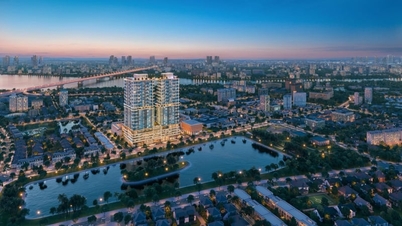
The more modern a city becomes, the more order it needs, so the most difficult challenge is how to ensure that this modernization process remains inclusive of ordinary people. Photo: Hoang Ha
It's true that Hanoi is a fiercely competitive city, with an increasingly high cost of living and immense pressure to make a living. In a large metropolis, competence is always a crucial factor for survival and advancement. However, judging the city solely by its outstanding achievements or remarkable success is perhaps incomplete.
In fact, a large part of a city is run not only by the elite, but by many ordinary people. They may not have admirable careers or achieve great things, but they are contributing to maintaining the city's rhythm of life through their daily labor.
For many years, Hanoi has strived to become more civilized, modern, and orderly. Therefore, tightening the management of sidewalks, street vendors, and spontaneous trading is understandable from an urban management perspective. However, sometimes, looking at a sticky rice stall at the corner of an alley, a tea cart on the sidewalk, or a flower vendor in the winter, it seems that it's more than just about selling goods.
It's also how many immigrants, the elderly, and low-skilled workers make a living in this city. And it's these little things that give life in Hanoi its unique character.
The more modern a city becomes, the more order it needs, so the most difficult challenge is how to ensure that this modernization process remains inclusive of ordinary people.
Current debates about Hanoi have perhaps overlooked one thing: People don't flock to big cities because of the low cost of living, but because of the opportunities.
Income in Hanoi is currently significantly higher than the national average. This disparity in opportunities is what continues to drive people to the capital, despite rising housing prices and the cost of living.
Hanoi is currently growing by approximately 200,000 people each year and aims to become a megacity of 14–15 million by 2035.
At the same time, the city is also embarking on an unprecedented urban reconstruction. Hanoi is currently clearing land for 1,428 projects. The large-scale Red River landscape project alone affects 247,431 people.
The question of "who gets to stay in Hanoi" is therefore no longer just an emotional opinion, but has become a very real pressure that many young people are facing every day.
A city that rebuilds too quickly but whose housing prices outpace income growth can easily create a sense of urban alienation among the working class and young middle class.
And it seems that the mindset of "if you're not outstanding, don't stay in Hanoi" unintentionally places a lot of pressure from the city on the shoulders of these young people.
Because if a hardworking, decent person who earns a living through their labor still cannot survive in the city, then it is no longer a personal failure, but a problem for the city itself.
In reality, many immigrant families in Hanoi are not "outstanding" by the standards of million-dollar startups, big tech companies, or foreign currency salaries; their excellence lies elsewhere: perseverance and never giving up.
Furthermore, young people come to Hanoi not only to earn money but also to have more opportunities to learn, interact with talented people, try jobs that they might never have the chance to do in their hometowns, and see how life outside is changing every day.
That's why, despite the huge amount of coal, people continue to flock to Hanoi.
And so, the biggest question facing Hanoi today seems no longer to be how to make the city more "elite," but how to remain open enough to ordinary, hardworking, decent people who want to live a respectable life here.
Hanoi needs to be cleaner, more civilized, and more orderly, but the question is what space will remain inclusive enough for the vulnerable and the small livelihoods of this city.
Ultimately, Hanoi cannot be just a place where the best win, but also a place where ordinary people can live decent lives through their own labor.
Source: https://vietnamnet.vn/ha-noi-khong-chi-danh-cho-nguoi-xuat-sac-2519640.html



![[Photo] Standing Committee member of the Party Central Committee Tran Cam Tu working with the Central Inspection Committee](https://vphoto.vietnam.vn/thumb/1200x675/vietnam/resource/IMAGE/2026/05/28/1779969579668_ndo_br_bnd-2495-jpg.webp)
















































































Comment (0)