In his house on Luu Van Te Street (Long An Ward, Tay Ninh Province), Mr. Nguyen Hoang Duoc meticulously cleans the items he has just collected. He said that the night before he had to go to My Tho and wait until after 11 PM to receive them, and he was so happy that he stayed awake until morning. Without his explanation, those who aren't antique collectors wouldn't recognize the value of the items he's displaying.
Amidst the hustle and bustle of modern life, Mr. Nguyen Hoang Duoc has chosen to slow down his pace of life, surrounded by artifacts dating back decades, even centuries. He wants to dedicate time to understanding and listening to the past through these ancient objects. “This is a water vessel from the Chu Dau pottery line, a style that appeared around the 14th century. This is a lime container from the Quang Duc pottery line, a style about 300 years old. And these are items from the Oc Eo culture,” Mr. Duoc explains.

For Mr. Nguyen Hoang Duoc, antique pottery always holds a special appeal because of its simplicity and closeness to everyday life.
For over 20 years, Mr. Nguyen Hoang Duoc has dedicated his heart and soul to researching and collecting antiques, and is particularly passionate about ceramic products. He says that since childhood, he has been very impressed by the simple vases, teapots, and other everyday ceramic items in his grandmother's cupboard. In his memory, the household ceramics of that era were quite simply decorated, with not very diverse designs, usually just streaks of blue and red, roosters, flowers, and butterflies. Some even had smudged colors and runny glaze. Despite this, he found those items incredibly familiar. This explains why he loves antique ceramics, especially those from Southern Vietnam.
For him, collecting antique ceramics is not simply a hobby, but a way to contribute to preserving the heritage left by his ancestors. “Sometimes it’s just chipped or glazed vases, jars, or pots, but I feel very happy to own them. The value of these items isn’t in how much they’re worth, but in their historical value and age,” Mr. Duoc shared. According to Mr. Duoc, an item is considered antique when it’s 150 years old or older, while an antique is one that’s over 100 years old.
Among his countless antique collections, he dedicates space to three renowned pottery lines from the old Southern region: Cay Mai pottery, Bien Hoa pottery, and Lai Thieu pottery. With his expertise in these ancient pottery lines, Mr. Duoc shares some identifying characteristics: “Cay Mai pottery dates back to around the late 19th century, possessing a rustic beauty with its relief-sculpting technique. Most products from this line are religious artifacts and items used in temples and pagodas. Bien Hoa pottery has a sophisticated beauty, combining Western techniques with the soul of the Southern people through its striking drawings, vibrant colors, and high-quality glaze. Meanwhile, Lai Thieu pottery is a more everyday, down-to-earth style with very ordinary yet lively and vibrant decorative motifs, simple colors mainly from nature, and some products are even single-colored.”
Three lines of pottery, made with different techniques, but over time they all share the serene beauty of ancient pottery beneath a glaze riddled with cracks. He calls this "the age of the product." Everyday items used by his grandparents, through his collecting and preserving efforts, have become priceless. "I collect many, but I still have a special affection for Lai Thieu pottery because of the rustic charm of its decorative patterns. The teacups and containers still hold memories of my childhood when I used to bring water to my grandparents in the fields."
Oddly enough, he couldn't remember the total number of items from the three famous Southern Vietnamese pottery lines he owned, but when asked about each item, he could recall where he collected them, on what occasion, and what era they belonged to.
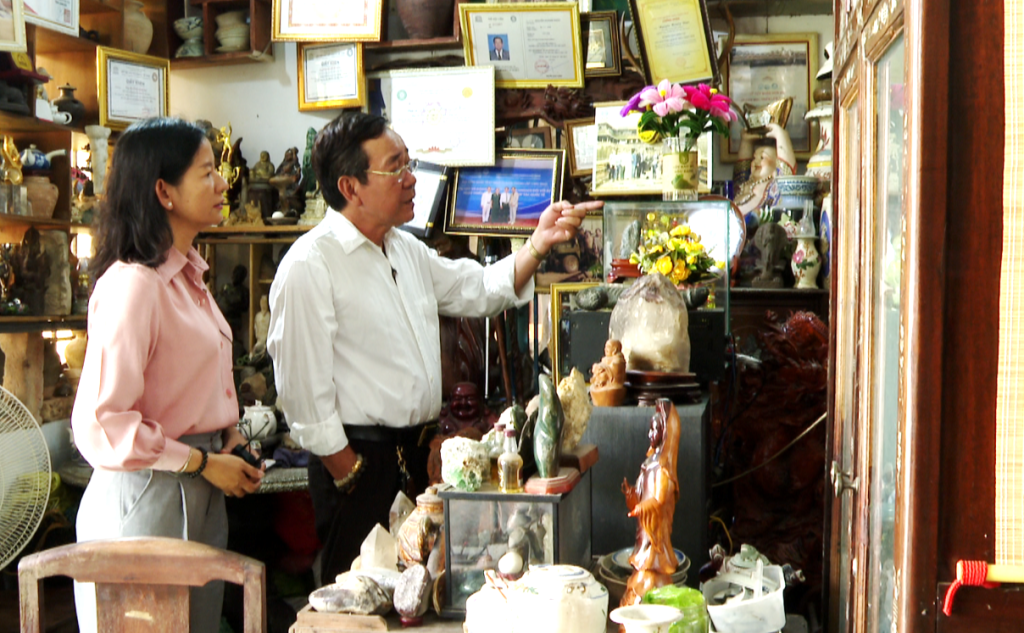
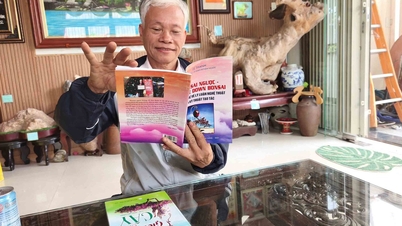
Mr. Nguyen Hoang Duoc enthusiastically introduced the items he was fortunate enough to own during his more than 20 years of living with his passion for collecting.
As a member of the UNESCO Center for Research and Preservation of Vietnamese Antiquities and currently the leader of the UNESCO Long An Club, Mr. Nguyen Hoang Duoc has transformed the club into a common home for those who share a passion for researching and collecting antiquities. He readily shares his knowledge and guidance with members on how to distinguish between genuine and fake glazes, how to identify the age of ancient pottery, and how to preserve antique ceramics from the ravages of time. He is affectionately called "Brother Six Duoc" by everyone in the club, considered the elder brother in the UNESCO Long An "family."
As a member of the UNESCO Long An Club since its early days, Mr. Hoang Dung shared: “Mr. Sau Duoc's passion for ancient pottery has grown significantly. It's not just about the number of 10 or 20 years, but about his understanding of pottery and his desire to preserve it. Whenever he hears about a piece of pottery that he considers historically valuable, he will do everything he can to find it. If he's lucky, he'll bring it home to learn more; otherwise, he's happy just admiring it.”
Pham Van Tam shared: "Thanks to Mr. Sau's guidance, I realized the beauty and value of antique pottery, and that sparked my passion for collecting. Before, I collected many things, but since meeting and being inspired by Mr. Sau, I've developed a passion for collecting pottery. However, it will probably be a long time before I can collect as many pieces and have as much expertise as Mr. Sau."
Antiques from various cultures in general, and Southern Vietnamese pottery in particular, despite experiencing the ups and downs of life, shine brightly in the hands of passionate collectors. What creates that light is the mark of time, the stories these items carry. “I hope that younger antique collectors will recognize the true value of these antique pottery pieces, not judging their value in terms of material worth, but rather in terms of their historical significance. Many pieces of pottery, hundreds of years old, may no longer retain their original shape or glaze, but they are still precious because they are a part of the heritage left by our ancestors.”
Yen Mai
Source: https://baotayninh.vn/tinh-yeu-danh-cho-gom-co-147783.html



![[Image] Checking the security conditions at the exam site, ready for the 10th grade exam.](https://vphoto.vietnam.vn/thumb/1200x675/vietnam/resource/IMAGE/2026/05/28/1779943458889_z7872507660648-d764421a26e8cd7b61d70d142a48a685-jpg.webp)


![[Photo] Opening Ceremony of the National People's Council Conference on the Implementation of Directions and Tasks for the 2026-2031 Term](https://vphoto.vietnam.vn/thumb/1200x675/vietnam/resource/IMAGE/2026/05/28/1779939257690_ndo_br_bnd-1991-jpg.webp)



























































Comment (0)