

Go Hoi and Go Cay Ke (Nhon Thuan village, Binh An commune) are examples. These are two of the ancient Champa pottery production centers along the Con River.
Although the landscape has changed and physical traces are gone, this does not mean their value has faded. On the contrary, this very silence raises a thought-provoking question: How can these seemingly modest relics contribute to enriching the cultural identity and increasing the attractiveness of the eastern region of Gia Lai – a place that once played a central role in the Champa kingdom?
Traces of an economy
When Champa is mentioned, people often immediately think of the majestic ancient towers – symbols of religious power and architectural artistry. However, looking only at the temples and towers would leave an incomplete picture of a civilization. A nation cannot survive solely on religion; behind it must be an economic life, a trade network, and production centers.
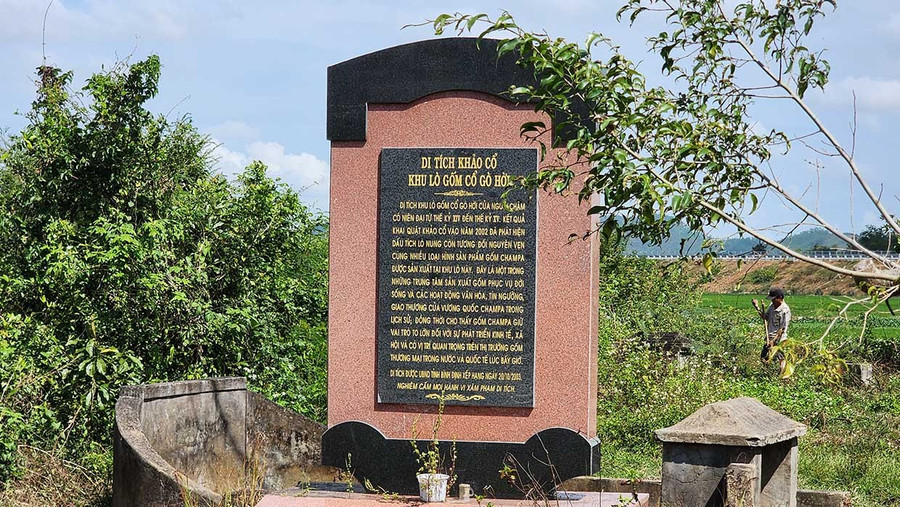
The pottery kilns along the Con River are part of that structure. According to researchers, Go Hoi is an important archaeological site excavated in 2002 with a characteristic inclined tube kiln structure. Many artifacts such as five-pronged supports, fragments of white, blue, and jade-glazed pottery from the 14th-15th centuries have been discovered, showing that this was once a large-scale production center.
Meanwhile, the Gò Cây Ké site, dating back to an earlier period from the 11th to 14th centuries, also reflects developed firing techniques, creating unique glazed products. Research results show that this area was part of the famous Champa pottery production system around the ancient capital of Vijaya, along with sites such as Gò Sành, Trường Cửu, Gò Cây Me, Gò Giang… This is evidence of a developed small-scale industry capable of participating in a large trade network.
The location of the pottery kilns reveals the meticulous planning of the ancients: proximity to raw materials, convenient waterways, and easy access to the Thi Nai port – a crucial trading gateway of Vijaya. This suggests a noteworthy insight: the ancient Eastern Gia Lai region was not merely a land of Cham towers, but also a dynamic economic and maritime space.
If ancient towers tell stories of spiritual life, then pottery kilns tell stories of livelihood. These two elements combine to create the form of a civilization.
Promoting the value of historical relics.
Promoting the value of historical sites does not mean grandiose restoration or the construction of expensive structures.
The first essential step is to help people today understand the significance of the place they are standing in. Because ultimately, preservation is not just about retaining what remains of the past, but also about restoring the spiritual status of a land, especially a land that was once the capital of a country with a unique culture like Champa.
Therefore, instead of viewing Go Hoi, Go Cay Ke, Go Sanh, Truong Cuu, Go Cay Me, Go Giang, etc., as independent, disconnected locations, perhaps it is time to place them within a broader spatial axis: Pottery kiln - river - capital - port city.
This spatial axis is not merely a tourist route, but a historical logic. From the production sites, goods flowed along the river to the sea; from the sea, they entered the regional exchange network. Viewed within this context, the riverside mounds are no longer insignificant but become links in a once powerful system.
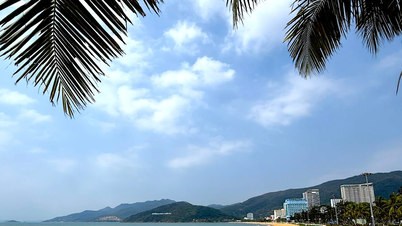
At that time, the eastern region of Gia Lai would not only be known for its unique Cham tower system and captivating blue sea, but also as a space that once converged power, religion, and commerce. Within that overall picture, the pottery centers along the Con River would no longer be modest relics but would become testaments to an economy that once contributed to shaping the face of Vijaya.
In an increasingly competitive tourism landscape, beautiful scenery alone is not enough. What truly sets a place apart lies in its historical depth and the stories it can tell. Reviving the value of Champa pottery relics is therefore not only about heritage preservation but also a way to enrich the tourism identity of eastern Gia Lai, making this dynamic region even more attractive on the tourism map.
Source: https://baogialai.com.vn/suy-nghi-tu-nhung-lo-gom-co-post579737.html
































































Comment (0)