

This reality further demonstrates that the instability of the agricultural market remains an unresolved problem.
Chili peppers and rice prices plummet simultaneously.
For the 2025-2026 Winter-Spring crop season, the entire province has more than 5,810 hectares of chili peppers, mainly concentrated in communes and wards such as Phu My, Tuy Phuoc Bac, An Khe, Dak Po, Kbang, Kong Chro…
Thanks to favorable weather conditions, the yield of chili peppers reached 8 quintals to 1 ton per sao (approximately 1000 square meters), and bird's eye chili peppers reached 9 quintals to 1.2 tons per sao, an increase of 10-15% compared to the previous winter-spring crop. However, the high yield could not compensate for the plummeting price of chili peppers.
In Phu My commune, a key chili-growing area in the eastern part of the province with approximately 320 hectares, many households are facing a situation where their income is not enough to cover their expenses. While at the beginning of the season, the price of bird's eye chili fluctuated between 15,000-19,000 VND/kg and local chili around 14,000 VND/kg, prices subsequently dropped sharply.
At one point, bird's eye chili peppers were priced at only 7,000-8,000 VND/kg, and ground chili peppers at 2,000-4,000 VND/kg, significantly lower than the 80,000-90,000 VND/kg during the same period last year. The extremely low prices led many households to let the chili peppers ripen and dry on the plants before harvesting them, as selling them fresh wouldn't even cover the harvesting costs.
Mr. Tran Dinh Van (Binh Tri village, Phu My commune) sadly stated: “This year's chili crop has been very difficult for the farmers. At one point in February (lunar calendar), the price of chili peppers dropped to 4,000 VND/kg. Meanwhile, investing in one sao (approximately 1000 square meters) of chili peppers costs 4-5 million VND for seeds, fertilizer, and a drip irrigation system. With such low prices, farmers are making almost no profit.”
A similar situation is occurring in Tuy Phuoc Bac commune, which has 38 hectares of chili peppers. Ms. Tran Thi Hanh (Luat Chanh village, Tuy Phuoc Bac commune) said that this season, she planted 1 sao (approximately 1000 square meters) of bird's eye chili peppers. Due to the low price of chili peppers, she earned less than 10 million VND for the entire season. In contrast, last year, the same area yielded an income of 40-50 million VND.
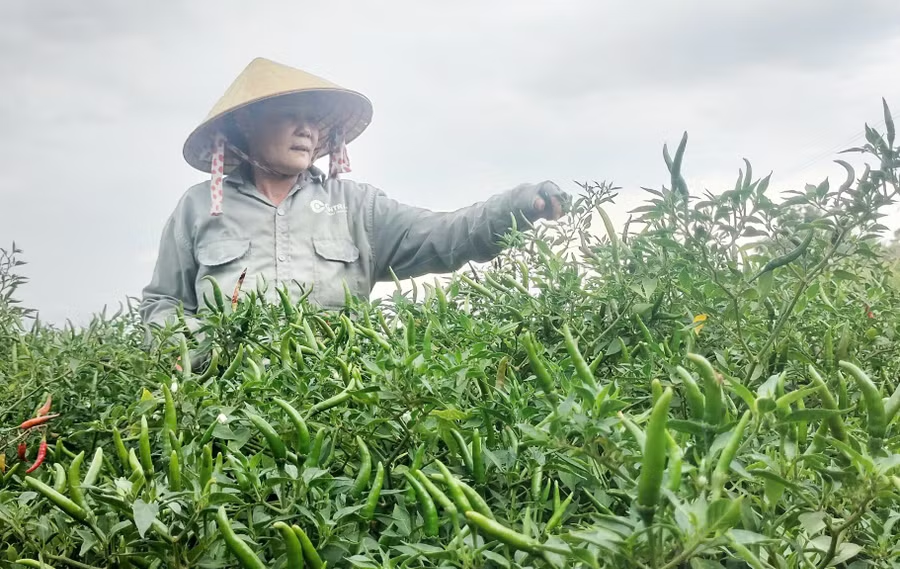
In Dak Po commune, the situation is no better. The entire commune has 235 hectares of chili peppers in the 2025-2026 Winter-Spring crop, with a yield of 18-20 tons/ha. According to Ms. Bui Thi Thuong, Chairwoman of the People's Committee of Dak Po commune, at the beginning of the season, the price of chili peppers fluctuated between 18,000-20,000 VND/kg, but dropped to 8,000 VND/kg in the middle of the season, only slightly increasing to 10,000-15,000 VND/kg at the end of the season. Despite the high yield, many households still suffered losses due to fluctuating selling prices and increased production costs.
Not only chili peppers, but the 2025-2026 Winter-Spring rice crop is also facing a similar situation. The entire province sowed 74,274 hectares of rice, with an estimated yield of 6.96 tons/ha, exceeding the plan and increasing compared to the same period last year. However, falling rice prices and unstable market outlets are causing difficulties for farmers.
Ms. Nguyen Thi Van, a rice trader in Tuy Phuoc commune, shared: “The price of rice in this year's Winter-Spring crop has decreased by 500-1,000 VND/kg. Many factories are not keen on buying large quantities due to difficulties in exporting. Traders also don't dare to stockpile large amounts. This year, I only bought about 20-30 tons, while last year I bought 200-300 tons.”
Finding stable solutions for agricultural product output.
Amidst the bleak picture of many agricultural products, peanuts have emerged as a rare bright spot. For the 2025-2026 Winter-Spring crop season, the entire province has 9,786 hectares of peanuts. The selling price remains stable at 28,000-29,500 VND/kg (dry weight), ensuring profitability for growers.
According to Mr. Nguyen Cong Vinh, Director of Binh Thuan Cooperative (Binh Hiep commune), after deducting expenses, peanut farmers earn a profit of approximately 40-50 million VND per hectare.
In this case, the cooperative is involved in the production and sale of peanuts on 36 hectares, while the total area owned by its members is approximately 800 hectares. According to Mr. Vinh, in recent years, peanut cultivation has provided a fairly stable source of income for farmers.
Faced with the recurring problem of "bumper harvests leading to price drops," localities and the agricultural sector are implementing various solutions to stabilize production. The People's Committee of Tuy Phuoc Bac commune is promoting the conversion of a portion of its low-yield crop land to corn cultivation for animal feed processing.
Mr. Doan Van Diep, Vice Chairman of the Tuy Phuoc Bac Commune People's Committee, said that the locality has worked with the supplier of raw materials for the De Heus Group's (Netherlands) factory in Nhon Hoa Industrial Park, An Nhon Nam ward.
Mr. Tran Xuan Khai, Head of the Crop Production and Plant Protection Sub-Department (Department of Agriculture and Environment), said that the agricultural sector is coordinating with localities to guide the conversion of inefficient crop structures; organize concentrated, large-scale commodity production; and develop chain linkages from production to consumption, processing, and export through economic contracts.
At the same time, the industry continues to develop codes for growing areas and packaging facilities to ensure food safety, traceability, and enhance the competitiveness of agricultural products.
It is clear that the recurring problem of "bumper harvests leading to falling prices" still lacks a fundamental solution, leaving farmers' incomes perpetually precarious. To break this vicious cycle, in addition to the regulatory role of the government, the genuine participation of businesses is crucial in establishing guaranteed purchase agreements, promoting processing, and expanding stable and sustainable consumer markets.
Source: https://baogialai.com.vn/bap-benh-gia-nong-san-post587667.html
















































































Comment (0)