Far-right populist politician Geert Wilders is on track for a landslide victory in the November 22 parliamentary elections, and has the opportunity to lead negotiations to form a new governing coalition and potentially become the country's first far-right prime minister at a time of significant political upheaval across the continent.
The opinion poll, released by state broadcaster NOS after the general election concluded, showed Wilders' Party for Freedom (PVV) would win 35 seats in the 150-seat House of Representatives, more than double the 17 seats he won in the previous election.
The poll conducted by Ipsos was generally accurate, with a margin of error of 3 seats. The final official results will be announced on November 23rd.
The election was held after the resignation of outgoing Prime Minister Mark Rutte's fourth and final coalition in July following disagreements over measures to restrict immigration.
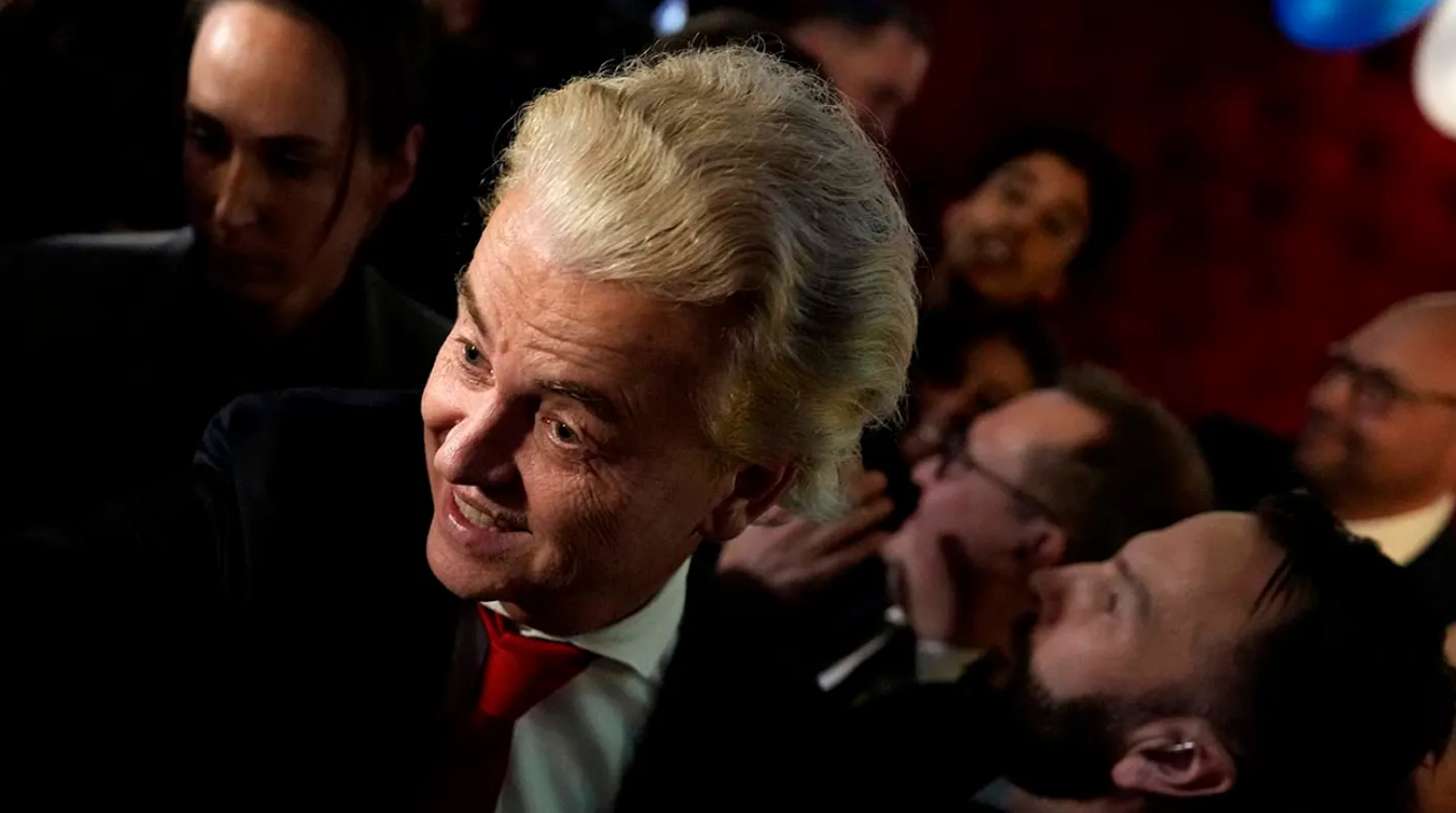
Geert Wilders, leader of the PVV party, smiles after the first preliminary results of the general election are announced in The Hague, Netherlands, on November 22, 2023. With his dyed blonde hair, this anti-Islam populist has become one of the most recognizable figures in the global far-right. Photo: Fox News
Mr. Rutte has announced his retirement from politics, and Dilan Yeşilgöz-Zegerius, a Turkish national, has succeeded him as leader of the liberal-conservative People's Democratic Party (VVD). In the recent general election, the VVD is expected to come in third with 24 seats.
The general election was once called a "battle of wits," with Yeşilgöz-Zegerius initially predicted to become the first female Prime Minister of "the land of windmills," but ultimately Wilders easily defeated all his opponents.
Wilders' victory delivered another "earthquake" to European politics a year after far-right populists came to power in Italy.
This result is the latest in a series of elections that are changing the political landscape of Europe. From Slovakia and Spain to Germany and Poland, populist and far-right parties have won in some EU member states and faltered in others.
Difficulties lie ahead.
“I had to pinch myself,” Wilders said gleefully after the post-election poll results were released. The 60-year-old politician campaigned on calls for a referendum on the Netherlands leaving the European Union (EU), a complete halt to asylum applications, and pushing back migrants at the Dutch border.


He also advocated for the "de-Islamization" of the Netherlands, although he appeared more moderate toward Islam during this election campaign than before. Wilders added: "The Dutch will be number one again. The people must take their country back."
The far-right politician has also repeatedly stated that the Netherlands should stop supplying weapons to Ukraine because the Netherlands itself needs weapons for self-defense.
But Wilders, once considered the "Dutch version of Donald Trump," will have to form a coalition government before he can take power and become Prime Minister.
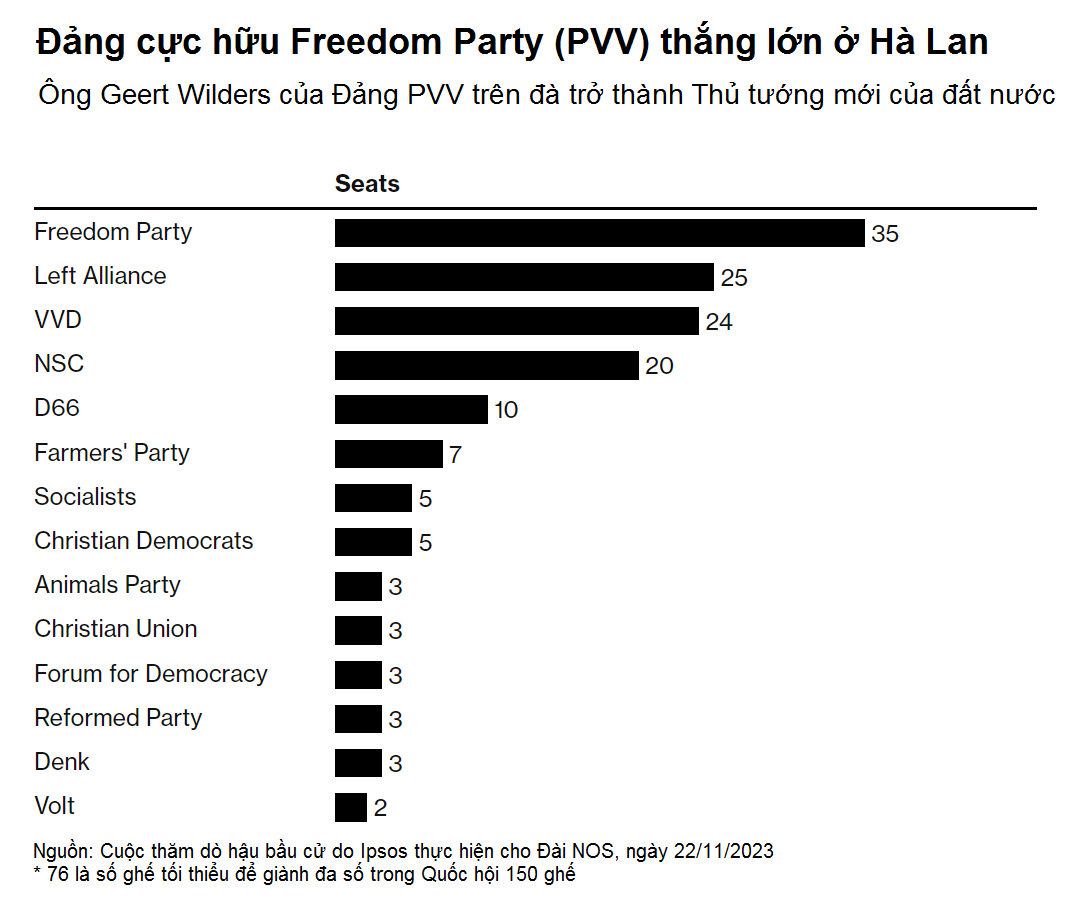
Post-election poll results in the Netherlands, November 22, 2023. Graphic: Bloomberg
A difficult road lies ahead as mainstream parties are unwilling to form a coalition with Wilders and his PVV party. But his landslide victory in the general election has put him in a stronger position in any negotiations.
"I am confident we can reach an agreement," Wilders said in his victory speech. "I understand very well that we should not take any unconstitutional measures."
Pieter Omtzigt, leader of the New Social Contract (NSC) party and a former centrist Christian Democratic (CD) party member who won around 20 seats, said he would always be open to negotiations.
The party that finished second in the general election was the Left Alliance (a left-wing coalition between the center-left Labour Party and the left-wing Green Party), which was predicted to win 26 seats. But the leader of the Left Alliance, Frans Timmermans, a former EU climate commissioner, made it clear that he would never form a coalition with parties that take such hardline stances on refugees as the PVV.
Softer
The historic victory in the Netherlands came a year after the victory of Italian Prime Minister Giorgia Meloni, chairwoman of the Italian Brotherhood (FdI) – a political party with far-right conservative ideology. Since coming to power, Meloni has shifted her stance on several issues and has become the accepted face of the hardline right wing in the EU.
Wilders is world-renowned for his anti-Islam political views and was convicted of discrimination by a Dutch judge after he insulted Moroccans at a 2014 election rally.



French far-right leader Marine Le Pen, who has twice come very close to the highest power in the Elysee Palace, praised Wilders and his PVV party “for their spectacular achievement in the legislative elections, affirming their growing commitment to protecting national identity.”
"It is precisely because there are people who refuse to see the national torch extinguished that hope for change still exists in Europe," said Le Pen.
Hungarian Prime Minister Viktor Orban, who holds similarly scathing views on migration and EU institutions, was quick to congratulate Wilders. “The winds of change are here! Congratulations,” Orban said.
Despite his harsh rhetoric, Wilders appealed to other right-wing and centrist parties by declaring that whatever he did, “it would be within the law and the constitution.”
In the final weeks of the election campaign, Wilders softened his stance somewhat, pledging to be Prime Minister for all the Dutch people. He even acquired a new nickname: Geert “Milderers” (softer) .
Minh Duc (According to AP, Bloomberg, iNews)
Source