

The draft legislative program for 2024, adjusted for 2023, currently being reviewed by the Ministry of Justice, includes a notable proposal to enact a Law on Real Estate Tax, to be submitted to the National Assembly for consideration at the October 2024 session for approval in May 2025.
Luxury apartments are subject to high taxes.
According to the Ministry of Justice, housing is considered an investment. Taxation should be studied based on the principle of not applying it to low-investment properties such as temporary houses, dilapidated houses, semi-permanent houses, and houses in rural and mountainous areas. In addition, it is necessary to tax illegally occupied houses and land, and houses and land not yet in use, at a rate five times higher than that of built properties. Notably, the Ministry of Justice proposes tax exemption for social housing and worker housing while imposing high taxes on luxury apartments priced above 50 million VND/m2.
Lawyer Luong Van Trung, an arbitrator at the Vietnam International Arbitration Center (VIAC), assessed that the Ministry of Justice's proposal to impose a high tax on apartments priced above 50 million VND/m2 is consistent with international practice, helps curb speculation, encourages economical and efficient housing use, and contributes to increasing state budget revenue.
"However, it should be noted that the land area for building an apartment complex has been divided among thousands of apartments, so each apartment occupies an insignificant amount of land. Meanwhile, the investor has to pour a large sum of money into construction, creating jobs and contributing to socio -economic development. Therefore, the tax rate on luxury apartments needs to be calculated appropriately," lawyer Trung analyzed.
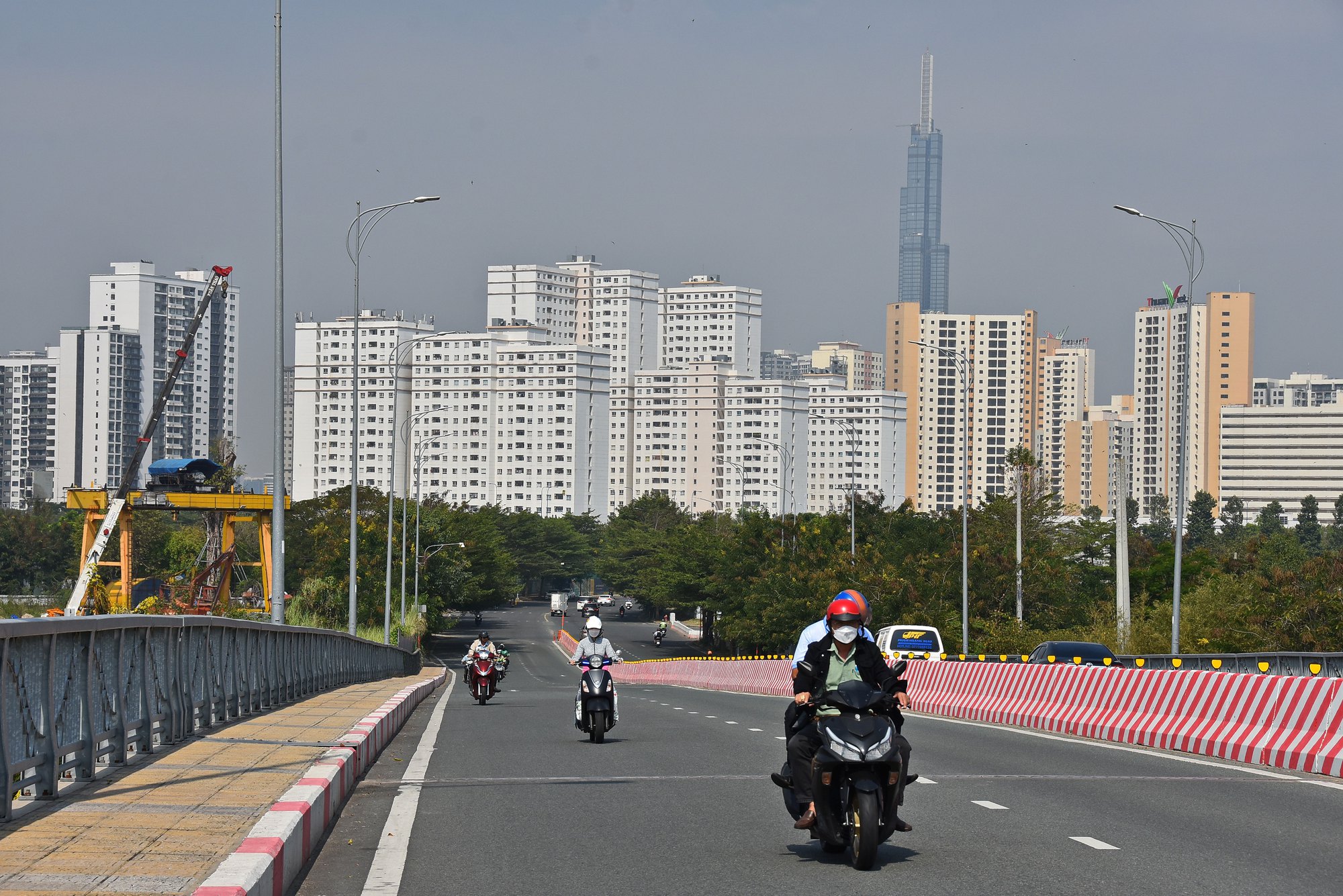
The Ministry of Justice's proposal to levy a housing tax has received much support as it aligns with international practices and the country's socio-economic development situation. (Photo: TAN THANH)
According to a leader in charge of real estate at the Ho Chi Minh City Tax Department, imposing high taxes on apartments priced above 50 million VND/m2 could lead to unfairness. "An apartment in the city center with an area of 70 m2, priced above 50 million VND/m2, equivalent to a value of 3.5 billion VND, would have to pay high taxes. Another apartment in the suburbs, priced at only 30 million VND/m2 but with an area of 150 m2, equivalent to a value of 4.5 billion VND, would pay low taxes," this official cited as an example.
According to the aforementioned leader, one of the goals of imposing high taxes is to curb speculative real estate trading that disrupts the property market. He suggested that the government should only impose high taxes on those who own a second home or more, with the tax rate increasing progressively for subsequent homes. Tax collection should begin immediately upon the homeowner transferring ownership. Simultaneously, consideration could be given to increasing non -agricultural land taxes to supplement state budget revenue.
Refer to methods used in other countries.
The Ministry of Justice has proposed a housing tax calculation method based on the area of the house multiplied by the price per square meter of land. The tax rate will increase progressively in stages.
Economist Dr. Vu Dinh Anh stated that property taxes on housing have been applied worldwide for a long time. In Vietnam, in 1991, the state taxed houses and land at a rate of 0.3%-0.4% of their value, but stopped applying the tax to housing in 1992. According to Dr. Vu Dinh Anh, it is necessary to develop a Real Estate Tax Law because this is consistent with international practice as well as the current socio-economic development situation. The remaining issues are how to calculate the property tax on housing, which unit will determine the property value for tax calculation, and what the implementation roadmap will be...?
According to Mr. Pham Anh Khoi, General Director of FINA Investment Consulting Company, real estate tax laws abroad are designed to be very simple and easy to apply. The nature of real estate tax is personal income tax based on existing assets. Therefore, some countries apply only one tax rate and reduce taxes by up to 50% for houses used as permanent residences to create fairness and facilitate the purchase of houses and land for those who do not yet own property.
"Simplified tax calculation methods help the government manage more easily, avoid causing confusion for taxpayers, and are also fair to second, third, and subsequent real estate properties if they are well-developed," Mr. Khoi commented.
Mr. Khoi also suggested that tax refunds could be allowed for taxpayers after deducting expenses. For example, during the COVID-19 pandemic, some properties with high investment costs could not be rented out, causing difficulties for homeowners. Tax refunds should be granted in these cases to create the best conditions for people to participate in business, while also preventing homeowners from making false declarations out of fear of paying taxes, thus avoiding revenue losses.
Mr. Ta Trung Kien, Deputy General Director of Big Land Fund Company, agrees with the proposal to apply a real estate tax to prevent speculation and contribute to market transparency. However, this also creates pressure on real estate owners if the policy and tax calculation method are unclear. In the long term, the market, upon receiving information about the government collecting real estate tax, will adjust in a way that slows down. Investors will have to recalculate to balance revenue and costs, and will adjust prices accordingly.
Concerns about the impact on rental prices.
Mr. Pham Van Tuan (residing in District 1, Ho Chi Minh City) – who owns numerous properties including apartments and factory buildings for rent – believes that taxing housing is a suitable and necessary policy, but it could help cool down the real estate market. Mr. Tuan also worries that having to pay property tax could affect rental prices, making it difficult for tenants to accept the situation given the current difficulties in production and business activities.
Source: https://nld.com.vn/kinh-te/danh-thue-bat-dong-san-can-thiet-20230208211419248.htm


![[Image] Checking the security conditions at the exam site, ready for the 10th grade exam.](https://vphoto.vietnam.vn/thumb/1200x675/vietnam/resource/IMAGE/2026/05/28/1779943458889_z7872507660648-d764421a26e8cd7b61d70d142a48a685-jpg.webp)

![[Photo] Life on both banks of the river returns to its bustling pace on the day the Long Bien Bridge opens to traffic.](https://vphoto.vietnam.vn/thumb/1200x675/vietnam/resource/IMAGE/2026/05/28/1779949763708_cau-long-bien-minh-duy-7-3610-jpg.webp)



















![[Photo] Opening Ceremony of the National People's Council Conference on the Implementation of Directions and Tasks for the 2026-2031 Term](https://vphoto.vietnam.vn/thumb/1200x675/vietnam/resource/IMAGE/2026/05/28/1779939257690_ndo_br_bnd-1991-jpg.webp)

























































Comment (0)