

During sweltering summer days, when temperatures soar but conditions don't allow for continuous air conditioning use, many families share a simple tip: placing a bowl of water or a basin of ice directly in front of a fan. So, from a scientific perspective, does this action actually provide effective cooling, or is it just a psychological illusion?
The short answer is: Yes. The principle behind this method is based on a natural thermodynamic phenomenon called evaporative cooling. When the fan is running, the strong airflow across the surface of the water basin accelerates the evaporation process faster than normal. To transition from a liquid to a gaseous state, water molecules must absorb heat from the surrounding air.
This heat absorption process causes the air flowing over the water to cool down by a few degrees Celsius. As a result, the breeze the fan blows on you is no longer the dry, hot air of summer, but carries cool, moist air, providing an immediate feeling of comfort.
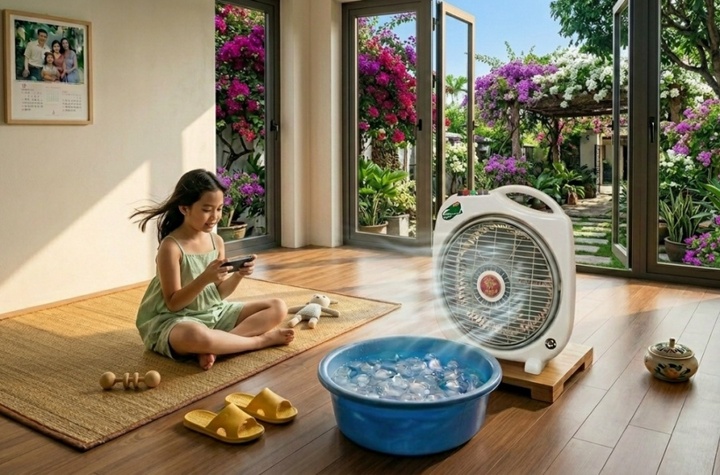
Using ice water will provide a more effective cooling effect. (Illustration: AI)
Placing a bowl of water in front of a fan doesn't always provide a cool breeze.
Despite its scientific basis, placing a bowl of water in front of a fan only provides localized cooling. Unlike air conditioners, which draw in hot air, cool it, and circulate it to lower the temperature of an entire enclosed space, the combination of a fan and a bowl of water only cools the area directly in the path of the airflow. If you step out of the fan's path, the room temperature will not change significantly.
Furthermore, the cooling effect depends heavily on the water temperature. If you only use tap water at room temperature, the cooling effect will be quite minimal. The effect only truly becomes apparent when you replace regular water with ice or ice cube trays. As the ice melts and evaporates, the heat absorption process is extremely powerful, resulting in a much colder airflow that quickly dispels the hot air.
The biggest drawback and potential risk of this method lies in the fact that it continuously adds moisture to the space. In Vietnam's tropical monsoon climate, air humidity is already high. When you place a bowl of water in front of a fan in a closed room, the moisture cannot escape, leading to a surge in room humidity.
According to natural physiological mechanisms, the human body cools itself by sweating and allowing the sweat to evaporate. When the ambient humidity is too high, sweat on the skin cannot evaporate, causing the body to become sticky, uncomfortable, and feel even more suffocated than before placing a basin of water. This phenomenon is commonly referred to as stifling heat.
More importantly, prolonged high humidity in confined spaces creates an ideal environment for mold and bacteria to thrive, threatening the respiratory health of the elderly and young children. The suspended water vapor can also condense on the surfaces of electronic devices, furniture, and wallpaper, causing short circuits, malfunctions, or reducing the lifespan of these items.
Cool the area by placing a basin of water in front of the fan correctly.
Despite certain limitations, combining a fan and water/ice remains an economical and effective solution if we know how to control the physical factors. To optimize functionality and protect health, users should adhere to the following scientific principles.
Use ice cubes or ice packs: Instead of using a loose basin of water that's easily spilled, freeze plastic water bottles or use dry ice gel packs and place them in a tray in front of a fan. This creates a very cold airflow while minimizing the amount of water evaporating into the air compared to the large surface area of a basin.
Ventilation is essential: Absolutely do not apply this tip in a completely sealed room. Open windows or doors slightly to allow for air circulation. Hot, humid air needs to escape, making way for fresh air, helping to maintain balanced room humidity and prevent stuffiness.
Electrical safety principles and placement: Always maintain a safe distance of 0.5 to 1 meter between the water basin/tray and the fan base to prevent water from splashing onto the motor and causing a short circuit. The water basin should be placed on a level surface, out of reach of children and away from areas with many electrical outlets.
Regular cleaning: If using a water tray, be sure to change the water and clean the tray daily. Stagnant water, combined with summer temperatures, can become a breeding ground for mosquitoes and disease-causing microorganisms.
In general, placing a bowl of water in front of a fan isn't a panacea for combating the scorching heat, but it's a clever physical intervention if placed in a well-ventilated environment. Understanding the nature of the problem will help you apply household tips scientifically, bringing safe coolness during those blazing summer days.
Source: https://vtcnews.vn/dat-chau-nuoc-truoc-quat-co-lam-mat-phong-hon-ar1020692.html
![[Photo] General Secretary and President To Lam presides over a meeting on preparations for the review of one year of operation of the three-tiered government system.](https://vphoto.vietnam.vn/thumb/1200x675/vietnam/resource/IMAGE/2026/06/02/1780391821195_a1-bnd-4595-9717-jpg.webp)




























































































Comment (0)