 |
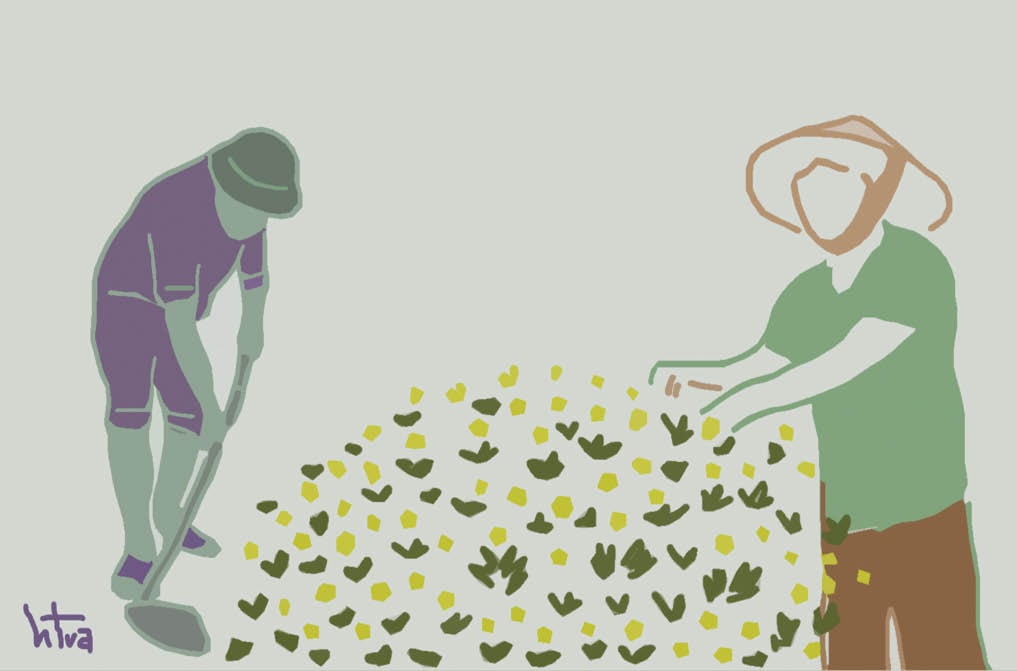
I'm familiar with this land after each flood season. I used to stand with Mr. Mien, admiring the flat, smooth, yellowish-brown alluvial plain along the river after the flood. This alluvial plain thickens a little more with each flood. Not a single weed grows; everything is buried under a thick layer of mud. After days of heavy rain and flooding, the sunlight seems weaker, casting a soft, gentle light on the soft mud. The entire stretch of alluvial land along the river lies still under the new sunlight, as if no great flood had just passed, as if the wind and rain had never appeared. Only the murky yellow river water flowing strongly outside remains a trace of the great flood, of the days of torrential rain and wind. I remember Mr. Mien saying that soft mud is a source of nutrients for the soil, but it's not easy for mud to become a "nutrient" for plants. That soft mud hardens when exposed to the sun, so farmers have to plow and turn over the soil to let it "breathe," requiring twice the effort to loosen and mix the soft mud evenly with the topsoil. Only then can plants absorb nutrients from the soft mud.
Looking at the thick, sticky mud in Mr. Mien's rake, I know this year's flood has left a layer of "golden soil" for farmers, but to have a golden harvest for the plants and flowers for Tet this year, farmers still have a lot of hard work to do. Mr. Mien said that since his wife suffered from back pain, she no longer works in the fields with him. He is alone in the fields, lacking the strength and feeling lonely, so this year he has reduced the amount of flowers he planted for Tet, only half of last year's.



Have you ever held a handful of soil in a flooded field, the soft, muddy grains clinging to your hands and fingernails? Those same grains of soil clung to your toes as you walked among the rows of Tet flowers, cool and soothing. I experienced that in the Tet flower fields of Mr. Mien and Mrs. Hoa. I sat on the soft grass, sipping a cup of green tea, its bitterness tinged with sweetness, gazing at the flowerbeds, inhaling the fragrant scent of the Tet season, and watching Mrs. Hoa, her hands still stained with mud, pour a cup of tea for her husband with a warm, loving, understanding, and shared look in her eyes. That afternoon of Tet flowers, a flower bloomed in my heart, a symbol of the deep love between my dear cousin and his wife.
After a flood season passes, each person will engrave in their heart a milestone of the flood, like the mud marks left on the walls of their houses, remembering the flood milestones of each year, or like the lines carved on the wooden pillars of an old traditional house marking the height increase of a boy each year.
I wasn't a boy anymore, but I also had mud marks carved on the wooden pillars of my house, always a pair of parallel carvings – one higher, one lower – because they were the marks of my older brother, who always loved his youngest sister: "I carved them to see how much taller you've grown compared to me in a year," my brother would often say as he pressed my head against the pillar, marked it, and then drew a short line on it. Those carvings in the wood also bore the imprint of mud from several flood seasons.
Therefore, in my understanding, the layers of mud from the flood season are not only the nourishing alluvial soil but also memories that, with each flood season that passes, remind me to cherish the land, the people, and the trees and fruits around me.


Source: https://huengaynay.vn/van-hoa-nghe-thuat/dau-bun-non-160408.html









![[Video] Weather forecast for July 5, 2026: Typhoon No. 1 causes strong sea disturbances, very heavy rain in the North, many areas warned of thunderstorms and tornadoes.](https://vphoto.vietnam.vn/thumb/402x226/vietnam/resource/IMAGE/2026/07/05/1783206051427_thum-sang-ok-png.webp)