

The centuries-old stone walls have cracked over time. The ancient temple roofs have sagged after many seasons of rain and sun.
The temples and pagodas, which embody the rich cultural heritage of Thanh Hoa province, are facing the risk of deterioration or even damage if timely intervention is not taken.

In response to this situation, the People's Committee of Thanh Hoa province has developed a plan for the preservation, restoration, and rehabilitation of historical relics in the province for the period 2026-2030, with the goal of protecting the values of historical, cultural, and architectural heritage, while effectively utilizing heritage resources to serve tourism and socio-economic development.
According to the plan, the total number of historical sites and projects included in the list for preservation, restoration, and rehabilitation in the coming period is 138.
These include 2 projects within the Ho Dynasty Citadel World Cultural Heritage site, 27 national monuments, and 109 provincial-level monuments.
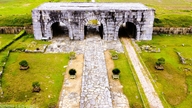
A notable highlight is that the province continues to prioritize resources for the Ho Dynasty Citadel World Heritage Site, a unique stone architectural work recognized by UNESCO in 2011.
Two major projects, including the urgent repair of the stone ramparts and the reinforcement and support of sections at risk of collapse or landslides, will continue to be implemented to protect the outstanding universal value of this heritage site.

This list not only includes the Ho Dynasty Citadel, but also spans many localities with numerous historical sites in a critical condition.
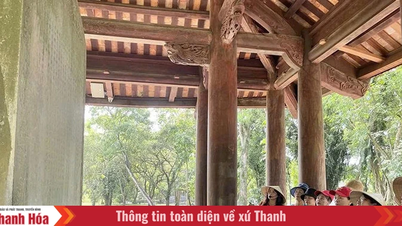
Many centuries-old structures such as communal houses, temples, pagodas, and shrines are showing signs of termite infestation, decaying wooden structures, crumbling roof tiles, cracked walls, sinking foundations, and require temporary support with iron columns or steel frames to prevent collapse.
In many localities, signs of deterioration are clearly visible. The Quang Trung Temple, part of the Lach Bang historical site complex, now has to be constructed with a steel frame and covered with corrugated iron roofing to prevent leaks and collapse.
The De Linh Temple in Sam Son has a system of columns, trusses, and wooden beams that are severely damaged by termites, with many components requiring temporary supports.
Quan Chiêm communal house, Chánh Lộc communal house, Bái Sơn communal house, and many other ancient architectural structures are in a similar condition.
According to the Thanh Hoa Provincial People's Committee, restoration in the coming period will prioritize traditional wooden architectural relics with outstanding historical and artistic value; relics that are severely degraded, difficult to socialize, or located in disadvantaged areas.
The implementation process must ensure the maximum preservation of the original elements constituting the monument, prioritizing the use of traditional materials and techniques, and minimizing impacts that could distort the original value of the structure.
One of the requirements set forth is to strengthen the supervisory role of the community.
Locals, experts, artisans, and historical witnesses will be consulted during the documentation and restoration process; and the establishment of community monitoring groups will be encouraged to ensure that projects are implemented in accordance with regulations and the historical value of the monument.
To implement the plan, funding will be mobilized from the provincial budget, local budgets, and other legitimate social resources.
Of that amount, the provincial budget is expected to provide support of no more than 50 billion VND per year, equivalent to a maximum of 250 billion VND over the entire period of 2026 - 2030.
Source: https://baovanhoa.vn/van-hoa/dau-tu-250-ti-dong-bao-ton-di-san-xu-thanh-234092.html
























































![[Video] Sunset at Lap An Lagoon – Where the sun sets over the fishing nets](https://vphoto.vietnam.vn/thumb/1200x675/vietnam/resource/IMAGE/2026/05/31/1780192137701_beach-landscape-sea-water-nature-grass-745871-pxhere-com.jpeg)


































Comment (0)