

Lesson 2: The worry of freshwater shortage
The Mekong Delta region is experiencing the most severe drought and saltwater intrusion of 2024. Along with the impact on agricultural production, the shortage of freshwater for daily use continues to spread in many areas.
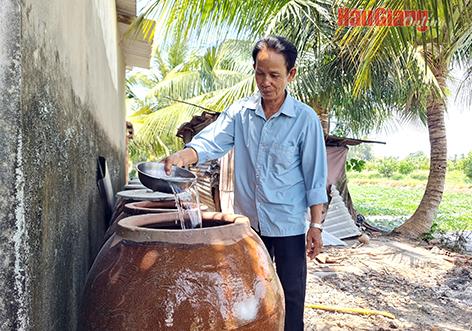
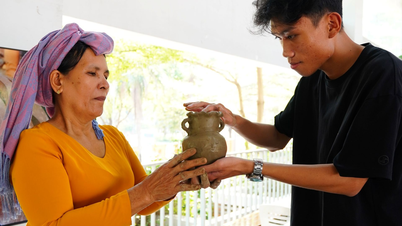
People in Vi Thuy district utilize earthenware jars and containers to store fresh water during the dry season and periods of saltwater intrusion. Photo: H.THU
There is a shortage of clean water in many areas.
The districts of Thoi Binh, Tran Van Thoi, and U Minh have the highest number of households experiencing a shortage of fresh water for daily use in Ca Mau province. Ms. Truong Thi Giau, from Bien Bach commune, Thoi Binh district, said: “Due to the lack of groundwater in this area, every year during the dry season, there is a shortage of water for daily use. Although families prepare water storage tanks and containers, they still cannot use enough due to the prolonged drought and salinity. For the past few months, my family has had to buy fresh water at a cost of 50,000 VND/m³. Even though we have tried many water-saving methods, we still spend more than 500,000 VND per month buying water for the whole family.”
Pointing to the dried-up canals caused by saltwater intrusion, Ms. Doan Ngoc Phe, from Bien Bach commune, shared: “Freshwater is currently very precious to people in disadvantaged areas. The cost of exchanging for fresh water is quite high and takes many days, so many families are exhausted. Therefore, recently, the army brought fresh water to support the people free of charge during this stressful period, and everyone is very happy…”
According to the Department of Agriculture and Rural Development of Ca Mau province, more than 2,600 households in the province are facing water shortages and lack of access to clean water due to drought and salinity. Of these, over 1,700 households face particularly difficult access to water because they cannot exploit groundwater, coupled with dried-up canals, collapsed roads, and disrupted transportation. In response to these difficulties faced by people in drought-affected areas, the Logistics Department of Military Region 9 recently deployed three iron ships to transport over 1,700 cubic meters of fresh water from Can Tho city to support thousands of people in drought-stricken areas of Thoi Binh, U Minh, and Tran Van Thoi districts. According to Colonel Tran Ba Loc, Political Commissar of the Logistics Department of Military Region 9, in recent days, the forces of Military Region 9 have been working day and night alongside local authorities and people in the Mekong Delta to implement measures to combat drought and salinity. This contributes to ensuring social welfare, stabilizing livelihoods, and sharing some of the difficulties with the people. This time, along with providing free water, they also supported the people with water storage containers so that disadvantaged households could store water for several days.
In Long An, Tien Giang, Ben Tre, Kien Giang, and other provinces, the shortage of clean water is also very serious. Over the past few days, Tien Giang Water Supply Company Limited and related units have opened hundreds of public water taps to provide clean water to people in disadvantaged areas of Tan Phu Dong and Go Cong Dong districts. They have also organized free water delivery by truck and set up water tanks at over 40 locations to provide free water to residents. Philanthropists have also transported thousands of cubic meters of water by barge to pump into reservoirs in Tan Phu Dong district to supply drinking water…
In mid-April, the Command of Coast Guard Region 4 (Phu Quoc City, Kien Giang Province) dispatched a ship carrying over 350,000 liters of fresh water to support residents of Hon Chuoi Island (Ca Mau Province) to help them overcome difficulties during the severe drought and water shortage. Mr. Nguyen Hoang Hiep, Deputy Minister of Agriculture and Rural Development, stated that due to the complex saline intrusion situation, many areas are unable to balance their local water resources because canals and ditches are drying up… To date, it is estimated that approximately 50,000 rural households in the Mekong Delta region are experiencing water shortages.
Ms. Nguyen Hong Van, residing in Vinh Thanh hamlet, Vinh Tuong commune, Vi Thuy district, Hau Giang province, stated that in recent days, the water level in the canal in front of her house has been very low, making it difficult to obtain water for daily use. Because this area has not yet been supplied with clean water, residents only use river water or collected rainwater. If the hot weather continues, people will face even greater difficulties.
According to the functional agencies of Hau Giang province, the areas at risk of freshwater shortage for daily life are mainly in localities affected by drought and saltwater intrusion. Therefore, the province has requested that drought- and saltwater intrusion-affected areas prepare well-planned prevention and mitigation measures to minimize damage caused by drought and saltwater intrusion; and proactively develop plans to expand and develop water supply pipelines to provide clean water to the people during the months affected by drought and saltwater intrusion in the province.
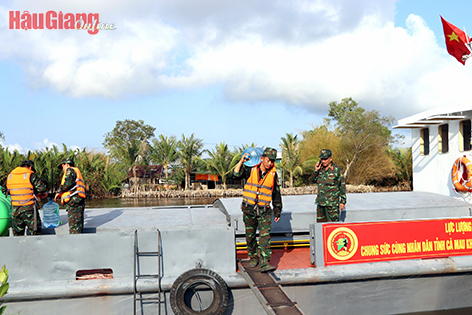
Forces from Military Region 9 provide clean water to people in disadvantaged areas of Ca Mau. Photo: H. Tan
Implementing various fundamental solutions
According to the Ministry of Agriculture and Rural Development, in recent days, the ministry's functional units have coordinated with localities in the Mekong Delta to implement many solutions to provide clean water for affected households, such as supporting water storage equipment and tools in difficult areas in Ca Mau, Kien Giang, and Bac Lieu; organizing rotational water supply in Long An; connecting water supply stations and expanding pipelines in Long An, Tien Giang, Kien Giang, and Soc Trang; drilling additional wells in Long An; using desalination equipment and salinity monitoring to operate water supply facilities in Ben Tre… In addition, the Ministry requested the Management Board of Irrigation Project 10 to accelerate construction progress by 3 months to ensure the Nguyen Tan Thanh sluice gate is put into operation and exploited as soon as possible, contributing to supporting salinity control, freshwater storage, and creating a source of raw water for water treatment plants serving approximately 800,000 people in Tien Giang province…
Mr. Ngo Minh Long, Director of the Department of Agriculture and Rural Development of Hau Giang province, said: "It can be said that the saline intrusion in the Mekong Delta is currently very severe, and Hau Giang is not outside this saline intrusion zone. Therefore, about four years ago, Hau Giang was given the authority to build a freshwater reservoir, which has now been basically completed. Recently, the Provincial People's Committee has decided to assign the management to the Department of Agriculture and Rural Development, specifically the Provincial Agricultural Extension and Service Center, which will manage and handle the operation and exploitation plan after investment. In this phase, the Department of Agriculture and Rural Development is coordinating with the Provincial Project Management Board for Investment in Construction of Transportation and Agricultural Projects to complete the handover procedures. In general, both sides have reviewed the scope, content of work, and project items, and plan to conduct trial operation training. At the latest, the handover to the Department of Agriculture and Rural Development for management will be at the end of April." This freshwater reservoir, covering an area of over 50 hectares, with a surface area of more than 20 hectares, will provide clean, hygienic water to residents in Vi Thanh city, Vi Thuy district, and Chau Thanh A district, with a water storage capacity of approximately 1 million cubic meters.
Mr. Truong Canh Tuyen, Standing Vice Chairman of the People's Committee of Hau Giang province, said that he has requested the Hau Giang Water Supply and Drainage - Urban Works Joint Stock Company and the Hau Giang Rural Water Supply and Environmental Sanitation Joint Stock Company to ensure the availability of clean water for people when saltwater intrusion occurs (salinity > 0.75‰). If necessary, a rotating water cut-off plan will be implemented in some areas to coordinate water supply for people's use. Simultaneously, they will coordinate with the Provincial Resource and Environment Monitoring Center, the Provincial Irrigation Sub-Department, and the Hau Giang Meteorological and Hydrological Station to proactively monitor and provide timely warnings. In particular, when necessary, the Hau Giang Water Supply and Drainage - Urban Works Joint Stock Company and the Hau Giang Rural Water Supply and Environmental Sanitation Joint Stock Company will link their water treatment plants and stations into a continuous system to regulate water sources from these plants and stations without affecting the people's water supply during drought and saltwater intrusion, coordinating synchronously and closely to ensure a ready water supply for the people. Operate and utilize groundwater wells as needed to ensure an adequate water supply for the people.
Recently, the Ministry of Agriculture and Rural Development, in coordination with the FAO in Vietnam, launched an early action program to support disadvantaged families in four communes: Khanh An and Khanh Thuan (U Minh district); Khanh Hung (Tran Van Thoi district); and Bien Bach (Thoi Binh district, Ca Mau province). Over 1,000 households received cash assistance of 6 million VND per household with three or more members, totaling 5.4 billion VND. While the amount is not large, it provides some relief to people in these disadvantaged areas during a period of water scarcity. Mr. Rémi Nono Womdim, Head Representative of the FAO in Vietnam, stated that the program of visiting and distributing cash to people affected by drought and salinity also aims to raise community awareness about water conservation in daily life and production.
Deputy Minister of Agriculture and Rural Development Nguyen Hoang Hiep stated that in the coming period, solutions will continue to be implemented to ensure sufficient water supply for people in disadvantaged areas. Priority will be given to transporting and supplying clean water and water storage equipment to households to overcome the drought and water shortage period in 2024 and subsequent years. A comprehensive review and assessment of the water supply capacity of centralized water supply systems in the Mekong Delta will be conducted; specific solutions for water supply to areas affected by drought and salinity will be identified. “The solution is to invest in and build new or upgrade existing water supply facilities in areas where centralized water supply is possible. In areas with dispersed populations, support should be provided with clean water storage equipment of appropriate capacity to ensure sufficient water for daily use during periods of drought and salinity intrusion. In particular, a more rational operation of the irrigation system in the Mekong Delta region is needed to strengthen inter-provincial water resource connections; thereby improving the efficiency of irrigation infrastructure, especially during the dry season…”, emphasized Mr. Nguyen Hoang Hiep, Deputy Minister of Agriculture and Rural Development.
Prime Minister Pham Minh Chinh also issued a directive requesting relevant ministries, agencies, and the People's Committees of provinces and cities in the Mekong Delta region not to be negligent or complacent; to closely monitor the situation and continue to decisively and effectively implement measures to respond to heatwaves, drought, salinity intrusion, and water shortages. They must accurately identify households at risk of water shortages to develop appropriate plans to ensure water supply for residents, resolutely preventing any situation where people lack access to clean water. They must review freshwater reserves in the area to develop a balancing plan; if these reserves cannot meet all water needs, priority must be given to using freshwater for domestic use and other essential needs. Local budgets and other legitimate financial resources must be proactively allocated and mobilized to immediately implement necessary measures to ensure freshwater supply for residents… |
HUNG TAN - HOAI THU
Lesson 3: Effective Adaptation During the Salinity and Drought Season
Source


![[Photo] Prime Minister Pham Minh Chinh receives the Chinese Ambassador to Vietnam](https://vphoto.vietnam.vn/thumb/1200x675/vietnam/resource/IMAGE/2026/04/05/1775397481797_ndo_br_dsc-5512-jpg.webp)
































































Comment (0)