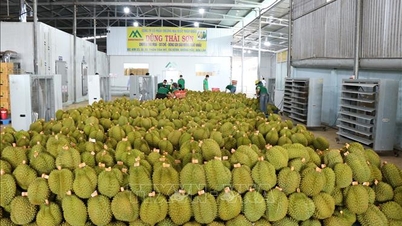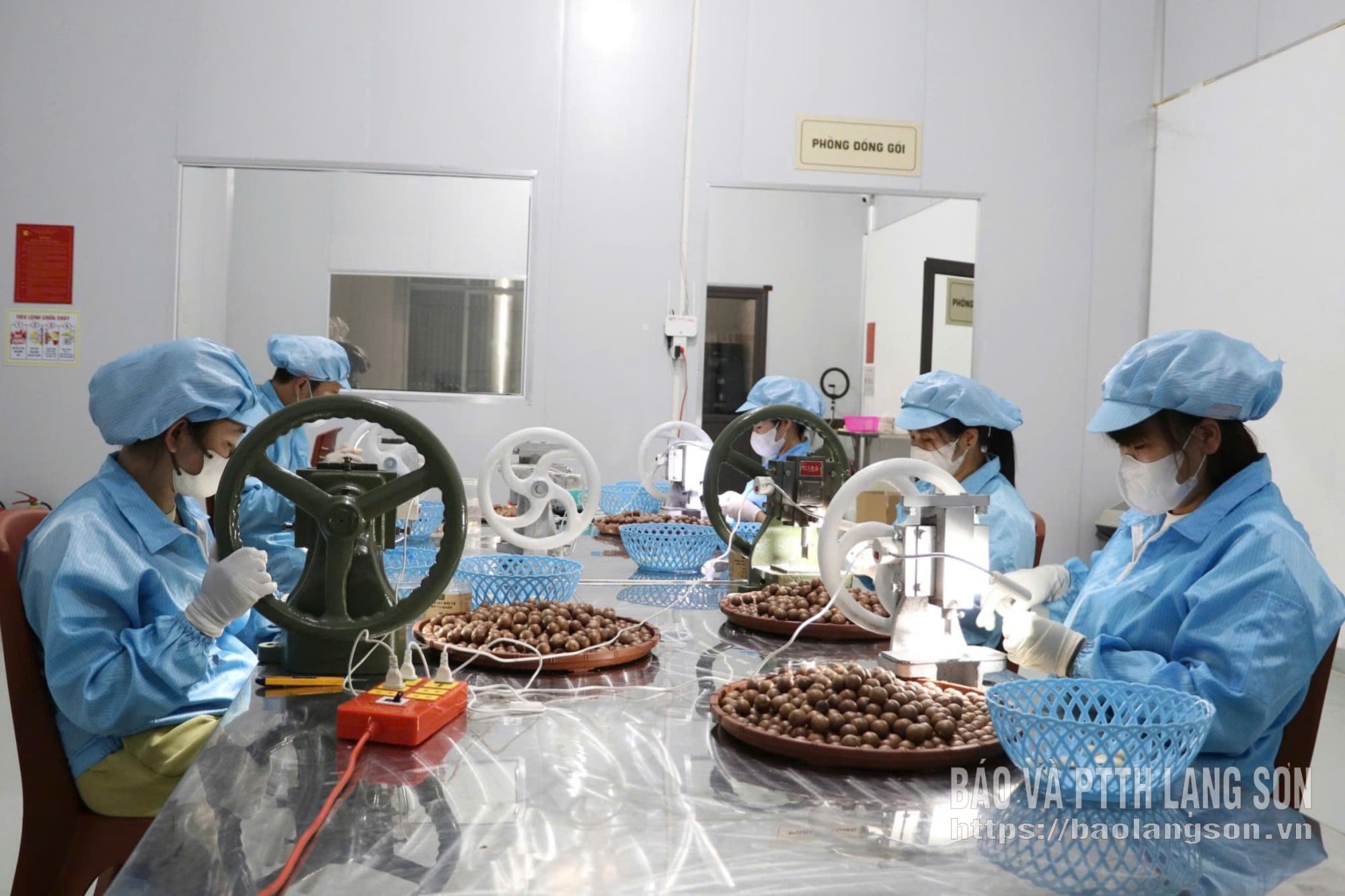
Macadamia trees have been introduced for trial planting in many communes and wards throughout the province, and initial results show their ability to adapt to the soil and climate conditions.
Confidence from new orchards
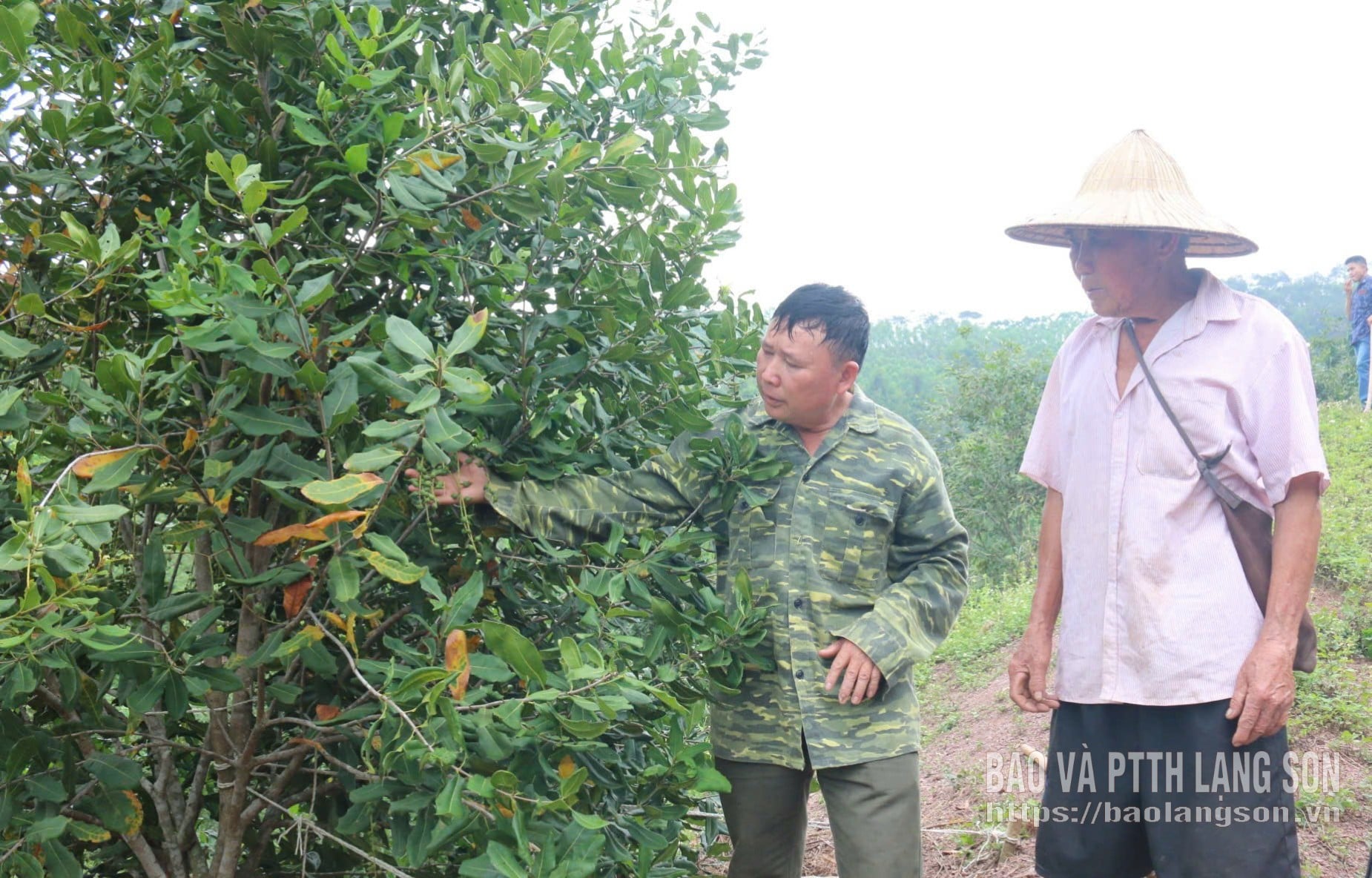
In early May, on the nearly one-acre hillside belonging to Ms. Vi Thi Luc's family in Xa Dan village, Van Linh commune, more than 90 macadamia trees were entering the fruit-bearing stage. Of these, about 60 trees were already producing a stable harvest, while the rest were just beginning to bear fruit. Few would have imagined that just a few years ago, this hillside was primarily used for growing citrus fruits, but the results were uncertain, with some years experiencing crop failures and low prices, resulting in unstable income.
Ms. Luc shared: "From 60 macadamia trees planted experimentally 8 years ago, my family has now developed about 150 trees. After 4 years of care, the first macadamia trees have started bearing fruit, opening up a new economic development direction on our family's hillside land. In the 2025 harvest season alone, the macadamia orchard will yield nearly 500 kg of fresh fruit, selling at prices ranging from 25,000 to 30,000 VND/kg. Currently, although the yield is not yet high, the economic efficiency is higher than some other crops. Along with having a company that buys the product, this is the basis for my family to continue expanding the area in the coming years."

In Van Linh commune, many hilly areas previously used for growing citrus fruits or short-term crops with unstable yields are now gradually being converted to macadamia cultivation. The entire commune currently has about 80 hectares of macadamia trees, of which about 20 hectares are already producing fruit.
Not only in Van Linh, but also in Cao Loc commune, many households have begun boldly investing in macadamia cultivation after the first macadamia orchards entered the harvesting stage. The family of Mr. Hoang Van Cuong in Ban Hec village is a typical example. Currently, his family has over 700 macadamia trees. After researching macadamia cultivation models in several localities, in 2020 his family invested in planting 500 trees, and in 2023 they further expanded by another 230 trees. After 5 years of care, many trees have started bearing fruit, with the first harvest yielding over 400 kg, selling at 32,000 VND/kg.
Mr. Cuong stated: "Although macadamia trees may not generate significant income immediately as they are only in the early stages of fruiting, practical experience shows that they are quite suitable for the hilly terrain in the area. The trees grow well, are less susceptible to pests and diseases, and have a relatively stable fruit setting rate. Based on my experience, I see macadamia as having more potential than some previously planted crops on the same area. If properly cared for, this could be a long-term development direction."
According to data from the Department of Agriculture and Environment, the province has developed over 1,070 hectares of macadamia trees to date, concentrated in several localities such as Van Linh, Cao Loc, Quoc Viet, Loi Bac, Khuat Xa, Trang Dinh, etc. While previously macadamia trees were mainly planted on a small scale on an experimental basis, in recent years, as some areas have begun to yield harvests, many households have boldly expanded their acreage or converted a portion of their hillside land to macadamia cultivation.
Not only local people, but also some businesses and cooperatives have begun to participate in supplying seedlings, providing technical guidance, and linking product consumption. This shows that macadamia trees are gradually developing and forming production areas in some localities in the province.
Giving momentum to macadamia trees.
In recent years, macadamia trees have begun to show economic benefits, with many areas starting to yield stable harvests. However, for this crop to develop sustainably and for people to confidently expand their planted area, it is necessary to build a linked chain from production to processing and consumption.
To solve this problem, business involvement is considered a key factor. Instead of simply supplying seeds as before, many businesses have begun to partner with growers throughout the entire production process, from technology transfer and establishing raw material areas to purchasing and selling the products.
Among the businesses involved in macadamia tree development in the province, the Northeast Forestry Seed Joint Stock Company is considered one of the pioneers. Currently, the company maintains over 20 high-quality macadamia mother trees, including 9 superior varieties. Each year, the company supplies 30,000 to 50,000 seedlings to people in the province. Varieties such as QN, QN1, 900, OC, 788, and A38 are considered suitable for the climate and soil conditions, offering stable growth and yield. The company not only supplies seedlings but also collaborates with the Provincial Agricultural Extension Center to organize training courses and transfer technology to farmers right in the planting areas. Since the beginning of 2026, the units have coordinated the organization of 4 integrated training courses to enhance production capacity for 128 farmers, cooperative members, and cooperative groups interested in developing macadamia cultivation. They have also distributed 128 sets of documents on techniques for planting, caring for, harvesting, and controlling pests and diseases in macadamia trees. This has helped growers access a more comprehensive approach, from seed selection to cultivation processes.
According to Mr. Vu Van Duc, Deputy Director of the Northeast Forestry Seed Joint Stock Company (Luong Van Tri Ward), for people to be committed to macadamia cultivation, businesses must accompany them throughout the entire production process. Growers need assurance from seed quality and technical guidance to product consumption, as this is a crop that requires perseverance and relatively large capital investment. In addition to supporting seedlings and techniques, businesses also participate in purchasing the product. In 2025, the company purchased over 100 tons of fresh macadamia nuts from households in the province.
Currently, there are 5 macadamia nut production and trading facilities in the province. Their processing capacity is approximately 100 to 200 tons of fruit per year. On-site processing not only facilitates brand building and increases competitiveness in the market but also forms the basis for a strong supply chain, guaranteeing product sales for farmers.
To provide a basis for the development of key crops, including macadamia nuts, on March 3, 2026, the Provincial Party Committee issued Resolution No. 24-NQ/TU on the development of key agricultural and forestry products in a focused and sustainable manner, linked with processing and consumption, for the period 2026-2030. Based on this resolution, the Provincial People's Committee issued Plan No. 122/KH-UBND to implement the development of macadamia nuts in the province.
This is the development orientation for the macadamia industry following a sustainable roadmap, linked with the application of science and technology. The province aims to achieve a planted area of 6,000 to 8,000 hectares by 2030; a yield of 2.5 tons/ha, with a total production of approximately 2,100 tons for deep processing. Alongside expanding the planted area, the province focuses on investing in a comprehensive preliminary processing system to enhance the value of the product.

To realize this goal, along with expanding the growing area, the province is implementing support policies on seeds, techniques, and production linkages. Households participating in the development of growing areas receive 100% financial support for purchasing seedlings, up to a maximum of 30 million VND/ha; they also receive technical training, guidance on establishing growing area codes, and connections to product consumption.
Mr. Hoang Van Chieu, Deputy Director of the Department of Agriculture and Environment, said: The province's orientation is to develop macadamia cultivation areas suitable to the conditions of each ecological zone, while strengthening linkages between people, cooperatives, and businesses to form stable commodity production areas. The department continues to review planting area planning, control seed quality, promote technology transfer, and attract businesses to invest in processing and product consumption.
From a crop initially grown experimentally on a small scale, macadamia is gradually proving its adaptability and economic effectiveness in many hilly areas of the province. However, for this crop to truly become a key crop, it is crucial not only to expand the planted area but also to form a sustainable supply chain from production and processing to consumption. When the market is secured, processing is expanded, and the product value is increased, it will contribute to creating sustainable livelihoods for the people.
Source: https://baolangson.vn/de-mac-ca-phat-trien-ben-vung-5094472.html
![[Image] Schools organize meetings and introduce teaching models to students admitted to grade 10.](https://vphoto.vietnam.vn/thumb/1200x675/vietnam/resource/IMAGE/2026/06/25/1782368077271_ndo_br_z7970052192242-1ec8daeb77a6eed1a4e9f58c564ddd3e-jpg.webp)
![[Photo] General Secretary and President To Lam attends the 13th National Congress of the Ho Chi Minh Communist Youth Union](https://vphoto.vietnam.vn/thumb/1200x675/vietnam/resource/IMAGE/2026/06/25/1782356968989_ndo_br_1-jpg.webp)
![[Photo] General Secretary and President To Lam receives Palestinian Ambassador Saadi Salama](https://vphoto.vietnam.vn/thumb/1200x675/vietnam/resource/IMAGE/2026/06/25/1782365384740_a1-bnd-9423-8322-jpg.webp)