

 |
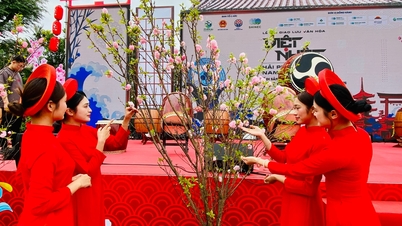
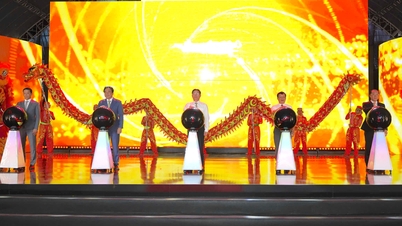
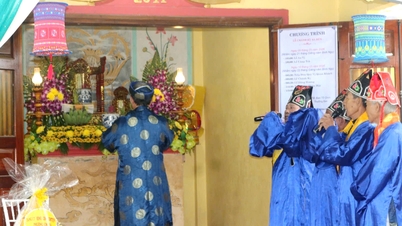
| Lanterns and offerings on the stage at the Hue Festival. Photo: Dinh Thang |
That spirit is further concretized in Resolution No. 80-NQ/TW (Resolution 80) dated January 7, 2026, of the Politburo on the development of Vietnamese culture.
Previously, the role of culture was seen as a "foundation," but with Resolution 80, culture is more clearly seen as an operating system for development. Because development is not simply about GDP growth, infrastructure expansion, or increased output; true development must be about improving the quality of human resources, upgrading social standards, and enhancing the creative capacity of the community. In this context, culture is the space for forming the "common denominator" of beliefs, ethics, discipline, and aspirations.
A nation can become wealthy rapidly through material resources, but can only become strong sustainably through cultural resources. That is why Resolution 80 places the building of Vietnamese culture as a strategic task, linked to people, the cultural environment, value systems, the cultural industry, and soft power.
However, culture only truly "guides the way" when it is organized into a system of policies, transformed into operational institutions, and present in every social behavior. A strong culture is not only manifested in vibrant festivals or vast heritage, but also in respect for the law, a spirit of community responsibility, the capacity for lifelong learning, integrity in governance, and civilized behavior on the streets and in cyberspace. Culture, therefore, must become an integral part of national governance and the lives of the people.
To be fair, we have seen many positive developments: Social awareness of culture has increased; many localities are beginning to consider culture as a resource for development; creative fields such as film, design, performing arts, cultural tourism , etc., are gradually becoming new driving forces. However, in reality, culture remains passive, relying on budget allocations and lacking market incentives; many grassroots cultural institutions operate formally; and while cyberspace creates new opportunities, it also poses significant challenges regarding ethics, lifestyles, and cultural security.
To have culture "guide the way," we must first answer the question: what is the path our nation is taking today? It is the path toward a strong and prosperous Vietnam by the middle of the 21st century, a wealthy and powerful society that does not lose its roots, a modern nation that still preserves its identity, a country deeply integrated into the global community but not self-dissolving. On that path, culture is not only "identity," but also a stance: a stance of confidence, a stance of calmness, a stance of creativity.
And to achieve that position, three major breakthroughs are needed.
Firstly, there needs to be a breakthrough in values and the cultural environment. A healthy cultural environment must be built from the family, school, community, business, and even the government apparatus. Where discipline declines, integrity is disregarded, and a pragmatic lifestyle prevails, the light of culture will dim, and the "path" will become more precarious.
Secondly, there needs to be a breakthrough in cultural resources and governance. We cannot expect strong cultural development if investment mechanisms and implementation methods remain scattered, fragmented, and lacking focus. Key areas such as heritage preservation, traditional arts, contemporary creativity, digital cultural transformation, and cultural industry development need to be approached with strategic thinking and modern governance. In the context of global competition, without sufficiently strong "cultural brands," it will be difficult to transform heritage into assets, tradition into new vitality, and creativity into economic value.
Thirdly, a breakthrough in human resources – the creators and beneficiaries of culture. Without cultured people, there can be no cultured society. Training cultural human resources today is not just about training industry officials, but also about cultivating a generation of citizens with aesthetic sensibilities, an open-minded spirit, the ability to integrate, digital skills, and a sense of responsibility to the community. Therefore, the orientations for developing cultural human resources in the spirit of the XIV Party Congress documents are not only correct but also extremely urgent.
In this context, the story of culture is no longer solely the concern of state management agencies or the arts community. Culture is the participation of the entire society. Culture begins with how we respect each other in daily life; with preserving a historical site, a language, a family tradition; with honesty in academia; with responsibility in the media; and with how public officials perform their duties to the people.
It could be argued that the greatest challenge facing culture today is not the lack of heritage, but the lack of mechanisms for heritage to become a living force; not the lack of art, but the lack of an environment for art to nurture the community's soul; not the lack of slogans, but the lack of the capacity to transform slogans into action and action into social habits.
Therefore, when we say, "Let culture guide the nation," it is crucial to make that statement a "principle of operation" in governance and development. A country that wants to go far cannot rely solely on economic motives; it must have a cultural compass. This compass helps us know what to preserve and what to innovate; to know the insurmountable limits and the values that need to be nurtured so that the nation not only becomes richer but also more beautiful. When culture is placed in the right position, invested in appropriately, and operated correctly, its light will not only "guide" the present but also pave the way for the future.
Source: https://huengaynay.vn/van-hoa-nghe-thuat/de-van-hoa-soi-duong-cho-quoc-dan-di-162572.html
![[Photo] Prime Minister Pham Minh Chinh presides over meetings of the Government Standing Committee to discuss several important issues.](https://vphoto.vietnam.vn/thumb/1200x675/vietnam/resource/IMAGE/2026/03/16/1773674631996_ndo_br_img-5789-jpg.webp)











![[Photo] Prime Minister Pham Minh Chinh holds a phone call with Angolan President João Manuel Gonçalves Lourenço](https://vphoto.vietnam.vn/thumb/1200x675/vietnam/resource/IMAGE/2026/03/16/1773674632171_ndo_br_dsc-4772-jpg.webp)































Comment (0)