

Heavy rains are affecting crops in Argentina.
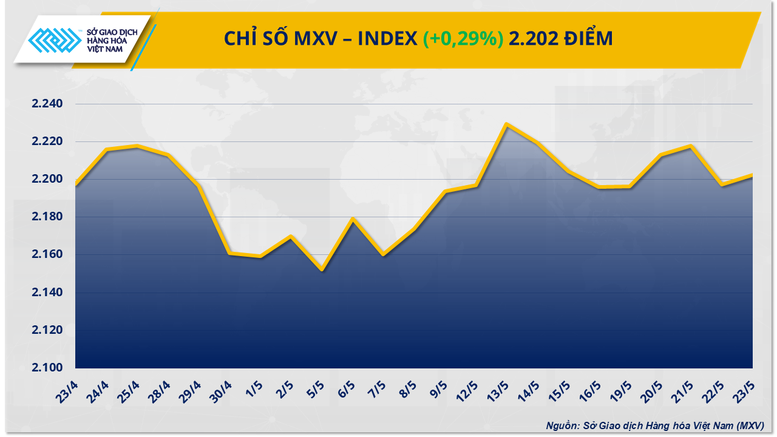
At the close of trading last week (May 19-25), positive sentiment continued in the agricultural market as all seven commodities in the group saw price increases. Soybean prices rose nearly 1% to $389 per ton, marking the first weekly increase after three consecutive weeks of declines. According to MXV, the price movements last week reflected a stable recovery, as the market reconsidered supply risks from South America, while technical buying and expectations of supportive US policies continued to maintain positive sentiment.
The main driver of prices this week came from concerns about the progress and quality of the crop in Argentina – the world's largest exporter of soybean meal and soybean oil. Prolonged heavy rains and severe flooding in northwestern Buenos Aires not only disrupted harvesting but also raised concerns about declining yields and drove up storage costs due to the high moisture content of the beans. In addition, the Argentine government's confirmation that it will not renew the export tax incentives for soybeans and processed products starting in July raised concerns about future supply.
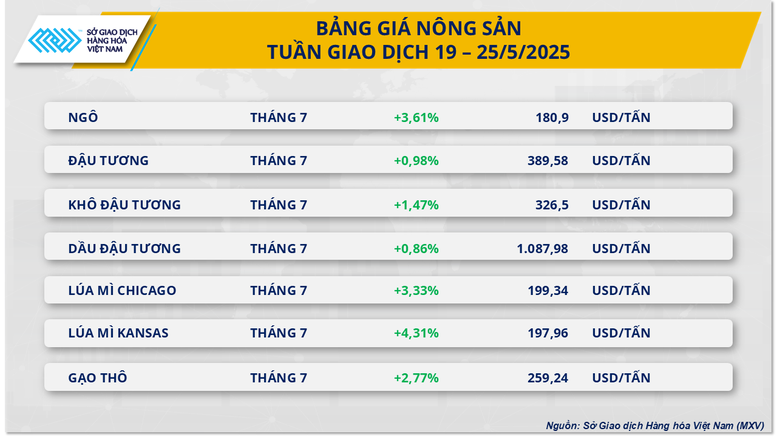
Furthermore, the market was also supported by the recovery of finished goods, especially soybean meal, which is directly affected by supply from Argentina. Soybean oil prices fluctuated slightly, but remained supported by expectations of an extension of the 45Z tariff credit policy for biofuels in the US. Although no final decision has been made, the House's passage of the "One Big Beautiful Bill" and the upcoming energy policy meeting at the White House have maintained investor confidence that policy support will continue in the near future.
Conversely, favorable weather conditions in the US continued to support planting progress, reaching 65% of the planned area. Although this did not cause a major surprise and did not create a strong price correction, it was still a factor that restrained the price decline last week.
Positive supply prospects are putting pressure on coffee prices.
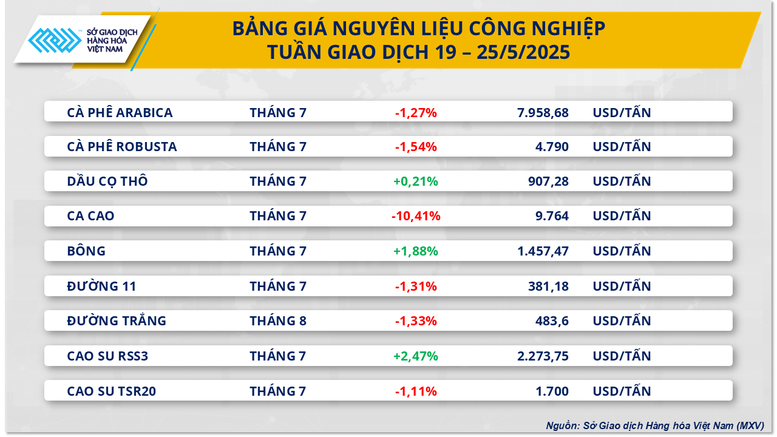
According to MXV's report, red dominated the prices of most key commodities in the industrial raw materials group. Specifically, Arabica coffee prices fell 1.27% to $7,958 per ton, while Robusta lost 1.54%, dropping to $4,790 per ton.
The U.S. Department of Agriculture (USDA) reports that Brazil's coffee production for the 2025-2026 crop year is expected to reach approximately 65 million 60-kg bags, a 0.46% increase compared to the previous year. Of this, Arabica production is projected to decrease by 6.4% to 40.9 million bags, while Robusta production is expected to surge by 14.76% to a record 24.1 million bags.
In addition, the USDA also forecasts that Vietnam's upcoming coffee crop (October 2025 to September 2026) – expected to begin harvesting at the end of this year – will increase by 6.90% compared to the previous crop, reaching 31 million bags, including 30 million bags of Robusta and 1 million bags of Arabica.
Favorable weather conditions have also accelerated harvesting progress in Brazil; according to Safras & Mercado's weekly tracking report as of May 21st, 13% of the 2025-2026 coffee crop has been harvested.
Regarding exports, according to MXV's calculations, in the 17 working days since the beginning of May, Brazil's average daily exports of Arabica and Robusta coffee totaled 116,535 60kg bags, 34% lower than the average of 176,601 60kg bags during the same period last year. In addition, in Vietnam, according to the General Department of Import-Export, coffee exports from the beginning of the year to May 15th reached 736,583 tons, a decrease of 5.5% compared to the same period last year.
Meanwhile, coffee consumption demand is showing less positive signs. Import figures for the US and EU markets, which account for nearly 50% of the world's coffee consumption, show an 8% decline compared to the first quarter of 2024 when considering total imports. Specifically, US imports of coffee (green beans, roasted, decaffeinated, and by-products) increased by 7.7% in the first quarter, while EU imports decreased by as much as 12%.
Source: https://baochinhphu.vn/dien-bien-trai-chieu-mxv-index-dong-cua-trong-sac-xanh-102250526090508654.htm


![[Photo] Prime Minister Pham Minh Chinh presides over a meeting on private sector economic development.](/_next/image?url=https%3A%2F%2Fvphoto.vietnam.vn%2Fthumb%2F1200x675%2Fvietnam%2Fresource%2FIMAGE%2F2025%2F12%2F20%2F1766237501876_thiet-ke-chua-co-ten-40-png.webp&w=3840&q=75)






















































































Comment (0)